GE Dehumidifier Review 2026 — GE's 25, 35 and 50-Pint Models Compared From Their Listings

GE Dehumidifier Review 2026

GE's 25, 35 and 50-Pint Models Compared From Their Listings

5 picks compared · prices, ratings and stock checked October 12, 2026

Our Top Pick

For a damp basement, the GE 50 Pint Dehumidifier for Basements: 50 pints a day, a 15-pint bucket and a drain hose connection. For a single room, the GE 25 Pint Small Dehumidifier states auto restart and auto defrost and holds 8.5 pints.

4.2 on Amazon · 90 ratings

Quick answer

If you want a GE dehumidifier for a basement, buy the 50-pint model, sold on Amazon as the GE 50 Pint Dehumidifier for Basements and rated 4.2 stars across 90 Amazon ratings. Its listing gives 50 pints a day, a 15-pint bucket, a drain hose connection and a 30% to 70% humidistat, but leaves out the test conditions, auto defrost and the lowest room temperature it runs in. For one damp bedroom or bathroom, GE's 25-pint model is enough. For a crawl space, or a basement that has just flooded, a portable GE is the wrong machine.

Our Picks at a Glance

Every pick below is currently stocked — ratings and stock read from Amazon on 12 October 2026.

How this page was made: we compare the current Amazon listings, the makers' published specs and what verified buyers report, then rank by fit for the job. Ratings, review counts and stock are read from Amazon and dated. We earn a commission on purchases through our links; it does not change the order. Reviewed by Marcus Reed, IICRC-certified Water Restoration Technician.

Full Reviews

Each pick in detail: what the listing states, what buyers report, and where it falls short.

#1
Best GE for Basements

Check price

on Amazon ↗

Listing verified 13 Oct 2026

GE 50 Pint Dehumidifier for Basements (15-Pint Bucket, Smart Dry, Drain Hose Connection)See it on Amazon ↗

Quick Verdict

GE 50 Pint Dehumidifier for Basements: GE's basement-size model, with a 15-pint bucket and a drain connection, but no stated defrost or test conditions.

Key Specs

Capacity (stated)

50 pints/day; test conditions not stated on the listing

Coverage (claimed)

Up to 5,000 sq ft

Bucket (stated)

15 pints, with a 10-second alarm when full or missing

Drainage (stated)

Built-in drain hose connection for continuous drainage; hose inclusion not stated

Controls (stated)

30% to 70% humidistat; Smart Dry adjusts fan speed to room humidity

Filter (stated)

Washable and reusable, with a cleaning reminder

Pros

  • Its 15-pint bucket holds close to twice what GE's 25- and 35-pint models hold, so fewer trips on days without a hose
  • A built-in drain connection lets it run unattended over a floor drain
  • Smart Dry slows the fan as the room dries instead of running on high all day
  • An audible 10-second alarm sounds when the bucket is full or missing

Cons

  • Its bullets do not mention auto restart or auto defrost, both of which GE's 25- and 35-pint listings state; confirm them before it goes in a cold basement
  • No pump, so the drain has to sit lower than the unit's outlet
  • The buyer record on this listing is still short

Suited to

A damp or wet basement with a floor drain within hose reach

Our take

Fifty pints is the largest of GE's current Amazon listings, and the size to buy for a basement. ENERGY STAR's sizing chart puts a wet space under 2,000 sq ft, one where walls or floor sweat or water seeps in, at 30 to 50 pints a day, and anything larger at 50 or more. The 5,000 sq ft claim on this listing assumes much drier air than that. Current DOE rules rate portable units at 65°F and 60% relative humidity, but GE does not print the conditions here, so expect less water in a cool basement than the box figure. At the full rated pace the 15-pint bucket fills in about seven hours, which makes the drain connection the feature that matters. Run a hose to a floor drain and set the humidistat near 45%.

Check today's price on Amazon →

Affiliate link — commission at no extra cost to you

Compare elsewhere

These open a search for this model. We quote prices only where we can verify them — Amazon, Sylvane and eBay.

#2
Best GE for a Very Damp Room or Small Basement

Check price

on Amazon ↗

Listing verified 13 Oct 2026

GE 35 Pint Dehumidifier (8.5-Pint Bucket, Smart Dry, Auto Restart and Auto Defrost)See it on Amazon ↗

Best GE for a Very Damp Room or Small Basement

GE 35 Pint Dehumidifier (8.5-Pint Bucket, Smart Dry, Auto Restart and Auto Defrost)

4.2(94 reviews)

Quick Verdict

GE 35 Pint Dehumidifier: the middle GE size for a very damp room, with auto restart and auto defrost stated on its listing.

Key Specs

Capacity (stated)

35 pints/day; test conditions not stated

Coverage (claimed)

Up to 3,000 sq ft

Bucket (stated)

8.5 pints, with a 10-second alarm when full or missing

Drainage (stated)

Built-in drain hose connection

Controls (stated)

Three fan speeds, 30% to 70% humidistat and Smart Dry

Outages and cold (stated)

Auto restart after a power outage; auto defrost

Pros

  • Auto restart is stated, so it comes back on with your settings after a storm cuts the power
  • Auto defrost is stated, which matters in a basement below 65°F, where ENERGY STAR notes frost can form on the coils
  • Three fan speeds sit alongside Smart Dry, so you can take manual control
  • Easy-roll wheels and pocket handles for moving it between rooms

Cons

  • The 8.5-pint bucket fills in about six hours at the rated 35 pints a day, so a hose is the practical setup
  • The 3,000 sq ft claim assumes mildly damp air; ENERGY STAR puts a very damp space under 2,000 sq ft at 25 to 40 pints
  • No pump, and noise is not stated

Suited to

A very damp bedroom, a finished basement room or a small basement that stays musty

Our take

Thirty-five pints sits inside ENERGY STAR's range for a very damp space under 2,000 sq ft, 25 to 40 pints a day. That describes a room that consistently feels and smells damp, with damp spots on walls or floors, which is where most musty basement rooms land. What this listing states that GE's 50-pint listing does not is auto restart and auto defrost. Both matter below ground: storms that drive water into a basement also knock out power, and a basement in spring and fall often sits below the 65°F mark where ENERGY STAR says frost can form on the coils. The bucket is the weak point, about six hours of collection at the rated pace, so plan on a hose to a floor drain for anything beyond a single room.

Check today's price on Amazon →

Affiliate link — commission at no extra cost to you

#3
Best GE for a Bedroom, Bathroom or Laundry Room

Check price

on Amazon ↗

Listing verified 13 Oct 2026

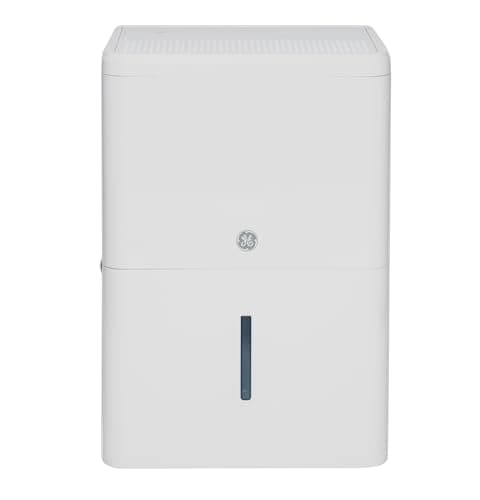
GE 25 Pint Small Dehumidifier (8.5-Pint Bucket, Smart Dry, Auto Restart and Auto Defrost)See it on Amazon ↗

Best GE for a Bedroom, Bathroom or Laundry Room

GE 25 Pint Small Dehumidifier (8.5-Pint Bucket, Smart Dry, Auto Restart and Auto Defrost)

4.3(90 reviews)

Quick Verdict

GE 25 Pint Small Dehumidifier: the GE for one moderately damp room, with auto restart and auto defrost stated.

Key Specs

Capacity (stated)

25 pints/day; test conditions not stated

Coverage (claimed)

Up to 1,500 sq ft

Bucket (stated)

8.5 pints, with a 10-second alarm when full or missing

Drainage (stated)

Built-in drain hose connection

Controls (stated)

Three fan speeds, 30% to 70% humidistat and Smart Dry

Outages and cold (stated)

Auto restart after a power outage; auto defrost

Pros

  • Shares the 8.5-pint bucket of the 35-pint model, so it runs about eight hours between emptying at its rated pace
  • Auto restart and auto defrost are both stated
  • Fits the 20 to 30 pint range ENERGY STAR gives for a moderately damp space under 2,000 sq ft

Cons

  • Too small for a basement where walls sweat or water seeps in
  • Noise is not stated, which matters in a bedroom
  • Its 1,500 sq ft claim only holds in mildly damp air; a very damp room calls for the 35-pint model

Suited to

One moderately damp room: a bedroom, bathroom or laundry room

Our take

For a single room, 25 pints is the right GE. ENERGY STAR describes a moderately damp space as one that feels damp with a musty odor now and then, at 50% to 75% relative humidity, and gives it 20 to 30 pints a day below 2,000 sq ft. A bedroom with condensation on the windows or a bathroom with no exhaust fan fits that description. The listing states auto restart and auto defrost, the same as the 35-pint model, and the same 8.5-pint bucket, which lasts longer here because the machine collects less. Noise is not given, so if it will run beside a bed, plan on Smart Dry or the low fan at night. In a basement with sweating walls or seepage, step up to the 50-pint model instead.

Check today's price on Amazon →

Affiliate link — commission at no extra cost to you

#4
If Not GE: Wi-Fi 50-Pint

Check price

on Amazon ↗

Listing verified 13 Oct 2026

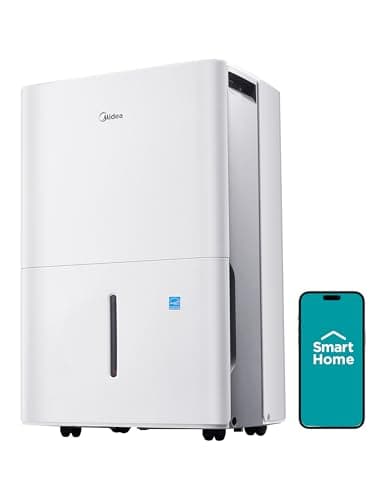
Midea 50 Pint Dehumidifier for Basements (Wi-Fi, 35% to 85% Humidistat, 4,500 Sq Ft Claim)See it on Amazon ↗

Quick Verdict

Midea 50 Pint Dehumidifier: the 50-pint, app-controlled option for anyone who wanted Wi-Fi from GE.

Key Specs

Capacity (stated)

50 pints/day; test conditions not stated

Coverage (claimed)

Up to 4,500 sq ft

Humidity setting (stated)

35% to 85%

Noise (stated)

49 dBA on low

Smart control (stated)

Wi-Fi with the SmartHome app; Alexa and Google Assistant

Drainage (stated)

Tank, or a standard hose (not included) to the built-in socket

Pros

  • Wi-Fi app control lets you check a basement's humidity from upstairs or away from home
  • Noise is stated, 49 dBA on low, which none of the GE listings gives
  • Restarts on its own once the emptied tank goes back in

Cons

  • Hose not included for continuous drainage
  • Tank size and auto defrost are not stated in the listing's bullets
  • No pump

Suited to

Anyone who wanted a Wi-Fi 50-pint GE, since GE's own Wi-Fi model did not clear this page's buyer-rating bar

Our take

GE does list a 50-pint Wi-Fi model with the SmartHQ app, and a 50-pint model with a built-in pump, but on 12 Oct 2026 neither had the buyer ratings this page requires, so they are left out. Midea's 50-pint unit is the closest match with an app. Remote control is more useful for a dehumidifier than it sounds: the basement is the room you visit least, and an app shows the humidity reading without the trip downstairs. The listing also gives a noise figure, 49 dBA on low, and states that the unit stops with a full tank and restarts once it is emptied. It does not state the tank size or auto defrost, and a hose for continuous drainage is not included, so add one before you leave it running.

Check today's price on Amazon →

Affiliate link — commission at no extra cost to you

#5
If Not GE: Large Wet Basement, Hose Included

Check price

on Amazon ↗

Listing verified 13 Oct 2026

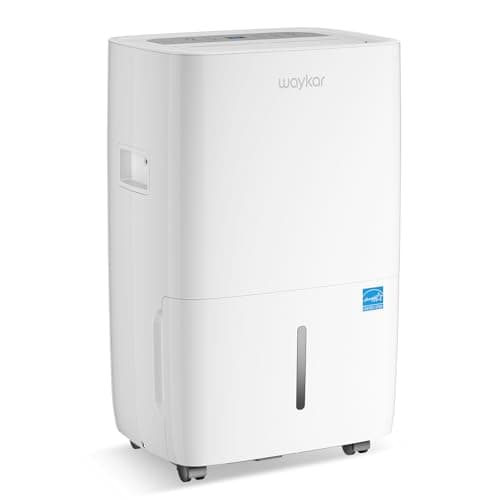
Waykar 80 Pint ENERGY STAR Dehumidifier (80 Pints at 95°F/90% RH, Drain Hose Included)See it on Amazon ↗

If Not GE: Large Wet Basement, Hose Included

Waykar 80 Pint ENERGY STAR Dehumidifier (80 Pints at 95°F/90% RH, Drain Hose Included)

4.3(22,687 reviews)

Quick Verdict

Waykar 80 Pint ENERGY STAR Dehumidifier: printed test conditions, stated defrost and a hose in the box, for a large wet basement.

Key Specs

Capacity (stated)

80 pints/day at 95°F and 90% RH

Coverage (claimed)

Up to 5,000 sq ft

Humidity setting (stated)

30% to 80%

Efficiency (stated)

ENERGY STAR certified

Drainage (stated)

4.3 L (1.14 gal) tank, or the included 3.3 ft hose; standard 3/4 in garden hose thread

Cold handling (stated)

Auto defrost and overload protection

Pros

  • A drain hose comes in the box, and the outlet takes a standard garden hose for a longer run
  • ENERGY STAR certified, per the listing, and ENERGY STAR says certified models are 20% more efficient than non-certified ones
  • Auto defrost is stated, for a basement that runs cool
  • The test condition behind its capacity is printed, which makes an honest comparison possible

Cons

  • The 80-pint figure is measured at 95°F and 90% RH, far warmer and wetter than a basement, so it cannot be set against a 50-pint rating directly
  • A 3.3 ft hose only reaches a drain right beside the unit
  • No pump, like the GE models

Suited to

A large or wet basement where you want the hose in the box and the test condition on the label

Our take

Do not read 80 pints as 30 more than GE's 50. Waykar measures its figure at 95°F and 90% relative humidity, close to saturated summer air, while current DOE ratings use 65°F and 60%, and a machine collects far more water in the hotter, wetter test. What earns the Waykar a place on a GE page is what GE's 50-pint listing leaves out: a printed test condition, ENERGY STAR certification, stated auto defrost and a hose in the box. It also carries a far larger buyer record than any GE listing here. The included hose is short, at 3.3 ft, but the outlet takes a standard 3/4 in garden hose, so a longer one reaches a floor drain across the room. Set it to 45% to 50% and let it run.

Check today's price on Amazon →

Affiliate link — commission at no extra cost to you

Buyer's Guide

What to know before you buy.

How This Review Was Built, and What GE's Listings Leave Out

This comparison is built from GE's current Amazon listings, read on 12 Oct 2026, their published specs and buyer ratings. Nobody at HearthDry ran these machines. Three GE models qualified: the 25, 35 and 50-pint units. GE also lists a 50-pint Wi-Fi model and a 50-pint model with a built-in pump, but their buyer ratings were too weak for this page. Several gaps run across the GE listings. None states the test conditions behind its pints-per-day figure, a noise level, the lowest room temperature it will run in, or whether it is ENERGY STAR certified, and none prints a model number in its title. The 50-pint listing also leaves out auto restart and auto defrost, which the smaller two state. Ask GE or check the manual on any of these before you buy.

Which GE Size Fits Your Room: ENERGY STAR's Chart

ENERGY STAR sizes dehumidifiers by how damp a space is, not only by its area. A moderately damp space, which feels damp with a musty odor now and then at 50% to 75% relative humidity, needs 20 to 30 pints a day under 2,000 sq ft. A very damp space, which smells damp all the time and shows damp spots at 75% to 90%, needs 25 to 40. A wet space, where walls or floor sweat or water seeps in at 90% to 100%, needs 30 to 50, and spaces over 2,000 sq ft need more in every row. That maps neatly onto GE's range: 25 pints for a damp room, 35 for a very damp room, 50 for a wet basement. ENERGY STAR's own advice is that it is better to oversize than undersize.

Pints Per Day Depends on the Test, So Compare Like With Like

A dehumidifier pulls far more water from warm, wet air than from cool air, so a capacity figure means little without the conditions behind it. Current Department of Energy rules rate portable units at 65°F and 60% relative humidity. Under the older test at 80°F, the class now sold as 50 pints was sold as 70 pints, and the machines did not change. Some brands still print a third figure: Waykar's 80 pints is measured at 95°F and 90%, close to saturated summer air. GE's listings give no conditions at all. When you compare GE with another brand, compare figures taken at the same conditions, and expect any unit to collect less in a 60°F basement in spring than its label suggests. The square-footage claims on these listings assume mild conditions too, so size by ENERGY STAR's chart instead.

Bucket or Hose: How Often You Will Be Emptying It

Divide the bucket by the daily capacity to see how long it lasts. GE's 50-pint model has a 15-pint bucket, about seven hours at its rated pace. The 35-pint model's 8.5-pint bucket lasts about six hours, and the 25-pint model's lasts about eight. A cool basement collects less than the rating, but in a wet month you will still be emptying the bucket two or three times a day, and when it fills the unit stops and an alarm sounds. A hose to a floor drain removes that chore, and all three GE models have a built-in drain connection. These picks drain by gravity, so the hose end must sit lower than the outlet. If the nearest drain is a laundry sink above the unit, you need a dehumidifier with a pump or a separate condensate pump.

Setting Up a GE in a Basement: Humidity, Cold and Outages

EPA advises keeping indoor humidity below 60%, ideally between 30% and 50%, and ENERGY STAR calls 30% to 50% the optimum range; anything higher may promote mold growth. GE's humidistat runs from 30% to 70%, so set it near 45% for a basement and leave Smart Dry to slow the fan once the room gets there. Keep doors and windows to the space closed while it runs, and keep the unit away from dust sources such as a woodworking bench, both ENERGY STAR tips. Cold is the other issue. ENERGY STAR notes frost can form on the coils below 65°F, so in a basement that runs cool, auto defrost matters, and it is stated on GE's 25 and 35-pint listings but not the 50. Auto restart, on those same two, brings the unit back after a storm cuts the power.

Who Should Not Buy a GE Portable Dehumidifier

A portable GE is built to hold humidity steady in a living space, not to dry a building. If a basement has just flooded, it cannot keep up: wet drywall, carpet and framing need extraction, air movers and low-grain refrigerant dehumidifiers to dry within the 24 to 48 hours EPA gives to prevent mold growth, and that is a restoration company's job. A crawl space is the wrong place too, because of the low clearance and the cold, and a purpose-built crawl space unit fits better. Whole-house humidity control belongs to a ducted unit. If mold already covers more than about 10 square feet, EPA's guidance points to a larger cleanup than a dehumidifier can handle. And if your only drain sits above the unit, a gravity-drain GE will mean carrying buckets.

Frequently Asked Questions

Is GE a good brand for dehumidifiers?

GE's current portable models are a sound, basic choice for a basement or a single room, judged by their listings and buyer ratings, though they leave out details other brands print.

The 25, 35 and 50-pint units cover the sizes most homes need, with Smart Dry, a 30% to 70% humidistat and a drain connection. What GE does not state, such as test conditions, noise and ENERGY STAR status, is worth checking before you buy.

What size GE dehumidifier do I need?

Match the size to how damp the space is: 25 pints for a moderately damp room, 35 for a very damp room and 50 for a basement where walls sweat or water seeps in.

Those steps follow ENERGY STAR's chart for spaces under 2,000 sq ft. If you are between two sizes, go up, since ENERGY STAR says it is better to oversize than undersize.

Does the GE dehumidifier have a pump?

The three GE models on this page do not; they drain by gravity through a built-in hose connection.

GE also lists a 50-pint model with a built-in pump that moves water up to 15 vertical feet through a 16 ft hose, per its listing, but its buyer ratings were too weak on 12 Oct 2026 for this page. A separate condensate pump can lift water from a gravity unit to a sink.

What humidity should I set my GE dehumidifier to?

Set it around 45% for a basement and between 40% and 50% for living spaces. EPA advises keeping indoor humidity below 60%, ideally between 30% and 50%, and GE's humidistat covers 30% to 70%. Check the reading with a separate hygrometer now and then, since a built-in sensor can read differently from the room as a whole.

How do I set up continuous drainage on a GE dehumidifier?

Attach a hose to the built-in drain connection and run it downhill to a floor drain, with no kinks or upward loops. Gravity does the work, so the drain must sit lower than the outlet on the back of the unit.

GE's listings do not say whether a hose is included or which fitting it takes, so check the manual first. Raise the unit on a sturdy block if the hose needs more fall.

Is there a GE Profile dehumidifier?

None turned up in this Amazon search. GE Profile is GE Appliances' premium line, and the GE Profile listings found on 12 Oct 2026 were window and portable air conditioners, one with a dehumidify mode.

An air conditioner's dry mode works while it cools a room, so it is not a stand-in for a basement dehumidifier. For a basement, compare the GE models above instead.

Who do I call right now for water damage?

Call (888) 840-6512. The line is answered 24 hours a day, seven days a week, and connects you with an IICRC-certified water damage restoration company that serves your area. A recorded menu picks up first: choose water damage or mold, key in your 5-digit ZIP code, and hold through the short silence while the call is passed to the company.

Describe what you can see — where the water is coming from, how long it has been there, and whether it smells — the more specific you are, the faster the right company is on the line. If the source is a pipe or an appliance, shut the main water valve first. Have four things ready and the call goes quickly: the address, when the water started, what is wet now, and whether you have filed an insurance claim.

Still not sure which of these is your situation? (888) 840-6512 · toll-free · answered 24/7

Sources

  1. ENERGY STAR — Dehumidifiers
  2. EPA — A Brief Guide to Mold, Moisture, and Your Home
  3. EPA — Mold Cleanup in Your Home
  4. ENERGY STAR — Dehumidifier Testing and Capacity

Methodology: How we source and verify data · Report an error

How we chose these picks

  • Every pick is a current listing. Stock, star ratings and rating counts are read from Amazon by script and carry the date they were read.
  • Nothing under 4.0 stars makes the list, and the top pick needs a large rating count, so one good week of reviews cannot put it there.
  • Specs are quoted from the listing or the maker, with the test condition behind the number where there is one, and sized against the job rather than the room on the box.
  • We do not run lab or field tests. Where a spec matters, we say what it is measured under and what it cannot tell you.

Free 2-day shipping

Amazon Prime members pay no shipping on restoration equipment

Dehumidifiers, air movers, and moisture meters qualify for free Prime delivery — bulk items that otherwise cost $15–$40 to ship.

Try Prime free →

Affiliate link — HearthDry earns a bounty if you sign up; costs you nothing extra.

Also Worth Comparing

Best Dehumidifier for Basement Use in 2026 — Drain Hose, Built-In Pump and Honest Pint Ratings

Most basement dehumidifier disappointment comes from two numbers nobody reads properly: the pint rating, measured at warm test conditions a 60°F basement never reaches, and the drainage method. Five units are compared here on those two points first, from a garden-hose drain to a built-in pump with a stated 15 ft lift.

Read the comparison

Best Dehumidifiers With a Built-In Pump in 2026 — Compared on Lift Height

A built-in pump is the answer when the only drain is above the dehumidifier: a laundry sink, a standpipe or a window. It is only an answer if it can lift water that high, and two of the four listings here state a lift height while two do not.

Read the comparison

Best Dehumidifier for Home in 2026 — Sized by Room, Dampness and Drain

The right dehumidifier for a home depends on the size of the space and how damp it is, and the pint number on the box depends on which test produced it. These five picks run from a 22-pint single-room unit to an 80-pint machine for a whole basement, compared on the figures their listings actually state.

Read the comparison

Best Dehumidifier for a Bedroom or Apartment in 2026 — Quiet Small-Room Units Compared

A bedroom dehumidifier has to be quiet enough to sleep beside, and five of the six picks here are thermoelectric units that remove ounces of water a day rather than pints. That is enough for a stuffy bedroom, closet or studio apartment; for a room with wet windows every morning, the sixth pick is a small compressor unit rated in pints.

Read the comparison

Best Condensate Pumps in 2026 — For Furnaces, AC Coils and Dehumidifiers That Sit Below the Drain

A condensate pump collects the water a furnace, air conditioner coil or dehumidifier makes and pushes it up to a drain the water could not reach on its own. When one fails with no safety switch wired in, that water ends up on the floor or through a ceiling, so these picks are judged first on the switch, then on lift, flow and noise.

Read the comparison