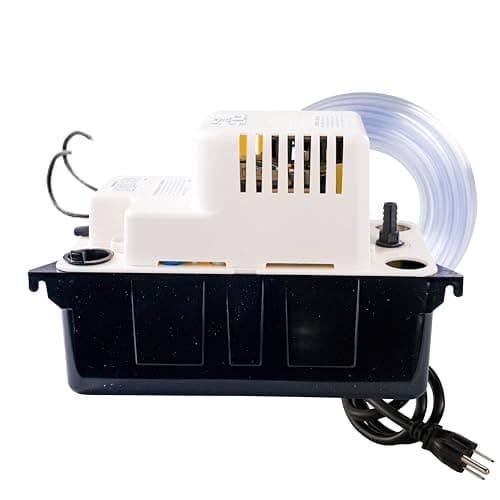
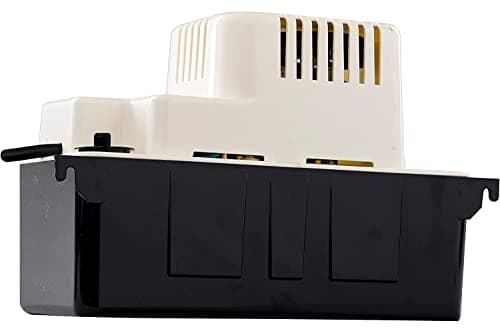
Best for: A furnace or central AC in a basement or utility room, where the drain sits several feet above the pump
- Flow (stated):
- 80 GPH at 1 ft of lift
- Shut-off height:
- 20 ft (max 8.7 PSI)
Listing verified 13 Oct 2026

For Furnaces, AC Coils and Dehumidifiers That Sit Below the Drain
5 picks compared · prices, ratings and stock checked October 11, 2026
Our Top Pick
For most furnace and central AC installs, the Little Giant VCMA-20ULS: 80 GPH at 1 ft, a 20 ft shut-off and an overflow switch that can shut the equipment down. For a high-efficiency furnace in a tight space, the low-profile Little Giant VCCA-20ULS is the one whose listing states it suits condensing furnaces.
4.6 on Amazon · 7,645 ratings
Quick answer
The best condensate pump for most homes is one with an overflow safety switch wired to shut the furnace or AC off, and the Little Giant VCMA-20ULS is the pick, rated 4.6 stars across 7,645 Amazon ratings. It moves 80 gallons per hour at 1 ft of lift and stops pumping at 20 ft, which leaves a wide margin for the climb from a basement furnace to a laundry sink or an exit near the ceiling. For a high-efficiency furnace, confirm the pump is rated for acidic condensate; for a ductless mini-split, buy a mini-split pump instead.
Every pick below is currently stocked — ratings and stock read from Amazon on 11 October 2026.
Best for: A furnace or central AC in a basement or utility room, where the drain sits several feet above the pump
Listing verified 13 Oct 2026
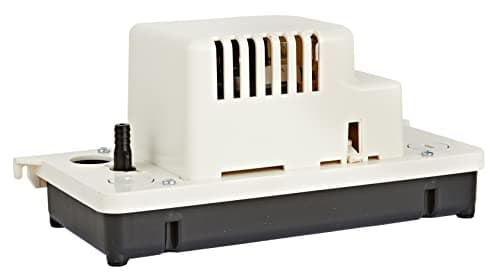
Best for: A short rise from a basement furnace or air handler to a nearby sink or drain, bought as a complete kit
Listing verified 13 Oct 2026
Best for: A high-efficiency (condensing) gas furnace or boiler, or any install with little height under the equipment
Listing verified 13 Oct 2026
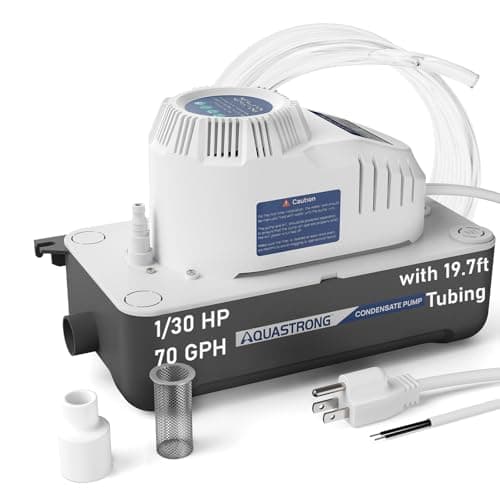
Best for: A utility room where several appliances drain to one pump, with an outlet within a few feet
Listing verified 13 Oct 2026
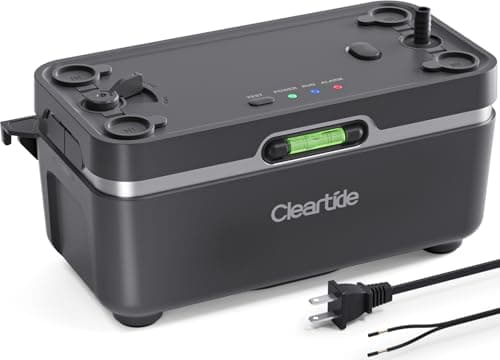
Best for: A pump next to a finished room, a bedroom or a home office, where the hum of a standard pump would be noticed
Listing verified 13 Oct 2026
How this page was made: we compare the current Amazon listings, the makers' published specs and what verified buyers report, then rank by fit for the job. Ratings, review counts and stock are read from Amazon and dated. We earn a commission on purchases through our links; it does not change the order. Reviewed by Marcus Reed, IICRC-certified Water Restoration Technician.
Full Reviews
Each pick in detail: what the listing states, what buyers report, and where it falls short.
Check price
on Amazon ↗
Listing verified 13 Oct 2026
See it on Amazon ↗Best Overall
Quick Verdict
The most-bought pump here, with an overflow switch and a 20 ft shut-off — wire the switch in.
Key Specs
Flow (stated)
80 GPH at 1 ft of lift
Shut-off height
20 ft (max 8.7 PSI)
Safety switch
Overflow detection switch; can shut down the appliance or sound an alarm (alarm not included); basic wiring knowledge required
Motor
1/30 HP, 115 V, 1.5 A, 93 W; fan-cooled, thermal overload protected
Water temperature
Up to 140°F
Connections
Three 1-1/8 in inlet holes; 3/8 in OD barbed discharge; 6 ft cord
Pros
Cons
Suited to
A furnace or central AC in a basement or utility room, where the drain sits several feet above the pump
Our take
Flow at 1 ft is the headline, but the number that decides whether a pump fits is the shut-off, the height at which flow falls to zero. Output drops steadily between those two points, so a pump asked to work close to its shut-off moves only a trickle. A 20 ft shut-off lifts water from a basement to a sink or a wall exit near the ceiling with plenty in reserve, and 80 GPH is a large margin over the steady drip a home system produces, which keeps each run short. The part that protects the house is the overflow switch. Have it wired into the system's control circuit so the equipment stops if the pump does; a switch left unconnected does nothing.
Affiliate link — commission at no extra cost to you
Compare elsewhere
These open a search for this model. We quote prices only where we can verify them — Amazon, Sylvane and eBay.
Check price
on Amazon ↗
Listing verified 13 Oct 2026
See it on Amazon ↗Best Kit for Short Lifts
Quick Verdict
Switch and tubing in one box for a short basement rise — step up to the 20 ft model for taller climbs.
Key Specs
Flow (stated)
65 GPH at 1 ft of lift
Shut-off height
15 ft (max 6.5 PSI)
Safety switch
Overflow detection switch; shuts the appliance down or sounds an alarm (alarm not included); basic wiring knowledge required
Included tubing
20 ft of 3/8 in ID vinyl tubing
Motor
1/50 HP, 115 V, 1 A, 60 W; fan-cooled, thermal overload protected
Water temperature
Up to 140°F
Pros
Cons
Suited to
A short rise from a basement furnace or air handler to a nearby sink or drain, bought as a complete kit
Our take
This is the smaller Little Giant sold as a kit, and for many basements it is all the pump needed. Its shut-off is 15 ft rather than 20, so it suits installs where the drain or exit point is a few feet up rather than at the ceiling, and its lower draw is a small bonus on a pump that runs for seconds at a time. The included 20 ft of 3/8 in tubing matters more than it seems. The discharge tube is a common weak point in older installs, where it sags, kinks or fills with slime, and starting a replacement with fresh tubing removes that variable. As with the larger model, the switch protects the house only once it is wired into the system.
Affiliate link — commission at no extra cost to you
Compare elsewhere
Check price
on Amazon ↗
Listing verified 13 Oct 2026
See it on Amazon ↗Best for High-Efficiency Furnaces
Quick Verdict
Stated for condensing furnaces and only 5.23 in tall — the pick for high-efficiency equipment.
Key Specs
Flow (stated)
80 GPH at 1 ft of head
Shut-off height
20 ft (max 8.6 PSI)
Size
11.96 in W x 5.02 in D x 5.23 in H
Suited to
Air conditioners, refrigerators and dehumidifiers; listing states it is suitable for high-efficiency condensing furnaces and boilers
Safety switch
Overflow detection switch with 5 in leads
Check valve
Quarter-turn, twist-off locking check valve; adapters for 3/8 in and 1/4 in ID tubing
Pros
Cons
Suited to
A high-efficiency (condensing) gas furnace or boiler, or any install with little height under the equipment
Our take
A condensing furnace makes water every time it heats, and that water is mildly acidic from the combustion gases. Many installers fit a neutralizer ahead of the pump for that reason, and the pump itself should be one meant for the job. This listing says so in plain terms: suitable for high-efficiency condensing furnaces and boiler equipment. That, plus a 5.23 in body that slides under a horizontal furnace or into a cramped closet, is the reason to choose it. It keeps the flow and shut-off of the standard VCMA-20 and adds a check valve that twists off by hand, which makes the periodic clean easier. Check that the switch leads reach the furnace controls before mounting it.
Affiliate link — commission at no extra cost to you
Compare elsewhere
Check price
on Amazon ↗
Listing verified 13 Oct 2026
See it on Amazon ↗Best for Several Appliances
Quick Verdict
Five inlets, a stated two-year warranty and a stated cleaning schedule — mind the short cord.
Key Specs
Flow (stated)
Up to 70 GPH
Lift (stated)
Up to 16 ft
Safety switch
High-level switch with two lead wires; cuts power to the connected appliance before the tank overflows
Reservoir
Removable 1/2 gallon; float starts the pump at 1.63 in and stops it at 0.9 in
Inlets and outlet
Five 1 in inlet ports; 2/5 in OD barbed outlet with check valve, fits 1/4–3/8 in tubing
Size and cord
11.2 in L x 5.5 in W x 6.7 in H; 3.3 ft UL-certified cord
Pros
Cons
Suited to
A utility room where several appliances drain to one pump, with an outlet within a few feet
Our take
Aquastrong's listing is more useful than most on upkeep. It says when the float starts and stops the pump, it says to clean the reservoir, float and filter at least every six months, and it states a two-year warranty, a service-life commitment the Little Giant listings do not make. Five inlets suit a utility room where a furnace, an AC coil and a dehumidifier all need somewhere to drain. Plan the power first. The cord is 3.3 ft, and a pump that sits beside water should plug straight into a nearby outlet, ideally a GFCI-protected one, rather than into an extension cord. Mount it level, as the listing asks, or the float will not work as intended.
Affiliate link — commission at no extra cost to you
Compare elsewhere
Check price
on Amazon ↗
Listing verified 13 Oct 2026
See it on Amazon ↗Quietest (Claimed)
Quick Verdict
The only pump here with a stated noise figure, plus fault lights and a test button — short buyer record.
Key Specs
Noise (claimed)
25 dB; measurement distance not stated on the listing
Flow (stated)
Up to 144 GPH
Lift (stated)
27.8 ft
Tank
5/8 gallon; drains up to 8/25 gallon per cycle
Motor and power
1/30 HP water-cooled brushless DC motor; 100–240 V
Safety and monitoring
Overflow safety switch; power, operation and malfunction lights; test button runs the pump for 5 seconds
Pros
Cons
Suited to
A pump next to a finished room, a bedroom or a home office, where the hum of a standard pump would be noticed
Our take
Search for the quietest condensate pump and this is the listing that answers with a number. Cleartide claims 25 dB from a water-cooled brushless motor, though it does not say how far from the pump that was measured, so treat the figure as a direction rather than a measurement you can compare. What makes it more than a quiet pump is the monitoring: a malfunction light, a test button and a probe sensor with no float to stick. The 27.8 ft lift and 144 GPH are more than a house needs. The open question is how long it lasts, since its buyer record is short, and the stated three-year warranty is what covers that uncertainty.
Affiliate link — commission at no extra cost to you
Compare elsewhere
What to know before you buy.
Air conditioner coils, high-efficiency furnaces, boilers and dehumidifiers all produce water. Where a drain sits below the equipment, gravity handles it. Where it does not, as with a furnace in a basement with no floor drain, an air handler in a closet, or a dehumidifier sitting lower than the laundry sink, a condensate pump collects the water in a small tank and pushes it up and out each time a float or probe senses the level rising. ENERGY STAR notes that most whole-home dehumidifiers come with only a drain, which an HVAC installer routes to a floor drain or a condensate pump. The pump is small and runs for seconds at a time, but everything feeding it depends on it. When it stops, the water has nowhere to go but the floor, the ceiling under an attic air handler or the inside of the furnace cabinet.
Two numbers describe every pump, and they are connected. Gallons per hour is quoted at a very low lift, usually 1 ft, and shut-off height is where flow falls to zero. Between them, output drops as the climb increases. Measure the vertical rise from the pump to the highest point of the discharge line, including any run up to the ceiling joists before it drops toward the drain, and pick a pump whose shut-off is well above that. Horizontal distance matters far less, though long runs still add resistance. Flow is rarely the limit in a home: the Little Giant VCMA-15ULST is rated 65 GPH at 1 ft and the Cleartide up to 144 GPH, both far more than a residential coil drips. Lift is the spec that rules a pump in or out.
Every pick on this page has an overflow or high-level safety switch, and it is the feature to insist on. When the water rises past the normal pumping level, because the motor has failed, the check valve has clogged or the tubing has kinked, the switch opens a circuit. Wired into the furnace or air conditioner controls, it shuts the equipment down so it stops making water. Wired to an alarm, it warns you instead. Little Giant's VCMA listings say the switch can do either, that no alarm is included, and that basic wiring knowledge is required. A switch that sits unconnected protects nothing, and it is easy to skip on a rushed replacement. If you are not comfortable working on thermostat or control wiring, this is the part to have an HVAC technician do. A pump sold without a switch, such as the VCMA-15UL, saves little and risks a ceiling.
A high-efficiency gas furnace or boiler, the kind usually vented through plastic pipe, condenses water out of its exhaust, and that condensate is mildly acidic. Over time it can attack metal parts, concrete and some drain materials. Two things follow. The pump should be one its maker says is suited to that water, and the Little Giant VCCA-20ULS is the listing here that states it. A neutralizer, a small cartridge of limestone or similar media that the water passes through on its way to the drain, protects the drain line, and many installers fit one regardless. The VCMA, Aquastrong and Cleartide listings name furnaces or boilers among their uses but do not state an acid rating, so for a condensing furnace, check the manual or the maker's specification sheet before buying.
Most condensate pumps are not loud, but in cooling season they cycle on and off around the clock, and a hum through a bedroom wall at night gets noticed. Only the Cleartide states a noise figure. To keep any pump quieter, fix it firmly to a wall or bracket, and keep the discharge tube from touching joists or ductwork, where it can drum. A pump must sit level for its float or probe to work properly, and Aquastrong's listing asks for vertical installation on a flat surface or wall. Plug it into an outlet close enough that the cord reaches without strain, and keep the outlet above anywhere water could collect. ENERGY STAR's dehumidifier guidance puts the rule plainly: never set up water drainage or disposal near electrical circuits or devices.
The usual trouble with a condensate pump comes from the water it handles: slime, dust and debris from the coil build up in the tank, on the float and in the check valve until the float sticks or the valve clogs. Aquastrong's listing advises cleaning the reservoir, float and filter at least every six months. Unplug the pump, empty and rinse the tank, flush the check valve, then pour in water to watch it cycle. The EPA's mold guidance makes the same point about the equipment upstream: keep air conditioning drip pans clean and drain lines unobstructed and flowing. Life span varies with the water, the run hours and the care, so the warranty is the firmest figure available. Ductless mini-splits are a separate category, using small pumps that mount inside or beside the indoor head, and none of the pumps on this page are meant for that job.
You need one when the equipment's drain outlet sits lower than the nearest place the water can go. A furnace or air handler in a basement without a floor drain, an attic or closet unit with no downhill path outside, or a dehumidifier below the sink all need a pump.
If a floor drain, a sump pit or a downhill route outdoors sits lower than the drain outlet, a gravity line is simpler and has nothing to fail.
It varies with how hard the pump works, what is in the water and how often it is cleaned, and none of the listings on this page promise a service life. The warranty is the firmest number available: Aquastrong states two years and Cleartide three, while the Little Giant listings do not state one.
A pump that cycles constantly, stays dirty or handles untreated condensate from a condensing furnace will wear out sooner. With the safety switch wired in, a failure is a nuisance rather than water damage.
Of the pumps reviewed here, the Cleartide is the only one that publishes a noise figure, 25 dB, though its listing does not say how far away that was measured.
The others give no number, so a true side-by-side comparison is not possible from the listings alone. Whatever you buy, solid mounting and a discharge tube clipped clear of framing and ducts cut the hum and rattle that carry through a house.
For a standard furnace and central AC, the Little Giant VCMA-20ULS, with its overflow switch and 20 ft shut-off, has the largest buyer record on this page.
For a high-efficiency condensing furnace, the low-profile Little Giant VCCA-20ULS is the better match, because its listing states it is suited to condensing furnaces and boilers. In either case, wire the safety switch into the system so the furnace or AC stops if the pump does.
Usually a clog. Slime in the tank can hold the float down, a dirty check valve can stop water leaving, and a kinked or sagging discharge tube can back water up into the tank. Less often the motor has failed or the pump has been knocked out of level.
Unplug it, clean the tank, float and check valve, straighten the tubing, and refill it to see whether it cycles. If the furnace or AC kept running while the pump overflowed, the safety switch is not wired in, and fixing that matters as much as the pump.
YesLittle Giant, Aquastrong and Cleartide all name dehumidifiers among their uses, and ENERGY STAR describes routing a whole-home dehumidifier's drain to a condensate pump.
Run the dehumidifier's hose into one of the pump's inlet holes so it cannot slip out. A portable dehumidifier with a built-in pump may be simpler if it is the only thing that needs draining, while a separate pump makes sense when a furnace or AC coil already drains into one nearby.
Call (888) 840-6512. The line is answered 24 hours a day, seven days a week, and connects you with an IICRC-certified water damage restoration company that serves your area. A recorded menu picks up first: choose water damage or mold, key in your 5-digit ZIP code, and hold through the short silence while the call is passed to the company.
Describe what you can see — where the water is coming from, how long it has been there, and whether it smells — the more specific you are, the faster the right company is on the line. If the source is a pipe or an appliance, shut the main water valve first. Have four things ready and the call goes quickly: the address, when the water started, what is wet now, and whether you have filed an insurance claim.
Still not sure which of these is your situation? (888) 840-6512 · toll-free · answered 24/7
Methodology: How we source and verify data · Report an error
Free 2-day shipping
Amazon Prime members pay no shipping on restoration equipment
Dehumidifiers, air movers, and moisture meters qualify for free Prime delivery — bulk items that otherwise cost $15–$40 to ship.
Affiliate link — HearthDry earns a bounty if you sign up; costs you nothing extra.

A built-in pump is the answer when the only drain is above the dehumidifier: a laundry sink, a standpipe or a window. It is only an answer if it can lift water that high, and two of the four listings here state a lift height while two do not.
Read the comparisonA water leak detector catches a leak while it is still a puddle rather than an insurance claim. These four flood sensors and water alarms range from a standalone 110 dB alarm with no Wi-Fi to a LoRa kit that sounds on the spot and texts your phone.
Read the comparisonMost homeowners do not discover a leak until it has soaked into subfloor and drywall. A Wi-Fi water leak detector sends the alert to your phone while the water is still on the floor, whether or not anyone is home to hear a siren.
Read the comparisonMost basement dehumidifier disappointment comes from two numbers nobody reads properly: the pint rating, measured at warm test conditions a 60°F basement never reaches, and the drainage method. Five units are compared here on those two points first, from a garden-hose drain to a built-in pump with a stated 15 ft lift.
Read the comparisonThe right dehumidifier for a home depends on the size of the space and how damp it is, and the pint number on the box depends on which test produced it. These five picks run from a 22-pint single-room unit to an 80-pint machine for a whole basement, compared on the figures their listings actually state.
Read the comparisonAn air conditioner pulls water out of the air all summer, and when its drain line clogs with slime, the pan overflows into the ceiling, the closet or the floor around the air handler. These picks are the tools that clear a clogged line from outside and the treatments that keep it flowing, compared on what each listing actually states.
Read the comparisonA secondary condensate drain pan sits under an air handler or furnace coil and catches the water when the unit's own drain clogs, which is how an attic AC ends up staining the ceiling below. These picks are judged on size against the model-code rule, depth, drain fitting and material, with a separate floor tray for portable air conditioners.
Read the comparison