Best Dehumidifier for an Attic in 2026 — Sealed Attics Only, a Pump for the Water, and the Bathroom Fan to Check First

Best Dehumidifier for an Attic in 2026

Sealed Attics Only, a Pump for the Water, and the Bathroom Fan to Check First

4 picks compared · prices, ratings and stock checked October 12, 2026

Our Top Pick

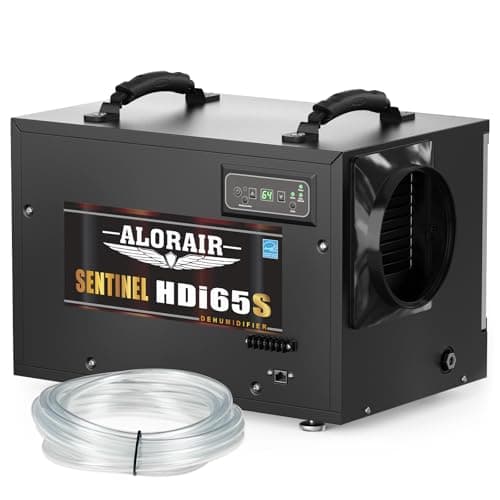
For a sealed attic, the ALORAIR 120 PPD ENERGY STAR Crawl Space Dehumidifier with Pump: 55 pints a day at AHAM conditions and a 19.6 ft pump lift to get water out of the attic. For a finished attic bedroom, the KNKA 80 Pint ENERGY STAR Dehumidifier instead.

4.1 on Amazon · 278 ratings

Quick answer

If your attic is sealed, with spray foam or insulation at the roofline, and its humidity stays above 60%, buy a dehumidifier with a built-in pump, and for most sealed attics that is the ALORAIR 120 PPD ENERGY STAR Crawl Space Dehumidifier with Pump, rated 4.1 stars across 278 Amazon ratings: 55 pints a day at AHAM conditions and a stated 19.6 ft pump lift. If the attic is vented to the outdoors, do not buy one, because it would be drying outdoor air. Find the moisture source instead: a bathroom fan ending in the attic, air leaks around lights and the hatch, or a roof leak.

Our Picks at a Glance

Every pick below is currently stocked — ratings and stock read from Amazon on 12 October 2026.

How this page was made: we compare the current Amazon listings, the makers' published specs and what verified buyers report, then rank by fit for the job. Ratings, review counts and stock are read from Amazon and dated. We earn a commission on purchases through our links; it does not change the order. Reviewed by Marcus Reed, IICRC-certified Water Restoration Technician.

Full Reviews

Each pick in detail: what the listing states, what buyers report, and where it falls short.

#1
Best Overall for a Sealed Attic

Check price

on Amazon ↗

Listing verified 13 Oct 2026

ALORAIR 120 PPD ENERGY STAR Crawl Space Dehumidifier with Pump (55 Pints/Day AHAM, 19.6 ft Lift, 1,300 Sq Ft)See it on Amazon ↗

Quick Verdict

ALORAIR 120 PPD ENERGY STAR with Pump: 55 pints/day at AHAM and a 19.6 ft lift, the pump unit for a sealed attic once its heat limit is confirmed.

Key Specs

Capacity (stated)

55 pints/day at AHAM; 120 pints/day at saturation

Coverage (claimed)

Up to 1,300 sq ft

Pump (stated)

Built-in condensate pump, lift up to 19.6 ft; gravity hose option

Housing

Metal outer casing

Low temperature

Auto defrost and low-temperature operation

Operating temperature range

Not stated on the listing

Pros

  • The pump moves water sideways over joists and out of the attic, a route gravity rarely manages
  • Tankless crawl space design, built for a space nobody visits to empty a bucket
  • ENERGY STAR, per the listing, for a machine that may run all summer
  • Auto defrost covers cool spring and fall nights in a sealed attic

Cons

  • No upper operating temperature on the listing; ask AlorAir before installing it under a hot roof
  • Sold as a crawl space unit; the listing does not name attics among its uses
  • Weight is not given in the listing bullets, so check it before planning the lift through the hatch

Suited to

A sealed, spray-foamed or encapsulated attic that holds above 60% RH, with a drain line the pump can reach

Our take

A sealed attic and a crawl space share a problem: an unvisited space where nobody empties a bucket. That is why the pick for an attic comes from the crawl space aisle. What makes this unit work up there is the pump. An attic floor is a grid of joists under a blanket of insulation, and a gravity hose needs steady fall all the way to a drain, which is hard to build across it. A pump with a stated 19.6 ft of lift can carry water over the joists to a drain line or out through a gable wall. The open question is heat. AlorAir lists low-temperature operation but no upper limit, so log your attic's temperature through a hot week and confirm the figure with the maker before you mount anything.

Check today's price on Amazon →

Affiliate link — commission at no extra cost to you

Compare elsewhere

These open a search for this model. We quote prices only where we can verify them — Amazon, Sylvane and eBay.

#2
Best for Watching an Attic From Downstairs

Check price

on Amazon ↗

Listing verified 13 Oct 2026

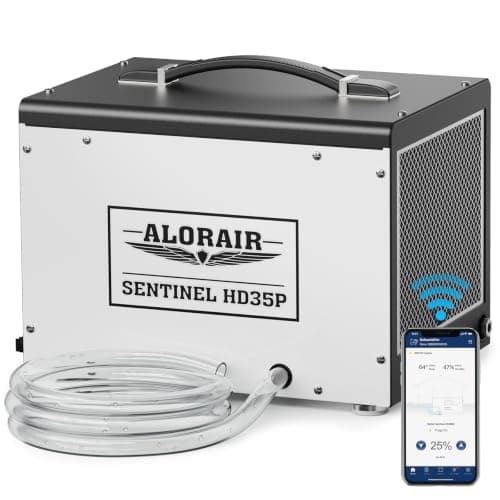
ALORAIR Smart Wi-Fi 70 Pint Crawl Space Dehumidifier with Pump (35 Pints/Day AHAM, 1,000 Sq Ft)See it on Amazon ↗

Quick Verdict

ALORAIR Smart Wi-Fi 70 Pint with Pump: 35 pints/day at AHAM, a 19.6 ft pump and live humidity on your phone, for small sealed attics.

Key Specs

Capacity (stated)

35 pints/day at AHAM; 70 pints/day at saturation

Coverage (claimed)

Up to 1,000 sq ft

Pump (stated)

Up to 19.6 ft lift; 19.6 ft line included

Controls

Wi-Fi app with live humidity and remote settings

Low temperature

Auto defrost

Operating temperature range

Not stated on the listing

Pros

  • Live humidity on your phone, so a fault in the attic shows up as a number instead of a smell
  • Built-in pump with a 19.6 ft line in the box
  • Smaller capacity suits a small sealed attic over part of the house

Cons

  • 35 pints at AHAM is light for a large or leaky attic
  • Wi-Fi has to reach the attic through ceiling drywall, ducts and foil-faced insulation
  • No upper temperature limit on the listing

Suited to

A small sealed attic up to about 1,000 sq ft where you want to see the humidity without climbing up

Our take

In an attic, the failure that hurts is the one you never see: a pump line that clogs, or a unit that quits on a hot afternoon. This model's Wi-Fi app shows live humidity and lets you change settings from the house, which turns a silent failure into a reading you notice the same day. At 35 pints a day under AHAM conditions it is a small machine, roughly two-thirds of the rank 1 pick, so keep it to small sealed attics or a spray-foamed section over one wing. Check the signal at the hatch with your own phone first. If it struggles there, add a Wi-Fi extender upstairs, or choose the rank 1 unit and pair it with a separate logging hygrometer.

Check today's price on Amazon →

Affiliate link — commission at no extra cost to you

#3
Best Ducted Pick for a Large Sealed Attic

Check price

on Amazon ↗

Listing verified 13 Oct 2026

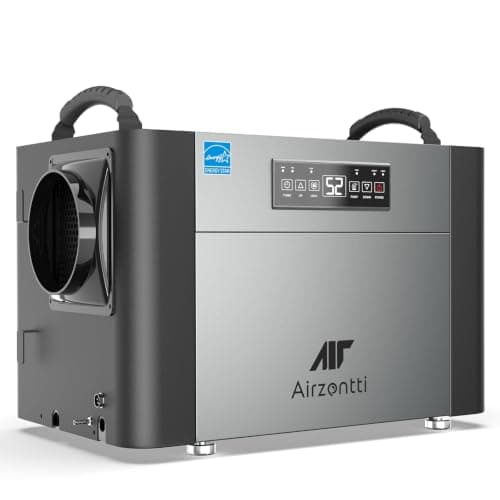
Airzentti 155 Pint Commercial Dehumidifier with Pump (70 Pints/Day AHAM, 220 CFM, 6 in Duct Collar)See it on Amazon ↗

Quick Verdict

Airzentti 155 Pint with Pump: 70 pints/day at AHAM, 220 CFM and a 6 in duct collar for large sealed attics, if two people can lift 60 lb into place.

Key Specs

Capacity (stated)

70 pints/day at AHAM; 155 pints/day in nearly saturated air

Coverage (claimed)

Up to 7,500 sq ft

Airflow (stated)

220 CFM

Ducting (stated)

6 in (150 mm) air duct collar

Pump (stated)

Built in, drains up to 16.4 ft; 6.56 ft gravity hose also included

Size and weight (stated)

24.3 x 14.2 x 15 in; 60 lb; 8.2 ft power cord

Pros

  • The only pick here whose listing names house attics as a use
  • A 6 in duct collar lets the unit sit near the hatch while ducting reaches the far end of the attic
  • Largest capacity on this page: 70 pints a day at AHAM
  • Pump and gravity drainage both included, plus auto defrost and a screen lock

Cons

  • At 60 lb it is a two-person lift up a ladder, and it needs a solid platform across the joists
  • Amazon showed it in limited stock when read on 12 Oct 2026
  • No operating temperature range on the listing, and the 16.4 ft pump figure does not say whether it is vertical

Suited to

A large sealed or conditioned attic where ducting can spread the dry air

Our take

Airzentti names house attics among the uses for this unit, and two details back that up. The 6 in duct collar lets you attach flexible duct, so the machine can sit on a platform near the hatch while it draws from, or delivers dry air to, the far end of a long attic. The built-in pump handles the drain. Size it with care, though. The 7,500 sq ft coverage claim is far more than most sealed attics need, and at 60 lb and 24.3 by 14.2 in it needs two people and a plywood platform screwed across the joists, never a perch on the ceiling drywall between them. Set it in a drain pan fitted with an overflow switch, because a leak up here lands on the ceiling below.

Check today's price on Amazon →

Affiliate link — commission at no extra cost to you

#4
Best for a Finished Attic Room

Check price

on Amazon ↗

Listing verified 13 Oct 2026

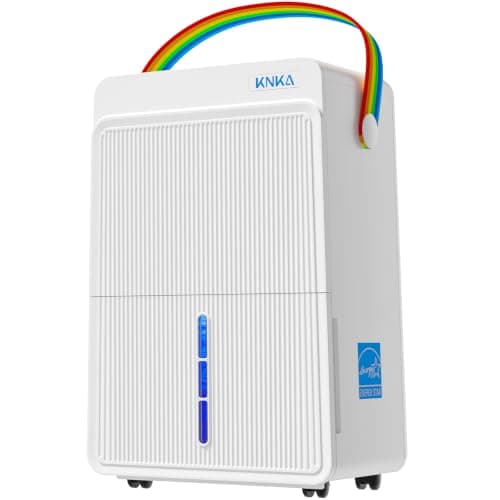
KNKA 80 Pint ENERGY STAR Dehumidifier (56 Pints/Day at 86°F, 80% RH, 5,500 Sq Ft)See it on Amazon ↗

Quick Verdict

KNKA 80 Pint ENERGY STAR Dehumidifier: 56 pints/day at 86°F and 80% RH, a 6.56 ft hose and a stated 40–45 dB, for a finished attic room rather than the attic itself.

Key Specs

Capacity (stated)

80 pints/day at 95°F and 95% RH; 56 pints/day at 86°F and 80% RH

Coverage (claimed)

Up to 5,500 sq ft

Tank and hose

1.45 gal tank; 6.56 ft drain hose included

Noise (stated)

40–45 dB

Humidity control

Auto mode at 50% RH; settable from 30% to 80% RH

Pump

None mentioned on the listing

Pros

  • States capacity at a second, more realistic condition, 86°F and 80% RH
  • A stated 40–45 dB and a display that switches off, for an attic bedroom
  • Longer included hose than many portables, at 6.56 ft
  • An optional external tank, sold separately, extends time between emptying

Cons

  • No pump, so it suits a room with a bucket routine or a drain below the hose
  • Not for an unfinished attic; auto defrost and temperature limits are not stated in the listing bullets
  • The humidity reading is taken at the air inlet and may differ from a separate meter, per the listing

Suited to

A finished attic bedroom, bonus room or loft that feels damp in summer

Our take

A finished attic room is living space, not an attic, and it is the one place under the roof where an ordinary portable dehumidifier makes sense. It is heated and cooled, someone is there to empty a tank, and noise matters. KNKA prints its capacity two ways, 80 pints at 95°F and 95% RH and 56 pints at 86°F and 80% RH, and the second is the better guide for a warm upstairs room. The 40–45 dB claim and a display you can switch off suit a bedroom. If the room stays damp with the dehumidifier running, look above and behind it: a bathroom fan venting into the space behind the knee walls, or a slow roof leak, will outpace any portable.

Check today's price on Amazon →

Affiliate link — commission at no extra cost to you

Buyer's Guide

What to know before you buy.

Vented or Sealed: The Question That Decides Everything

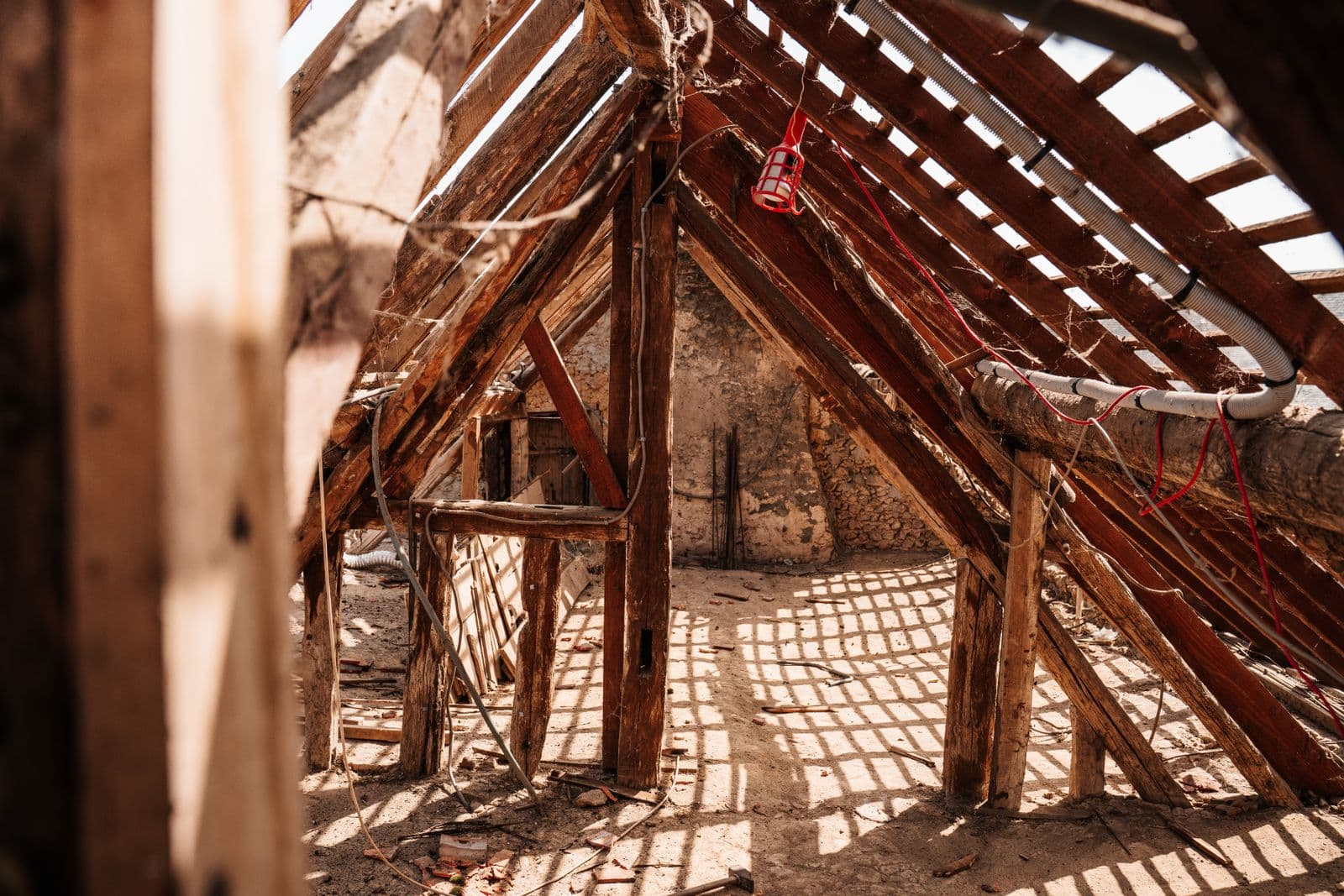
Most American attics are vented. Air comes in at the soffits and leaves at the ridge or gable vents, and the insulation lies on the attic floor. In that kind of attic, the air is outdoor air, so a dehumidifier up there would spend its effort drying the weather, around the clock, without end. The fix for a damp vented attic is to stop moisture coming up from the house and to make sure the vents actually move air. A sealed attic is different. When spray foam or rigid insulation is applied under the roof deck and the vents are closed, the attic becomes part of the house's conditioned space, and its humidity can build up like a basement's. That is the attic where a dehumidifier, or a supply duct from the HVAC system, belongs. Look up before you buy: insulation on the floor means vented, foam on the rafters usually means sealed.

Find the Moisture Source Before Buying Anything

Attic moisture almost always comes from below or above, not from the attic itself. The usual culprit is a bathroom, kitchen or dryer exhaust duct that ends in the attic instead of outdoors. Residential building codes require exhaust air to discharge outside, and EPA advises venting moisture-producing appliances to the outdoors. Next come air leaks: warm, damp house air rising around recessed lights, the attic hatch, plumbing vent pipes, wiring holes and the tops of interior walls, then condensing on cold roof sheathing in winter. Signs include frost on nail tips, dark staining on the sheathing, damp insulation and a bathroom fan that drips. A roof leak shows up as a stain that grows after rain. Fix the duct, seal the leaks with foam and caulk, and repair the roof. In a vented attic, that is the whole job; no dehumidifier is needed.

Heat and Cold: Read the Operating Range Before You Buy

None of the four listings on this page states an operating temperature range, and that is the biggest gap for attic use. At the cold end, ENERGY STAR notes that frost can form on dehumidifier coils below 65°F, which is why auto defrost matters in a sealed attic on cool nights; both AlorAir units and the Airzentti list it. At the hot end, a compressor has an upper limit too, and a vented attic on a summer afternoon can run far hotter than the outdoor air. A sealed attic usually stays much closer to the temperature of the house, which is one more reason dehumidifiers belong only in sealed attics. Before buying, place a logging thermometer and hygrometer in the attic for a week of hot weather. Then ask the maker for the unit's maximum operating temperature and compare. If the attic exceeds it, the answer is an HVAC supply duct, not a dehumidifier.

Getting the Water Out of an Attic

The 55-pint AlorAir is rated to pull almost 7 gallons a day at AHAM conditions, and in an attic every drop of that sits above a ceiling. Choose a unit with a built-in pump: the attic floor is a grid of joists, and a gravity hose needs continuous fall to its outlet, which is rarely possible. The AlorAir picks list up to 19.6 ft of lift, and Airzentti lists 16.4 ft. Common destinations are a nearby plumbing drain with the proper fitting, or a line run down through a wall to the outdoors, away from the foundation. If the attic has an air handler, ask an HVAC technician before sharing its condensate line, since one clog would then back up both. Set the dehumidifier in a drain pan with a float switch that cuts power if water rises, the same protection attic air handlers get. Check the pump and pan each spring and fall.

Sizing and Setpoint for a Sealed Attic

Size from the attic's floor area and how damp it runs. ENERGY STAR's chart calls for 20 to 30 pints a day for a slightly to moderately damp space under 2,000 sq ft, rising to 30 to 50 pints when the space is wet, and it advises oversizing rather than undersizing. Use AHAM figures when comparing, since saturation numbers run about twice as high. A sealed attic over a 1,500 sq ft house that holds 65% RH in summer sits comfortably within the range of the 55-pint AlorAir; the 35-pint Wi-Fi unit suits a smaller section. Set the target at 50% RH. EPA's guidance is below 60% indoors, ideally 30% to 50%, and a sealed attic is indoors. Read the result with a hygrometer at the far end of the attic, away from the machine, and watch it through the first summer.

Who Should Not Put a Dehumidifier in the Attic

Skip the dehumidifier if your attic is vented; fix the moisture source, and if the vents are weak, see the attic fan and soffit advice linked below. Skip it while the roof is leaking, because the machine would only hide the leak. Skip it if the attic has no outlet and no safe place for a 24/7 appliance; an electrician should add a dedicated outlet first, and a long extension cord to a compressor is a fire risk. And if mold already covers the sheathing, more than about 10 square feet, which EPA treats as beyond a routine homeowner cleanup, the job is remediation first: cleaning the wood, removing wet insulation and correcting the ventilation. A dehumidifier holds a dry attic dry. It does not clean mold off rafters, and it cannot keep up with a bathroom fan pouring shower steam into the attic.

Frequently Asked Questions

Should I put a dehumidifier in my attic?

Only if the attic is sealed, with insulation at the roofline and no open vents. A vented attic exchanges air with the outdoors, so a dehumidifier there would spend its effort drying outdoor air.

In a vented attic, fix the source instead: reroute any bathroom or dryer duct that ends in the attic, seal air leaks from the rooms below and repair roof leaks. In a sealed attic that holds above 60% RH, a pump-equipped dehumidifier is a sound fix.

What humidity should an attic be?

A sealed attic should stay below 60% relative humidity, the same EPA ceiling that applies to the rest of the house, with about 50% as a sensible target.

A vented attic will track the outdoor humidity, so the number matters less than the signs: frost on nail tips, wet insulation or dark staining on the roof sheathing mean warm, damp house air is getting into the attic and condensing there.

Will a dehumidifier get rid of attic mold?

NoDrying the air can stop mold from spreading, but it does not remove growth already on the wood.

EPA's guidance is that a homeowner can usually clean an area under about 10 square feet, while larger areas call for its larger-scale cleanup guidance or a professional. Attic mold usually comes back unless the moisture source, often a misrouted exhaust fan or air leaks from the house, is fixed first.

Can a bathroom fan vent into the attic?

NoResidential building codes require bathroom exhaust to discharge outdoors, not into an attic, soffit or ridge vent.

A fan that ends in the attic blows warm shower air onto cold roof sheathing, where it condenses, feeds mold and can drip back down the duct. Extend the duct to a roof or wall cap with a damper, insulate it where it crosses the cold attic, and keep the run short and sloped so condensation drains outward.

Is an attic fan or a dehumidifier better for attic moisture?

It dependsOn the attic: ventilation suits a vented attic, and a dehumidifier suits a sealed one.

In a vented attic, an attic fan with a humidistat can help clear damp air, but only with enough soffit intake; without it, the fan pulls air up from the rooms below. Never add an exhaust fan to a sealed attic, because it defeats the seal. There, a pump-equipped dehumidifier or an HVAC supply duct controls the humidity.

How do you drain a dehumidifier in an attic?

With a built-in condensate pump, in most attics. A pump can push water up and over joists to a plumbing drain or out through an exterior wall, where a gravity hose would need continuous downhill fall.

Set the unit in a drain pan with a float switch that shuts it off if water collects, keep the line away from sharp bends, and check it each season, because a failure in the attic shows up first as a stain on the ceiling below.

Who do I call right now for water damage?

Call (888) 840-6512. The line is answered 24 hours a day, seven days a week, and connects you with an IICRC-certified water damage restoration company that serves your area. A recorded menu picks up first: choose water damage or mold, key in your 5-digit ZIP code, and hold through the short silence while the call is passed to the company.

Describe what you can see — where the water is coming from, how long it has been there, and whether it smells — the more specific you are, the faster the right company is on the line. If the source is a pipe or an appliance, shut the main water valve first. Have four things ready and the call goes quickly: the address, when the water started, what is wet now, and whether you have filed an insurance claim.

Still not sure which of these is your situation? (888) 840-6512 · toll-free · answered 24/7

Sources

  1. EPA — A Brief Guide to Mold, Moisture, and Your Home
  2. EPA — Mold Cleanup in Your Home
  3. ENERGY STAR — Dehumidifiers
  4. ENERGY STAR — Dehumidifier Testing and Capacity

Methodology: How we source and verify data · Report an error

How we chose these picks

  • Every pick is a current listing. Stock, star ratings and rating counts are read from Amazon by script and carry the date they were read.
  • Nothing under 4.0 stars makes the list, and the top pick needs a large rating count, so one good week of reviews cannot put it there.
  • Specs are quoted from the listing or the maker, with the test condition behind the number where there is one, and sized against the job rather than the room on the box.
  • We do not run lab or field tests. Where a spec matters, we say what it is measured under and what it cannot tell you.

Free 2-day shipping

Amazon Prime members pay no shipping on restoration equipment

Dehumidifiers, air movers, and moisture meters qualify for free Prime delivery — bulk items that otherwise cost $15–$40 to ship.

Try Prime free →

Affiliate link — HearthDry earns a bounty if you sign up; costs you nothing extra.

Also Worth Comparing

Best Attic Fan in 2026 — Gable, Solar and Humidistat Fans, and the Intake and Air Sealing That Decide Whether One Helps

A powered attic fan lowers attic heat only when the soffit vents can feed it and the ceiling below is sealed; otherwise it pulls cooled air and moisture up from the rooms and can upset gas appliance flues. These picks are compared on what each listing states about airflow, watts, thermostats and humidistats, with the sizing arithmetic for fan and intake and the moisture fixes that come first.

Read the comparison

Best Bathroom Exhaust Fans in 2026 — Sized by CFM, Judged by Stated Sones, and Ducted Outside to Stop Mold

In a bathroom with mold, the exhaust fan is the thing to fix first, because it clears the steam before it condenses on the ceiling, the grout and the window. These picks are compared on the airflow and noise each listing states, humidity sensing and the duct each fan needs, alongside the sizing rule, the 20-minute habit and the attic-venting mistake that undoes any fan.

Read the comparison

Best Crawl Space Dehumidifiers in 2026 — Compared at Crawl-Space Temperatures

A damp crawl space feeds mold and wood rot in the framing above it. These four crawl space dehumidifiers are ranked on published specifications, buyer records and how honestly each states its capacity for the cool, damp conditions under a house.

Read the comparison

Best Dehumidifiers With a Built-In Pump in 2026 — Compared on Lift Height

A built-in pump is the answer when the only drain is above the dehumidifier: a laundry sink, a standpipe or a window. It is only an answer if it can lift water that high, and two of the four listings here state a lift height while two do not.

Read the comparison

Best Hygrometers for Home in 2026 — Indoor Humidity Monitors That Tell You When a Room Is Too Damp

A hygrometer is the small, inexpensive instrument that tells you whether a room needs a dehumidifier, a humidifier or nothing at all. These picks are judged on the accuracy each listing states, how easily you can read them, and whether they can warn you about a damp basement before you smell it.

Read the comparison