

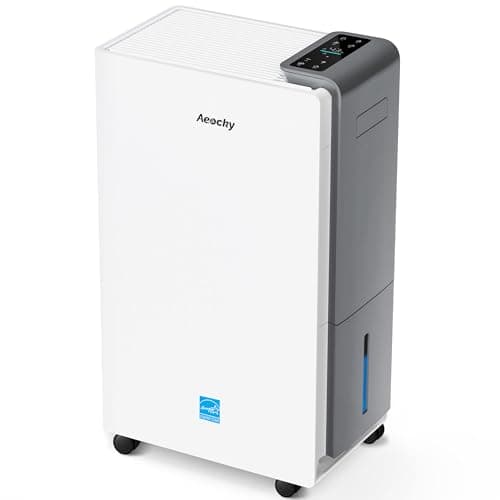
Best for: A damp basement or large room where the unit will stay put for the season
- Type:
- Compressor dehumidifier
- Capacity (stated):
- 56 pints/day at 86°F, 80% RH; 80 pints/day at 95°F, 95% RH
Listing verified 13 Oct 2026

Compared on Weight, Wheels, Tank and What Each Removes at Its Stated Conditions
5 picks compared · prices, ratings and stock checked October 12, 2026
Our Top Pick
For a damp basement or large room, the AEOCKY RHEA-001 80 Pint Dehumidifier. To roll one machine between rooms, the KNKA 34 Pint Dehumidifier With Wheels. For a bedroom at night, the ToLife 95 oz Dehumidifier.
4.5 on Amazon · 7,140 ratings
Quick answer
The best portable dehumidifier for a damp basement or large room is a compressor unit, and the AEOCKY RHEA-001 80 Pint Dehumidifier leads here: rated 4.5 stars across 7,140 Amazon ratings, it states 56 pints a day at 86°F and 80% RH and is listed as ENERGY STAR Most Efficient 2025. If you will roll the unit from room to room, the KNKA 34 Pint Dehumidifier With Wheels states 360° wheels and includes a drain hose. Mini units remove ounces, not pints: the Windangel 44 oz Small Dehumidifier states 11.8 oz a day, so keep minis for a closet or small bedroom.
Every pick below is currently stocked — ratings and stock read from Amazon on 12 October 2026.
Best for: A damp basement or large room where the unit will stay put for the season
Listing verified 13 Oct 2026
Best for: Moving one machine between a bedroom, a laundry room and a damp corner as the seasons change
Listing verified 13 Oct 2026
Best for: A bedroom or small home office that feels clammy at night
Listing verified 13 Oct 2026
Best for: A walk-in closet, small bathroom or RV corner that you want to keep from smelling stale
Listing verified 13 Oct 2026
Best for: A closet, cabinet, gun safe or boat locker with no outlet nearby
Listing verified 13 Oct 2026
How this page was made: we compare the current Amazon listings, the makers' published specs and what verified buyers report, then rank by fit for the job. Ratings, review counts and stock are read from Amazon and dated. We earn a commission on purchases through our links; it does not change the order. Reviewed by Marcus Reed, IICRC-certified Water Restoration Technician.
Full Reviews
Each pick in detail: what the listing states, what buyers report, and where it falls short.
Check price
on Amazon ↗
Listing verified 13 Oct 2026
See it on Amazon ↗Best Overall
Quick Verdict
AEOCKY RHEA-001 80 Pint Dehumidifier: the most capable plug-in unit here, best left in one damp room rather than moved daily.
Key Specs
Type
Compressor dehumidifier
Capacity (stated)
56 pints/day at 86°F, 80% RH; 80 pints/day at 95°F, 95% RH
Coverage (claimed)
Up to 5,500 sq ft
Efficiency (stated)
ENERGY STAR Most Efficient 2025
Noise (stated)
44 dB at the lowest fan speed
Size and weight (listing)
14.45 x 8.66 x 24.09 in; 31 lb
Pros
Cons
Suited to
A damp basement or large room where the unit will stay put for the season
Our take
Portable means plug-in, not light. This is the most capable machine on the page and the one you will move least. Its two capacity figures are the useful part of the listing: 80 pints at 95°F and 95% RH is a ceiling, while 56 pints at 86°F and 80% RH is closer to a warm, damp basement. Neither is the 65°F figure of the current DOE test, which will be lower again. The ENERGY STAR Most Efficient 2025 label matters on a machine that may run for months, because efficiency sets the running cost. Before buying, check the listing photos for the drain outlet and casters, since the bullets leave both out.
Affiliate link — commission at no extra cost to you
Compare elsewhere
These open a search for this model. We quote prices only where we can verify them — Amazon, Sylvane and eBay.
Check price
on Amazon ↗
Listing verified 13 Oct 2026
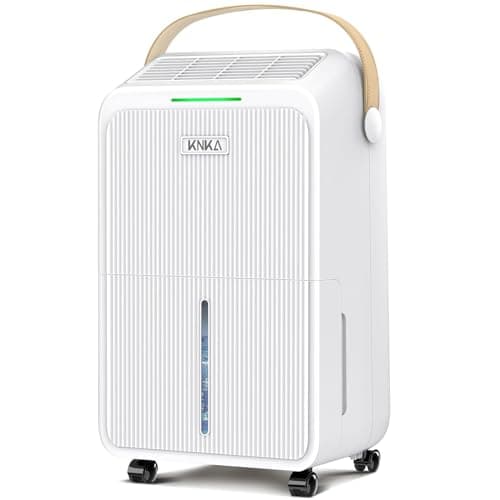
See it on Amazon ↗Best With Wheels
Quick Verdict
KNKA 34 Pint Dehumidifier With Wheels: a quiet compressor unit that rolls room to room, with a hose in the box.
Key Specs
Type
Compressor dehumidifier
Capacity (stated)
34 pints/day at 95°F, 90% RH
Coverage (claimed)
Up to 2,500 sq ft
Moving it (stated)
360° wheels and a soft leather handle
Tank (stated)
0.79 gal with auto shut-off; optional 2.64 gal external tank sold separately
Hose (stated)
3.28 ft (1 m) drain hose included
Pros
Cons
Suited to
Moving one machine between a bedroom, a laundry room and a damp corner as the seasons change
Our take
This is the rolling unit on the page. The listing states 360° wheels and a handle, and both matter more than they sound: a compressor dehumidifier with water in its tank is awkward to carry, and a dropped tank means a wet floor. Read the 34 pints as a hot-and-humid ceiling at 95°F and 90% RH. The small tank holds about 6 pints, so in a damp space the included 3.28 ft hose is the realistic setup. One instruction to follow: KNKA says to keep the unit upright and let it stand for 24 hours before first use, which is common advice for compressor units after shipping.
Affiliate link — commission at no extra cost to you
Compare elsewhere
Check price
on Amazon ↗
Listing verified 13 Oct 2026
See it on Amazon ↗Quick Verdict
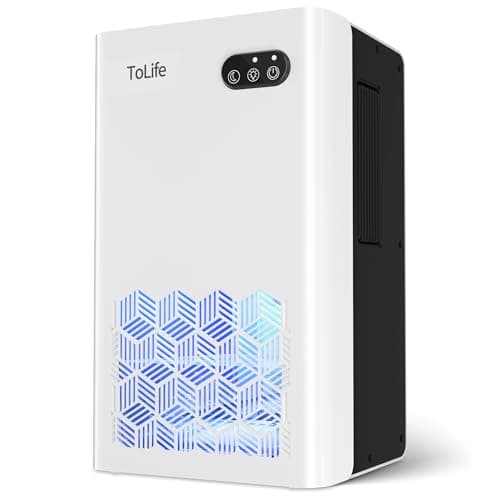
ToLife 95 oz Dehumidifier: a quiet bedroom unit with a roomy tank, though its output is not stated.
Key Specs
Type
Thermoelectric (semiconductor), no compressor
Moisture removal
Not stated on the listing
Tank (stated)
95 oz; stops when full or not seated correctly
Noise (stated)
Under 30 dB in sleep mode
Size (stated)
About 8.27 x 5.55 x 13.78 in, with handles
Coverage (claimed)
Up to 1,000 sq ft
Pros
Cons
Suited to
A bedroom or small home office that feels clammy at night
Our take
Thermoelectric units cool a small plate instead of running a compressor, which is why they are quiet and light, and also why they remove little water. ToLife does not state a daily figure at all, so judge it by the job rather than the box: one small room that feels sticky, not a basement. The 95 oz tank is roomy for this class, and the listing says the unit stops when the tank is full or seated wrongly, the safety feature that matters most on a bedside unit. Ignore the 1,000 sq ft claim. If a hygrometer still shows the room above 60% after a few days, move up to a compressor unit.
Affiliate link — commission at no extra cost to you
Compare elsewhere
Check price
on Amazon ↗
Listing verified 13 Oct 2026
See it on Amazon ↗Quick Verdict
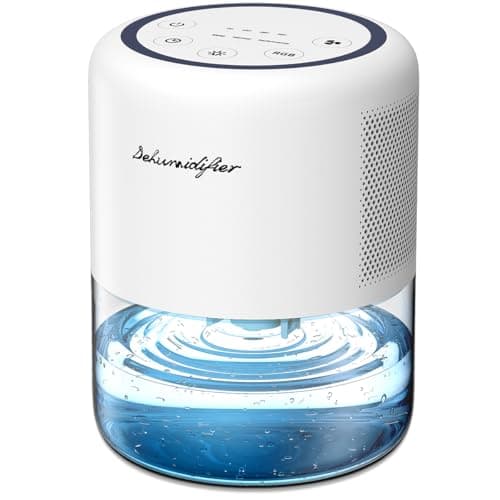
Windangel 44 oz Small Dehumidifier: a 2.6 lb closet-size unit that states its real output, under a pint a day.
Key Specs
Capacity (stated)
11.8 oz (349 ml) a day at 86°F, 80% RH
Tank (stated)
44 oz (1.3 L), auto shut-off when full
Weight (stated)
2.6 lb
Size (stated)
5.91 x 5.91 x 8.46 in
Power (stated)
24 W
Coverage (claimed)
215 sq ft
Pros
Cons
Suited to
A walk-in closet, small bathroom or RV corner that you want to keep from smelling stale
Our take
Windangel gives the two numbers most minis leave out: 2.6 lb, and 11.8 oz of water a day at 86°F and 80% RH. That second figure is the honest scale of this class. It is about three-quarters of a pint, against the tens of pints a compressor unit quotes, so a mini keeps a closet or small bathroom from turning stale but cannot dry a damp basement. The 215 sq ft coverage claim is believable next to rivals claiming 1,000. Auto defrost helps in an unheated space. With a 44 oz tank filling at 11.8 oz a day, expect to empty it every three to four days.
Affiliate link — commission at no extra cost to you
Compare elsewhere
Check price
on Amazon ↗
Listing verified 13 Oct 2026
See it on Amazon ↗Best Cordless for Closets
Quick Verdict
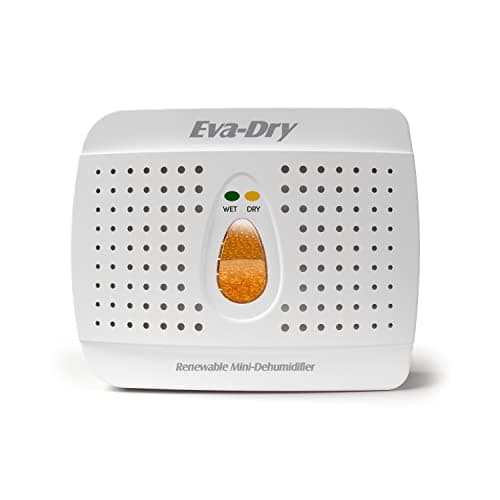
Eva-Dry E-333 Cordless Mini Dehumidifier: a cordless absorber for closets and cabinets, holding 6 oz between recharges.
Key Specs
Type
Renewable silica gel; no power while working
Capacity (stated)
Absorbs up to 6 oz before recharging
Space (stated)
Up to 333 cubic feet
Recharge interval (stated)
Every 20 to 30 days in use
Placement (stated)
Hangs or stands
Recharge method
Not described in the listing bullets
Pros
Cons
Suited to
A closet, cabinet, gun safe or boat locker with no outlet nearby
Our take
This is portable in the truest sense: no cord, no tank, no compressor. Silica gel beads absorb moisture until they are full, then you recharge the unit and start again. The listing sets the limit at 6 oz and the space at up to 333 cubic feet, with 20 to 30 days between recharges, and a damp closet will fill it sooner. It will not lower the humidity of an open room at all. Where clothes or shoes are already growing mildew, it is no substitute for a powered unit and a search for the source of the damp.
Affiliate link — commission at no extra cost to you
Compare elsewhere
What to know before you buy.
In DOE and ENERGY STAR terms, a portable dehumidifier is any unit that works inside the room without being ducted into the house, from a 2.6 lb closet mini to a 31 lb basement machine. The word does not promise light. On this page the AEOCKY RHEA-001 weighs 31 lb and stands about 24 in tall, while the Windangel weighs 2.6 lb, and those are the only two listings that give a weight. What makes a full-size unit easy to move is wheels and a handle, which KNKA states. Whatever you buy, empty the tank before you move it: a gallon of water adds about 8.3 lb and slops out of a tank tilted on a stair. Keep compressor units upright while you move them, too.
Two kinds of machine share the portable label. Compressor units, like the AEOCKY and the KNKA, pass air over a refrigerated coil and quote output in pints a day. Mini units quote ounces, if they quote anything; ToLife's listing names thermoelectric (semiconductor) cooling, which is quiet but slow. The gap is large. Windangel states under a pint a day at 86°F and 80% RH, while KNKA states 34 pints at 95°F and 90%. A mini is right for a closet, a small bathroom or a bedside shelf, and it will not bring a basement under 60% RH. The Eva-Dry is different again: a silica gel absorber with no power at all, holding 6 oz before it needs recharging.
A capacity number is only useful beside the temperature and humidity it was measured at. AEOCKY states 56 pints at 86°F and 80% RH and 80 pints at 95°F and 95%. KNKA states 34 pints at 95°F and 90%. Windangel states 11.8 oz at 86°F and 80%. ToLife and Eva-Dry give no removal rate at all. None of them prints the figure from the current DOE test, which ENERGY STAR says has run at 65°F since June 2019, and cooler air always gives a lower number. Expect real output in a 65°F basement to sit well below every figure here. Use the stated numbers to compare units quoted at the same conditions, and size with a margin.
A tank sets how often you walk to the sink. One gallon holds 8 pints, and KNKA's 0.79 gal tank holds about 6, so in a damp room running near its stated output it could fill several times a day; its included 3.28 ft hose is the practical answer. A hose needs a drain lower than the outlet, such as a floor drain, a sump pit or a utility sink beside a raised unit. The minis here describe no hose outlet, which is fine at a few ounces a day. KNKA, ToLife and Windangel each state an automatic shut-off when the tank is full. That protects the floor, but it also stops the drying until someone empties the tank.
Some jobs are beyond any plug-in dehumidifier. If a whole house feels damp on every floor, a whole-home unit installed with the ductwork is the better fit. If the space stays below 65°F, ENERGY STAR notes that frost can form on a standard unit's coils; look for a stated low-temperature rating, which neither compressor listing here gives as a number. After a burst pipe or a flooded floor, a portable unit is a support tool at best. Drying wet framing and drywall takes air movers and larger equipment, the work the IICRC S500 water damage restoration standard covers, and EPA advises drying water-damaged areas within 24 to 48 hours to prevent mold growth. If mold already covers more than about 10 square feet, EPA's cleanup guide points to professional guidance before anything else.
Put the unit where the damp is, with space around it. ENERGY STAR advises keeping a dehumidifier away from walls and furniture so air circulates, and closing the doors and windows of the space while it runs. Set it to 45% to 50% rather than its lowest setting; EPA's guidance is to keep indoor humidity below 60%, ideally 30% to 50%. Check the room with a separate hygrometer for the first week, since the unit's own sensor reads the air at its intake. When you move a compressor unit, switch it off, empty the tank and roll it rather than tipping it on its side.
YesWhen the size matches the space.
A compressor unit such as the AEOCKY RHEA-001 or the KNKA 34 Pint removes pints of water a day and can hold a basement or damp room near 50% RH. Small thermoelectric and silica units work too, on a scale of ounces rather than pints. Most disappointment comes from a mini bought for a basement, where it cannot keep up.
In the dampest room, out in the open, with the doors and windows closed. ENERGY STAR advises keeping it clear of walls and furniture so air reaches the intake and exhaust.
In a basement, a central spot near the source of the damp works better than a far corner. If you use a hose, place the unit near a floor drain or raise it so the hose runs downhill.
YesAnd wheels make it easy. Switch it off and empty the tank first, then roll it rather than carrying it with water inside.
Keep compressor units upright; KNKA tells owners to let a new unit stand upright for 24 hours before first use, and a short wait after a hard tilt is a sensible habit. Minis such as the 2.6 lb Windangel can simply be carried.
Let the humidistat decide rather than a clock. Set it to 45% to 50% and the unit cycles off when the room reaches that level. In a damp basement it may run most of the day at first and less once the room and its contents dry out.
A unit that runs nonstop for weeks without reaching its set point is too small for the space, or the water source needs fixing.
YesFor any compressor unit you plan to move. Full-size machines are bulky even when empty, and a tank of water adds weight and slops.
The KNKA 34 Pint states 360° wheels and a handle. The AEOCKY RHEA-001's bullets do not mention casters, so check its photos if you need to roll it. For a mini that weighs a few pounds, a handle is enough.
NoNot for an open basement. Their output is measured in ounces a day: Windangel states 11.8 oz at 86°F and 80% RH, and ToLife gives no figure.
ENERGY STAR's sizing guidance starts at 20 pints a day for a slightly damp space under 2,000 sq ft. A basement needs a compressor unit, and a wet one needs a hose or pump so a full tank never stops the job.
Call (888) 840-6512. The line is answered 24 hours a day, seven days a week, and connects you with an IICRC-certified water damage restoration company that serves your area. A recorded menu picks up first: choose water damage or mold, key in your 5-digit ZIP code, and hold through the short silence while the call is passed to the company.
Describe what you can see — where the water is coming from, how long it has been there, and whether it smells — the more specific you are, the faster the right company is on the line. If the source is a pipe or an appliance, shut the main water valve first. Have four things ready and the call goes quickly: the address, when the water started, what is wet now, and whether you have filed an insurance claim.
Still not sure which of these is your situation? (888) 840-6512 · toll-free · answered 24/7
Methodology: How we source and verify data · Report an error
Free 2-day shipping
Amazon Prime members pay no shipping on restoration equipment
Dehumidifiers, air movers, and moisture meters qualify for free Prime delivery — bulk items that otherwise cost $15–$40 to ship.
Affiliate link — HearthDry earns a bounty if you sign up; costs you nothing extra.
The right dehumidifier for a home depends on the size of the space and how damp it is, and the pint number on the box depends on which test produced it. These five picks run from a 22-pint single-room unit to an 80-pint machine for a whole basement, compared on the figures their listings actually state.
Read the comparisonMost basement dehumidifier disappointment comes from two numbers nobody reads properly: the pint rating, measured at warm test conditions a 60°F basement never reaches, and the drainage method. Five units are compared here on those two points first, from a garden-hose drain to a built-in pump with a stated 15 ft lift.
Read the comparisonA bedroom dehumidifier has to be quiet enough to sleep beside, and five of the six picks here are thermoelectric units that remove ounces of water a day rather than pints. That is enough for a stuffy bedroom, closet or studio apartment; for a room with wet windows every morning, the sixth pick is a small compressor unit rated in pints.
Read the comparisonA closed closet trades very little air with the rest of the house, so a hanging absorber or a mini dehumidifier can keep up with it where it could never dry a room. The picks here are sorted by the closet you have: no outlet, an outlet, or a walk-in beside a damp wall or a bathroom.
Read the comparisonA built-in pump is the answer when the only drain is above the dehumidifier: a laundry sink, a standpipe or a window. It is only an answer if it can lift water that high, and two of the four listings here state a lift height while two do not.
Read the comparison