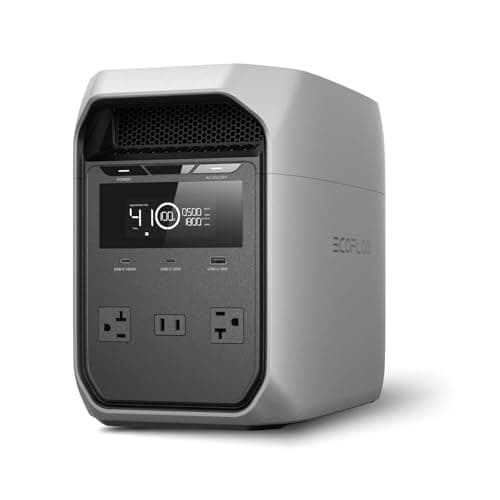
Best for: Automatic, silent backup for a typical 1/3 HP sump pump through an outage of a few hours to most of a day
- Capacity (stated):
- 1,024 Wh, LiFePO4 cells
- AC output (stated):
- 1,800 W rated, 3,600 W surge
Listing verified 13 Oct 2026

Surge, Runtime Math, and When a Backup Pump Is the Better Buy
5 picks compared · prices, ratings and stock checked October 12, 2026
Our Top Pick
For automatic, silent backup on a typical 1/3 HP sump pump, the EcoFlow DELTA 3 Classic: 1,024 Wh, 1,800 W output with a 3,600 W surge, and a stated UPS switchover under 10 ms. For outages that run past a day, the Jackery Explorer 2000 v2 doubles the capacity and lists a 20 ms UPS.
4.7 on Amazon · 1,328 ratings
Quick answer
If you want a sump pump to keep running by itself when the power fails, buy a station whose listing states a UPS switchover and a surge rating well above the pump's starting draw, and for most 1/3 HP pumps that is the EcoFlow DELTA 3 Classic, rated 4.7 stars across 1,328 Amazon ratings. Its listing gives 1,024 Wh, 1,800 W output with a 3,600 W surge, and switchover in under 10 ms. Expect roughly one hour of nonstop pumping from 1,024 Wh, or most of a day if the pump runs only a few minutes each hour.
Every pick below is currently stocked — ratings and stock read from Amazon on 12 October 2026.
Best for: Automatic, silent backup for a typical 1/3 HP sump pump through an outage of a few hours to most of a day
Listing verified 13 Oct 2026
Best for: A household where someone is usually home to plug the pump in, and the station has to be easy to carry
Listing verified 13 Oct 2026
Best for: A larger or harder-starting sump pump, or a home that wants to add battery capacity later
Listing verified 13 Oct 2026
Best for: Outages that last a day or more, with a cycling pump and automatic switchover
Listing verified 13 Oct 2026
Best for: Whole-home outage backup where the sump pump is one of several circuits to keep running
Listing verified 13 Oct 2026
How this page was made: we compare the current Amazon listings, the makers' published specs and what verified buyers report, then rank by fit for the job. Ratings, review counts and stock are read from Amazon and dated. We earn a commission on purchases through our links; it does not change the order. Reviewed by Marcus Reed, IICRC-certified Water Restoration Technician.
Full Reviews
Each pick in detail: what the listing states, what buyers report, and where it falls short.
Check price
on Amazon ↗
Listing verified 13 Oct 2026
See it on Amazon ↗Best Overall for Automatic Sump Backup
Quick Verdict
EcoFlow DELTA 3 Classic: 1,024 Wh, a 3,600 W surge and a stated UPS under 10 ms, the right shape for automatic sump backup.
Key Specs
Capacity (stated)
1,024 Wh, LiFePO4 cells
AC output (stated)
1,800 W rated, 3,600 W surge
X-Boost (stated)
Runs some heavier loads up to 2,600 W; do not size a pump against this figure
Switchover (stated)
UPS, under 10 ms
Recharge (stated)
0 to 80% in 45 minutes on AC; about 2.5 hours from a 500 W solar panel, sold separately
App (stated)
Charging schedules and backup modes, including Storm Alert
Pros
Cons
Suited to
Automatic, silent backup for a typical 1/3 HP sump pump through an outage of a few hours to most of a day
Our take
For sump duty, the line that matters most on this listing is the UPS switchover under 10 ms. It lets the pump stay plugged into the station and the station stay plugged into the wall, so when the grid drops the battery takes over on its own, at 3 a.m. or while you are away. A station with no stated UPS only helps if someone is home to move the plug. The second figure is surge: 3,600 W, against the roughly 1,300 W starting draw that generator charts commonly list for a 1/3 HP pump. Leave X-Boost out of your sizing and plan on the 1,800 W rating. Then do the runtime arithmetic in the buying guide, because 1,024 Wh is about an hour of nonstop pumping and lasts much longer only if the pump cycles.
Affiliate link — commission at no extra cost to you
Compare elsewhere
These open a search for this model. We quote prices only where we can verify them — Amazon, Sylvane and eBay.
Check price
on Amazon ↗
Listing verified 13 Oct 2026
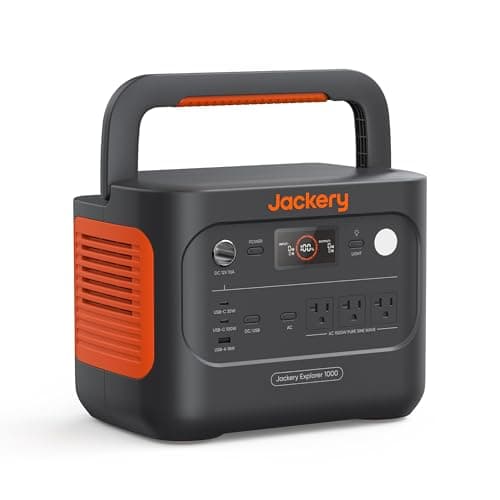
See it on Amazon ↗Best for Plug-In Backup When Someone Is Home
Quick Verdict
Jackery Explorer 1000 v2: pure sine wave output and a 3,000 W surge in a 23.8 lb unit, but no stated UPS, so someone has to move the plug.
Key Specs
Capacity (stated)
1,070 Wh LFP battery; over 70% of capacity after 4,000 cycles
AC output (stated)
1,500 W, 3,000 W surge peak
Outlets (stated)
Three pure sine wave AC, two USB-C, one USB-A and one car port
Recharge (stated)
1.7 hours by default; 1 hour with emergency charging turned on in the app
Weight (stated)
23.8 lb with a foldable handle
Quiet mode (stated)
30 dB overnight charging mode
Pros
Cons
Suited to
A household where someone is usually home to plug the pump in, and the station has to be easy to carry
Our take
On paper, the Explorer 1000 v2 suits a 1/3 HP sump pump: 1,500 W of pure sine wave output and a 3,000 W surge peak, against the roughly 800 W running and 1,300 W starting that generator charts commonly list for that size of pump. What its listing does not state is a UPS or automatic switchover, and for sump duty that is the gap to plan around. Without it, the pump runs on battery only after someone unplugs it from the wall and plugs it into the station, which suits a household that is usually home. The one-hour emergency charge set in the app is useful before a forecast storm. Whatever you buy, test it with your own pump while grid power is still on.
Affiliate link — commission at no extra cost to you
Compare elsewhere
Check price
on Amazon ↗
Listing verified 13 Oct 2026
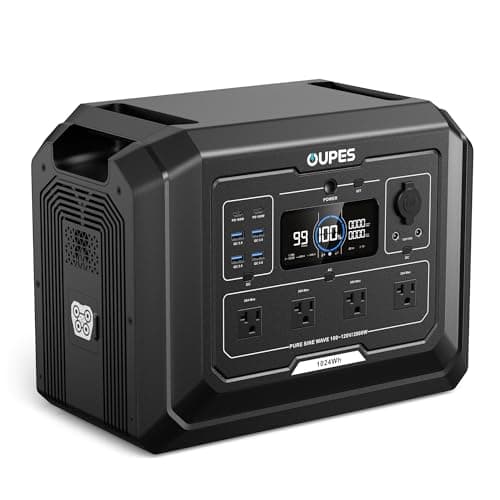
See it on Amazon ↗Highest Stated Surge, Expandable
Quick Verdict
OUPES Mega 1: a 4,500 W surge, a stated UPS under 20 ms and room to grow to 5,120 Wh for a bigger pump or longer outages.
Key Specs
Capacity (stated)
1,024 Wh; up to 5,120 Wh with two B2 Extra Batteries
AC output (stated)
2,000 W continuous, 4,500 W surge, pure sine wave
Switchover (stated)
UPS, under 20 ms
Recharge (stated)
0 to 80% in 36 minutes on AC; 26 minutes with AC and solar together
Battery (stated)
LiFePO4, rated for 3,500+ cycles
App (stated)
Bluetooth monitoring and output settings
Pros
Cons
Suited to
A larger or harder-starting sump pump, or a home that wants to add battery capacity later
Our take
Two numbers set the OUPES apart for sump duty. The first is the 4,500 W surge, the highest stated here. Motor start-up is the moment a power station most often trips on overload, so surge headroom is the spec most worth paying for. The second is expansion. With two B2 Extra Batteries the system reaches 5,120 Wh, five times the base capacity, through the same inverter, which turns hours of backup into days for a pump that cycles. The UPS switchover is stated as under 20 ms, which is ample, because what a pump needs is a switch that happens on its own, not a fast one. Weight is not stated, so check it before planning to carry it, and pair it with a high-water alarm.
Affiliate link — commission at no extra cost to you
Compare elsewhere
Check price
on Amazon ↗
Listing verified 13 Oct 2026
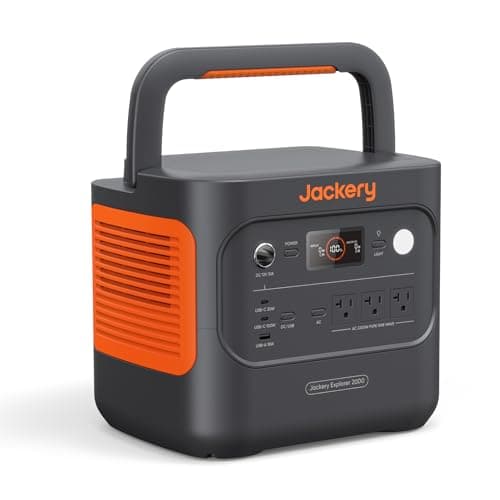
See it on Amazon ↗Best for Long Outages
Quick Verdict
Jackery Explorer 2000 v2: 2,042 Wh and a UL1778-certified 20 ms UPS for long outages; test its unstated surge against your pump first.
Key Specs
Capacity (stated)
2,042 Wh LiFePO4, up to 10 years
AC output (stated)
2,200 W total across three AC ports
Surge
Not stated in the listing's bullets
Switchover (stated)
20 ms; UL1778 test certified for uninterruptible power systems
Recharge (stated)
0 to 80% in 66 minutes on AC; full in 102 minutes with Emergency Super Charging; about 6 hours on 400 W of solar
Weight (stated)
39.5 lb
Pros
Cons
Suited to
Outages that last a day or more, with a cycling pump and automatic switchover
Our take
This is the pick for a long outage. At 2,042 Wh, it holds about 1,735 Wh after typical inverter losses, which for an 800 W pump running 5% of the time works out to a little over 40 hours, before the station's own idle draw, by the arithmetic in the buying guide. The UPS is stated at 20 ms and test certified to UL1778, the safety standard for uninterruptible power systems, so it can sit between the wall and the pump full time. What the bullets leave out is a surge figure, and surge is the number that decides whether a pump starts. Before you trust it, unplug the station from the wall, pour water into the pit until the float lifts, and watch for an overload warning.
Affiliate link — commission at no extra cost to you
Compare elsewhere
Check price
on Amazon ↗
Listing verified 13 Oct 2026
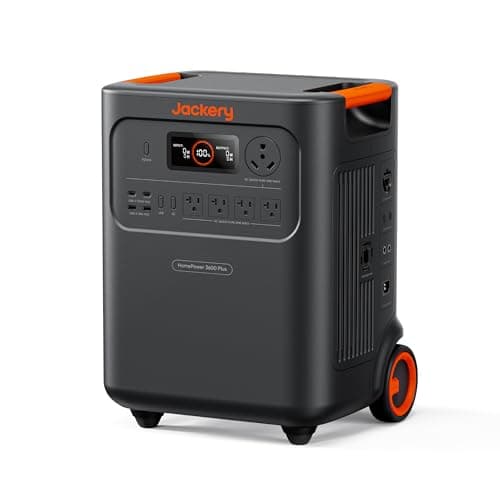
See it on Amazon ↗Best for Whole-Home Backup
Quick Verdict
Jackery HomePower 3600 Plus: 3,584 Wh and 3,600 W for a whole-home backup plan in which the sump pump is one circuit of several.
Key Specs
Capacity (stated)
3,584 Wh; expandable to 21 kWh per unit
AC output (stated)
3,600 W; 7,200 W and 120/240 V with two units in parallel
Loads named (stated)
Pumps, heaters and dryers
Home connection (stated)
Paired with Jackery's MTS transfer switch to power home circuits
Recharge (stated)
0 to 100% in 2 hours on AC plus DC; 2.5 hours on AC or from a gas generator; 4 hours on solar
Battery (stated)
6,000 cycles, 10-year lifespan; works in -4°F conditions
Pros
Cons
Suited to
Whole-home outage backup where the sump pump is one of several circuits to keep running
Our take
A sump pump on its own does not need 3,584 Wh, but a home that loses power in a storm usually needs more than the pump: the fridge, the furnace blower, a few lights. That is the job this Jackery is built for, with 3,600 W of output, capacity that expands to 21 kWh, and a transfer switch that feeds chosen home circuits, the sump circuit among them, without cords. Jackery lists pumps among the loads it runs. Two practical points follow. The bullets give no surge rating or switchover time, so test the start-up with your pump. And a manual transfer switch means someone has to flip it when the power goes, so unless the pump stays plugged straight into the station, its backup is not automatic.
Affiliate link — commission at no extra cost to you
Compare elsewhere
What to know before you buy.
Every sizing decision starts on the pump's label or manual. Running watts are amps times 120 volts, so a label reading 6.5 A means about 780 W while the pump runs. Starting watts are the brief spike as the motor spins up, commonly two to three times the running figure. Generator makers' wattage charts commonly list a 1/3 HP sump pump at about 800 W running and 1,300 W starting; a 1/2 HP pump draws more on both counts. The station needs a continuous rating above the running watts and a surge rating comfortably above the starting watts, or it trips the moment the float lifts. Look for pure sine wave output too, the kind of AC a motor is built for. A plug-in watt meter will confirm running watts, though it usually misses the start-up spike.
Start with usable energy. Inverters lose some power converting battery to AC, and one listing read for this page prints its own runtime formula using 0.85 for that loss, so a 1,024 Wh station gives about 870 Wh. Next comes the pump's duty cycle. An 800 W pump running nonstop empties 870 Wh in about 1.1 hours. In steady rain, a pump that runs 15 seconds every 5 minutes is on 5% of the time and averages 40 W, so the same station lasts about 21 hours. In a heavy storm, 30 seconds every 2 minutes is 25% of the time, about 200 W, and the runtime drops to roughly 4 hours. Time your own pump in the next rain: count cycles in one hour and multiply by the seconds each one lasts.
For a sump pump, a UPS or pass-through function decides whether the backup works while you sleep. With it, the pump stays plugged into the station, the station stays plugged into the wall, and the battery takes over the instant the grid drops. The millisecond figure matters for computers; a pump only needs the switch to happen without you. Of the picks here, EcoFlow, OUPES and the Jackery 2000 v2 state a UPS; the Jackery 1000 v2 and HomePower 3600 Plus listings do not. The other buried number is idle draw, the power the inverter uses with AC switched on and nothing running. Few listings state it, though Anker's SOLIX S2000 listing gives 6 W. Even 10 W, over a 24-hour outage, is 240 Wh, close to a quarter of a 1 kWh station, before the pump has run once.
Keep the station off the basement floor, on a shelf or sturdy table above the highest water you have seen, and well away from the pit. Plug the pump straight into the station's AC outlet; if you must use an extension cord, use one heavy enough for the pump's load and keep the connection off the floor. Never wire a station into a home outlet with a double-ended cord, which can send power back into the lines. Test once now and again every few months: unplug the station from the wall, pour a bucket of water into the pit until the float lifts, and confirm the pump starts with no overload warning. If your station has no UPS, keep it charged, since one listing read for this page asks for a recharge at least every three months in storage.
Each covers a different failure. A power station keeps your existing pump running through a power cut, silently and with no fumes, so it can sit indoors. It does nothing if the pump itself fails, the float sticks or the motor burns out. A battery backup sump pump is a second pump in the same pit with its own float and battery, so it covers a dead primary pump as well as a power cut, and for that reason it is the first backup most basements need. A gas generator runs as long as there is fuel, which makes it the answer for outages measured in days, but it has to run outdoors, well away from doors and windows, because of carbon monoxide. Never run one in a basement or an attached garage. Many homes end up with a backup pump first and a station second.
Skip a power station as your only protection if your pump runs almost constantly in wet seasons, because even 2,042 Wh lasts only a few hours under a near-nonstop load. The same goes for areas where storms often knock out power for several days, where a generator or a standby system fits better, and for a pump that has never been checked, since a station cannot save a pump that fails mechanically. Small stations are the wrong size altogether: Jackery's Explorer 300 lists 300 W rated output and a 600 W peak, short of a typical 1/3 HP pump's start. If water is already over the basement floor, the job is no longer backup power. EPA advises drying water-damaged areas within 24 to 48 hours to prevent mold growth, and standing water usually needs a restoration company's pumps and dryers.
YesIf its continuous rating covers the pump's running watts and its surge rating covers the starting spike.
A typical 1/3 HP pump is commonly listed at about 800 W running and 1,300 W starting, so a station with 1,500 W or more continuous and a surge near 3,000 W has room. For backup that works while you sleep, the listing should also state a UPS or automatic switchover.
Anywhere from about an hour to most of a day for a 1 kWh station, depending on how often the pump runs. Multiply the station's watt-hours by about 0.85 for inverter losses, then divide by the pump's average draw.
An 800 W pump running nonstop empties a 1,024 Wh station in roughly 1.1 hours; the same pump running 5% of the time averages 40 W and lasts about 21 hours.
Look for at least 1,500 W continuous output, a surge rating of 3,000 W or more, and 1,000 Wh or more of capacity.
Those figures cover the roughly 800 W running and 1,300 W starting that generator charts commonly list for a 1/3 HP pump, with margin for a hard start. Check your own pump's label, since amps times 120 volts gives its running watts.
NoFor most basements a battery backup sump pump is the better first purchase.
It is a second pump with its own float, so it also covers a primary pump that burns out or jams, which a power station cannot. A power station is the better choice when the pump itself is reliable and the risk is a power cut, and it can run other things during an outage too.
YesIf the station's listing states a UPS or pass-through function, which is the setup that makes the backup automatic.
The station stays plugged into the wall and switches to battery when the grid drops. The trade-off is that a fault in the station stops the pump even with grid power on, so test it every few months and add a high-water alarm in the pit.
Almost certainly not. A typical 1/3 HP sump pump is commonly listed at about 800 W running, well above a 300 W rated output, and its starting spike is higher still. Jackery's Explorer 300, for example, lists 300 W rated and a 600 W peak. Small stations suit phones, routers and lights during an outage, not a pump motor.
Call (888) 840-6512. The line is answered 24 hours a day, seven days a week, and connects you with an IICRC-certified water damage restoration company that serves your area. A recorded menu picks up first: choose water damage or mold, key in your 5-digit ZIP code, and hold through the short silence while the call is passed to the company.
Describe what you can see — where the water is coming from, how long it has been there, and whether it smells — the more specific you are, the faster the right company is on the line. If the source is a pipe or an appliance, shut the main water valve first. Have four things ready and the call goes quickly: the address, when the water started, what is wet now, and whether you have filed an insurance claim.
Still not sure which of these is your situation? (888) 840-6512 · toll-free · answered 24/7
Methodology: How we source and verify data · Report an error
Free 2-day shipping
Amazon Prime members pay no shipping on restoration equipment
Dehumidifiers, air movers, and moisture meters qualify for free Prime delivery — bulk items that otherwise cost $15–$40 to ship.
Affiliate link — HearthDry earns a bounty if you sign up; costs you nothing extra.

The power goes out during the storm that fills your basement — that is the whole reason this category exists. Here is what each system actually costs once you add the battery nobody includes.
Read the comparisonThe right sump pump prevents basement flooding before it starts — and handles it fast when it happens. These are the 3 best sump pumps for basement flooding in 2026, tested and ranked by an IICRC-certified water damage restoration technician.
Read the comparisonA sump pump alarm is a float switch hung in the pit just above the pump's turn-on level and wired to a siren or a phone alert, so a stuck float, a tripped breaker or a dead motor gets noticed while the water is still below the rim. These picks are compared on what each listing states about the float, the battery that keeps it working when the power fails, and how the warning reaches you.
Read the comparisonWhen a sump pump fails, the switch is often the part that quit: a float pinned against the pit wall never tells the pump to start. These picks are vertical, tethered and electronic switches compared on pit fit, amp rating, pumping range and what each listing states, with the bucket test and the alarm a new switch still needs.
Read the comparisonA water leak detector catches a leak while it is still a puddle rather than an insurance claim. These four flood sensors and water alarms range from a standalone 110 dB alarm with no Wi-Fi to a LoRa kit that sounds on the spot and texts your phone.
Read the comparisonA sump pump only protects the basement while it has power, and the storms that fill the pit are the same storms that cut the power. These generators are compared on rated and surge watts, stated run time, CO shutoff and transfer-switch outlets, with the sizing arithmetic taken from your pump's own label.
Read the comparisonThe battery, not the pump, decides how long a backup sump pump keeps the pit empty once the power goes out. These five sealed 12 V deep-cycle batteries are compared on amp-hours, chemistry, case size and terminals as each listing states them, with the arithmetic for turning amp-hours into hours of pumping and the replacement habit that keeps that number honest.
Read the comparison