Best Generator for a Sump Pump in 2026 — Inverter and Portable Generators Sized From Your Pump's Label, With the Cord, Fuel and CO Rules That Keep It Safe

Best Generator for a Sump Pump in 2026

Inverter and Portable Generators Sized From Your Pump's Label, With the Cord, Fuel and CO Rules That Keep It Safe

5 picks compared · prices, ratings and stock checked October 12, 2026

Our Top Pick

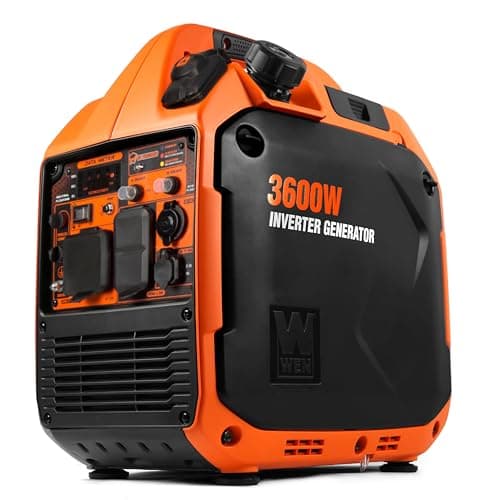
For a sump pump plus a few essentials, the WEN DF360iX 3600-Watt Dual Fuel Inverter Generator, with a CO shutoff and propane as a fuel that stores well. If you plan to have a transfer switch installed, the Westinghouse 6500 Watt Dual Fuel Portable Generator with its L14-30R outlet.

4.4 on Amazon · 531 ratings

Quick answer

If you want one machine to keep a household sump pump and a few essentials running through an outage, buy an inverter generator with a CO shutoff and surge watts well above your pump's label, such as the WEN DF360iX 3600-Watt Dual Fuel Inverter Generator, rated 4.4 stars across 531 Amazon ratings. Its listing gives 2,900 rated and 3,600 surge watts on gasoline. Size it yourself: volts times amps on the pump label gives running watts, and the start-up surge runs several times higher. Run it outdoors, well away from windows and doors, and plug the pump in with a heavy-duty outdoor cord. Never backfeed a wall outlet.

Our Picks at a Glance

Every pick below is currently stocked — ratings and stock read from Amazon on 12 October 2026.

How this page was made: we compare the current Amazon listings, the makers' published specs and what verified buyers report, then rank by fit for the job. Ratings, review counts and stock are read from Amazon and dated. We earn a commission on purchases through our links; it does not change the order. Reviewed by Marcus Reed, IICRC-certified Water Restoration Technician.

Full Reviews

Each pick in detail: what the listing states, what buyers report, and where it falls short.

#1
Best Overall for a Sump Pump

Check price

on Amazon ↗

Listing verified 13 Oct 2026

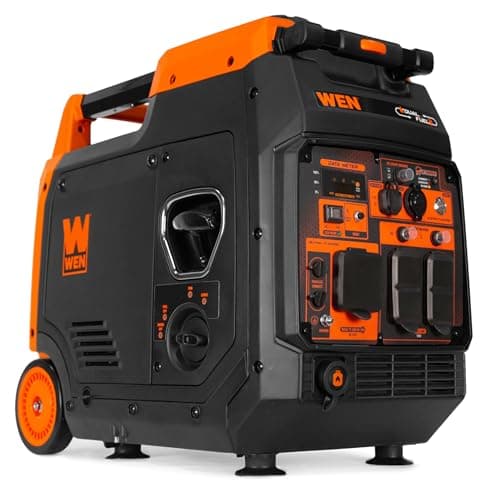
WEN DF360iX 3600-Watt Dual Fuel Inverter Generator (2,900 Rated Watts on Gas, CO Watchdog)See it on Amazon ↗

Quick Verdict

WEN DF360iX 3600-Watt Dual Fuel Inverter Generator: 3,600 surge watts, a CO shutoff and propane that stores well; check the run time in the manual.

Key Specs

Output, gasoline (stated)

2,900 rated watts, 3,600 surge watts

Output, propane (stated)

2,600 rated watts, 3,500 surge watts

CO safety (stated)

WEN Watchdog CO shutdown sensor

Outlets (stated)

Two 120V three-prong receptacles, one TT-30R RV receptacle, one 12V DC, two 5V USB

Fuel shutoff (stated)

Included, to help limit maintenance

Warranty (stated)

3 years

Pros

  • 3,600 surge watts give headroom for a pump motor's start-up draw, once you check your label
  • Runs on propane, which keeps in a sealed cylinder far longer than gasoline keeps in a can
  • A CO shutdown sensor turns the engine off if carbon monoxide builds up around it
  • A fuel shutoff and a 3-year warranty, both stated on the listing

Cons

  • No tank size or run time on the listing, so you cannot plan fuel from it
  • Only two household receptacles, so a pump and a fridge use both
  • Lower output on propane, 2,600 rated watts

Suited to

One sump pump plus a fridge and a few lights, on a generator that can sit ready between storms

Our take

A sump pump is a stop-start load. It sits idle, the float lifts, the motor pulls a burst of current to get going, and then it runs until the pit is low and stops. That makes the surge figure as important as the rated one, and this WEN gives 3,600 surge and 2,900 rated watts on gasoline. Dual fuel is the quiet advantage for storm prep. Untreated gasoline goes stale in a can within a few months, while a sealed propane cylinder keeps, so the generator can sit ready all season. The CO Watchdog sensor shuts the engine down if carbon monoxide builds up near it. Treat that as a backstop, never a reason to run it close to the house. Look up the run time in the manual before the first storm.

Check today's price on Amazon →

Affiliate link — commission at no extra cost to you

Compare elsewhere

These open a search for this model. We quote prices only where we can verify them — Amazon, Sylvane and eBay.

#2
Best Value Portable

Check price

on Amazon ↗

Listing verified 13 Oct 2026

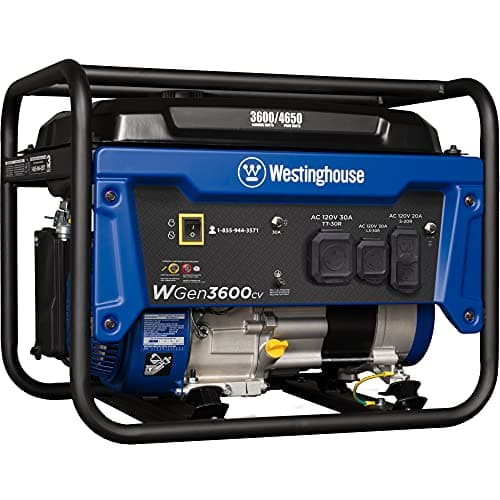
Westinghouse 4650 Peak Watt Portable Generator (3,600 Running Watts, 4 Gal Tank, CO Sensor)See it on Amazon ↗

Quick Verdict

Westinghouse 4650 Peak Watt Portable Generator: plenty of surge for a pump, a stated 14-hour tank and CO shutdown, at the cost of noise and a pull start.

Key Specs

Output (stated)

3,600 running watts, 4,650 peak watts, gasoline

Fuel tank (stated)

4 gallons, with fuel gauge

Run time (stated)

Up to 14 hours per tank; load not stated

Outlets (stated)

Two 5-20R 120V duplex receptacles, one TT-30R 30A RV, one L5-30R 30A

Safety (stated)

Automatic low oil and carbon monoxide shutdown

Start (stated)

Recoil (pull) start

Pros

  • 4,650 peak watts give a pump motor plenty of starting surge
  • A stated run of up to 14 hours on a 4-gallon tank
  • CO shutdown and low-oil shutdown, both on the listing
  • Two duplex receptacles, so four household plugs

Cons

  • Not an inverter, so the engine holds full speed and is usually louder at light loads
  • Pull start only, which is harder on a cold night
  • Gasoline only, so stored fuel needs stabilizer and rotation

Suited to

A sump pump and one or two other essentials, where surge and a long stated run matter more than quiet

Our take

This is a plain open-frame generator, and for a sump pump that is no drawback. A pump motor does not need the clean output of an inverter; it needs enough surge to start, and 4,650 peak watts covers that with room left over for a fridge. Plan fuel around the stated run time, up to 14 hours on a 4-gallon tank, though the listing does not say at what load. The CO shutdown and low-oil shutdown are good signs, and so is the 3-year coverage. What you give up is quiet. A conventional engine runs at full speed even when the pump is idle, so expect more noise and more fuel per hour than an inverter, which matters if it sits under a neighbor's bedroom window.

Check today's price on Amazon →

Affiliate link — commission at no extra cost to you

#3
Best for a Pump Plus Fridge

Check price

on Amazon ↗

Listing verified 13 Oct 2026

WEN DF480iX 4800-Watt Dual Fuel Inverter Generator (4,000 Rated Watts, Electric Start, CO Watchdog)See it on Amazon ↗

Quick Verdict

WEN DF480iX 4800-Watt Dual Fuel Inverter Generator: 4,000 rated watts on either fuel and electric start, for a pump plus a fridge.

Key Specs

Output, gasoline (stated)

4,000 rated watts, 4,800 surge watts

Output, propane (stated)

4,000 rated watts, 4,320 surge watts

Start (stated)

Electric start

CO safety (stated)

WEN Watchdog CO shutdown sensor

Outlets (stated)

Four three-prong 120V receptacles, one TT-30R, one 12V DC, two 5V USB

Moving it (stated)

Onboard wheels and a telescoping pull handle

Pros

  • The same 4,000 rated watts on propane as on gasoline, per the listing
  • Electric start, far easier at night in a storm than a pull cord
  • Four household receptacles spread the pump, fridge and lights across separate plugs
  • Wheels and a pull handle for rolling it out to a safe spot

Cons

  • No tank size or run time on the listing
  • Electric start depends on a battery that needs keeping charged between outages
  • No decibel figure; the listing compares it to normal conversation

Suited to

A sump pump and a refrigerator together, started with a button on a dark night

Our take

Step up to this WEN when the pump is not the only thing you need running. Its 4,000 rated watts on both gasoline and propane leave more room than the DF360iX for a refrigerator or freezer, whose compressor, like the pump, pulls a surge each time it starts. When two motors kick on together their surges add up, and that is when a small generator stalls. Electric start matters more than it sounds. Outages come with storms, often at night, and a pull cord on a cold engine is a poor plan. Keep the starter battery charged and run the generator briefly every month or so. The listing gives no run time, so check the manual before you decide how much fuel to store.

Check today's price on Amazon →

Affiliate link — commission at no extra cost to you

#4
Best for a Transfer Switch

Check price

on Amazon ↗

Listing verified 13 Oct 2026

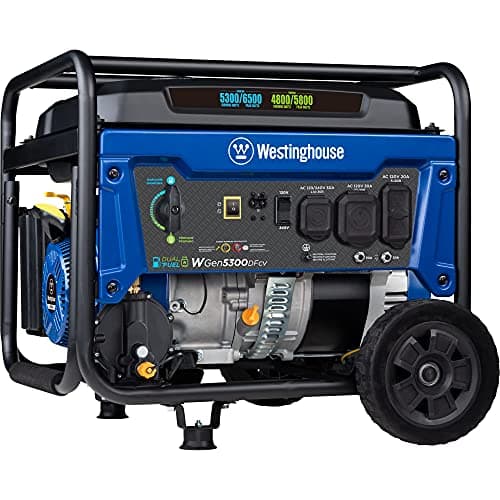
Westinghouse 6500 Watt Dual Fuel Portable Generator (5,300 Running Watts, L14-30R Transfer Switch Ready, CO Sensor)See it on Amazon ↗

Quick Verdict

Westinghouse 6500 Watt Dual Fuel Portable Generator: an L14-30R outlet and 5,300 running watts for a transfer-switch setup that carries the pump circuit.

Key Specs

Output, gasoline (stated)

5,300 running watts, 6,500 peak watts

Output, propane (stated)

4,800 running watts, 5,800 peak watts

Fuel and run time (stated)

4.7 gallon tank with fuel gauge; up to 14.5 hours; load not stated

Transfer switch outlet (stated)

One L14-30R 30A, with a 120/240V selector switch

Other outlets (stated)

One 5-20R 120V duplex, one TT-30R 30A RV

Safety (stated)

Automatic low oil and carbon monoxide shutdown

Pros

  • An L14-30R twist-lock outlet for a manual transfer switch or inlet box
  • A 120/240V selector, useful when the switch carries a 240V circuit such as a well pump
  • Dual fuel, with propane output stated
  • A stated run of up to 14.5 hours on 4.7 gallons, with a wheel kit included

Cons

  • Only one household duplex receptacle on the panel
  • Conventional engine with no stated noise figure, so expect more noise than an inverter
  • The transfer switch or interlock it is built for needs a licensed electrician to install

Suited to

Running the sump pump circuit and other chosen circuits through a manual transfer switch

Our take

Extension cords through a cracked window work, but a transfer switch is the cleaner setup: the generator plugs into an inlet outside, and the sump pump circuit, the fridge and a few lights switch over at the panel. This Westinghouse has the L14-30R 30A twist-lock outlet that many manual transfer switches and inlet boxes use, plus a 120/240V selector. Its 5,300 running watts cover a pump and several circuits, and the stated 14.5-hour run on 4.7 gallons gets you through a night between refills. A licensed electrician has to install the switch or interlock, because that is the part that stops the generator from feeding power back into the utility lines.

Check today's price on Amazon →

Affiliate link — commission at no extra cost to you

#5
Best Whole-Home Inverter

Check price

on Amazon ↗

Listing verified 13 Oct 2026

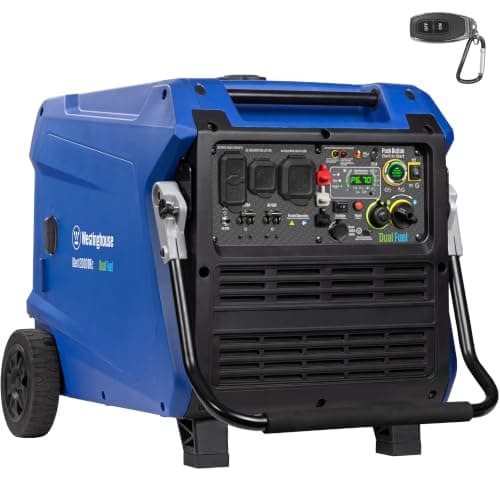
Westinghouse iGen12000DFc Dual Fuel Inverter Generator (9,000 Running Watts, 50A Outlet, CO Sensor)See it on Amazon ↗

Quick Verdict

Westinghouse iGen12000DFc Dual Fuel Inverter Generator: whole-home inverter power with a stated 19-hour run at 25% load; oversized for a pump alone.

Key Specs

Output, gasoline (stated)

9,000 running watts, 12,000 peak watts

Output, propane (stated)

8,100 running watts, 11,000 peak watts

Run time (stated)

Up to 19 hours at 25% load on a 7.9 gallon tank

Noise (stated)

As low as 64 dBA; measuring distance not stated

Transfer switch outlets (stated)

One 14-50R 50A and one L14-30R 30A, both transfer switch or interlock kit ready

Power quality (stated)

3% THD or less

Pros

  • Run time stated at a named load, up to 19 hours at 25% load
  • Both a 50A and a 30A outlet ready for a transfer switch or interlock kit
  • A display shows fuel level, power output and remaining run time
  • Remote start from a key fob

Cons

  • Far more generator than a sump pump alone needs
  • Stock was listed as limited when the listing was read
  • The 64 dBA figure is a best case with no distance given

Suited to

Whole-home backup through a transfer switch, with the sump pump as one load among many

Our take

Buy this only if the sump pump is one part of a bigger plan, such as furnace, fridge, well pump and lights through a transfer switch or interlock kit. For that job it reads well. The listing gives run time at a named load, up to 19 hours at 25% load on 7.9 gallons, which is more useful than a bare hour figure. Its display shows remaining run time, so you know when a night refill is due. The 3% THD rating means clean power for electronics, though the pump itself does not need it. For a pump alone it is oversized: a big generator idling far below its capacity still needs the same fuel storage, oil changes and outdoor space as a smaller one.

Check today's price on Amazon →

Affiliate link — commission at no extra cost to you

Buyer's Guide

What to know before you buy.

Size the Generator From Your Pump's Label

Start with the label on the pump or its manual, not a horsepower chart. Multiply volts by amps to get running watts: a pump marked 9.5 amps at 115 volts draws about 1,090 watts while it runs. Motors also pull a short surge to start, often several times the running draw, and that surge is what stalls an undersized generator. Some manuals list a starting figure. If yours does not, compare the generator's surge or peak rating with a generous margin over the running watts. Then add whatever else will share the generator, such as a refrigerator, a freezer, a few lights and a phone charger. Total their running watts, and remember that two motors starting together add their surges. Buy a generator whose rated watts, not its peak watts, cover that total.

Inverter or Conventional: What a Pump Actually Needs

An inverter generator turns the engine's output into steady, clean power, and many models throttle the engine down when the load is light. A sump pump motor does not need clean power. What an inverter gives a pump owner is quiet and fuel economy, because a pump that runs in short bursts leaves the generator lightly loaded for most of the night. A conventional open-frame generator holds its engine at full speed, so at the same light load it burns more fuel and makes more noise, but it usually gives more watts for the money. Both work. Pick an inverter if neighbors are close or fuel runs are hard, and a conventional unit like the Westinghouse 4650 for surge on a budget. Small camping inverters need a careful check of their surge figure against your pump.

Run Time, Fuel and Storage

Listings that state run time usually give it at 25% load, and a storm night with a busy pump can sit above that. The Westinghouse iGen12000DFc gives the clearest figure here: up to 19 hours at 25% load on a 7.9 gallon tank. Neither WEN listing gives a run time, so find it in the manual. Gasoline is the weak link in storm prep. It degrades in storage within months unless you treat it with stabilizer, and stale fuel gums up carburetors, which is why a fuel shutoff for draining the carburetor before storage is worth having. Propane keeps in a sealed cylinder, so a dual-fuel generator with two full tanks in the shed is ready whenever the power drops. Store fuel outside the living space, away from the water heater and furnace, in approved containers.

Cords, Transfer Switches and Backfeeding

There are two safe ways to connect. The simple one is to plug the pump straight into the generator with a heavy-duty, outdoor-rated, three-prong extension cord sized for the pump's amps and long enough to keep the generator well away from the house. The better one is a manual transfer switch or interlock kit, installed by a licensed electrician, so the generator feeds chosen circuits through the panel. Never connect a generator to a wall outlet or dryer receptacle with a double-ended cord. That is backfeeding, and electrical codes prohibit it: it can send power back up the utility lines and injure line workers, and it can start a fire in your own wiring when the grid comes back. Keep spare cord out of puddles and every plug connection off wet ground.

Carbon Monoxide: Where the Generator Goes

Generator exhaust carries carbon monoxide, which you cannot see or smell, and it kills people every storm season. Run the generator outdoors only, never in a garage, basement, crawl space or enclosed porch, even with the doors open. Keep it well away from doors, windows and vents, with the exhaust pointing away from the house, and follow the minimum distance in its manual. Every generator on this page lists a CO shutdown sensor, which turns the engine off if CO builds up around the machine; it does nothing for the people indoors. For them, fit CO alarms on every level of the house and outside sleeping areas, with battery power or battery backup. Keep the generator dry in rain under a cover made for running generators, never under a closed tarp.

Who Should Not Buy a Generator for the Sump Pump

A generator only helps if someone is home to start it, fuel it and move it. If you travel, work long shifts or cannot roll a heavy machine outside in a storm, a battery backup sump pump is the better first buy, because it switches on by itself when the main pump loses power. A generator also does nothing for a burned-out pump, a stuck float or a frozen discharge line, so a high-water alarm earns its place either way. Condo owners and renters usually cannot run a generator safely outdoors or have a transfer switch fitted. If water gets in anyway, EPA advises drying water-damaged areas within 24 to 48 hours to prevent mold. And if the basement floods with the pump running, the fix is pump capacity or drainage, which is a job for a plumber, not more watts.

Frequently Asked Questions

What size generator do I need to run a sump pump?

One whose rated watts cover the pump's running draw plus everything else you plug in, with surge headroom for the motor starting. Read the pump label: volts times amps gives running watts, so 115 volts at 9.5 amps is about 1,090 watts.

The starting draw is several times higher for a moment. That is why a generator with a few thousand rated watts, like the WEN DF360iX at 2,900 on gasoline, suits one pump and a fridge.

Can a 2000 watt inverter generator run a sump pump?

SometimesFor a small pump, but the margin is thin. The surge rating is the number to check, because a pump motor's start-up draw is several times its running draw.

Compare the generator's peak watts with the figure on your pump label or manual, and do not plan to run anything else on it at the same time. If the numbers are close, a generator in the 3,000 to 4,000 watt class is the safer choice.

Can I plug my sump pump directly into a generator?

YesPlug the pump into a generator receptacle with a heavy-duty, outdoor-rated, three-prong extension cord rated for the pump's amps, routed so the generator stays well away from the house.

Do not plug the generator into a wall outlet to power the circuit the pump normally uses; that is backfeeding, which endangers utility workers and is prohibited by electrical codes. To run the pump's own circuit, have an electrician fit a transfer switch.

How long will a generator run a sump pump?

As long as the fuel lasts, which depends on tank size and load. The Westinghouse iGen12000DFc lists up to 19 hours at 25% load on 7.9 gallons, while the Westinghouse 6500 lists up to 14.5 hours on 4.7 gallons without naming the load.

A pump cycling hard in a heavy storm adds load, so plan to refuel before the stated figure, and only refuel with the engine off and cooled.

Is an inverter generator better for a sump pump?

For most homes, yes, though not because the pump needs it. A pump motor runs fine on a conventional generator. An inverter is usually quieter and, on models with an economy mode, burns less fuel while the pump sits idle between cycles, which stretches a tank through a long night.

A conventional unit like the Westinghouse 4650 gives more surge for the money. Either works if its surge rating clears your pump label.

Can you run a generator in the garage with the door open?

NoAn open garage door does not clear carbon monoxide fast enough, and the gas can seep into the house through a connecting door, gaps and vents.

Run the generator outdoors, well away from doors, windows and vents, with the exhaust pointing away from the house, and fit CO alarms inside. A built-in CO shutdown sensor is a backstop, not permission to run the generator close to the house.

Who do I call right now for water damage?

Call (888) 840-6512. The line is answered 24 hours a day, seven days a week, and connects you with an IICRC-certified water damage restoration company that serves your area. A recorded menu picks up first: choose water damage or mold, key in your 5-digit ZIP code, and hold through the short silence while the call is passed to the company.

Describe what you can see — where the water is coming from, how long it has been there, and whether it smells — the more specific you are, the faster the right company is on the line. If the source is a pipe or an appliance, shut the main water valve first. Have four things ready and the call goes quickly: the address, when the water started, what is wet now, and whether you have filed an insurance claim.

Still not sure which of these is your situation? (888) 840-6512 · toll-free · answered 24/7

Sources

  1. EPA — A Brief Guide to Mold, Moisture, and Your Home

Methodology: How we source and verify data · Report an error

How we chose these picks

  • Every pick is a current listing. Stock, star ratings and rating counts are read from Amazon by script and carry the date they were read.
  • Nothing under 4.0 stars makes the list, and the top pick needs a large rating count, so one good week of reviews cannot put it there.
  • Specs are quoted from the listing or the maker, with the test condition behind the number where there is one, and sized against the job rather than the room on the box.
  • Each comparison is reviewed by Marcus Reed, an IICRC-certified Water Restoration Technician, against the IICRC drying standards and public guidance listed under Sources.

Free 2-day shipping

Amazon Prime members pay no shipping on restoration equipment

Dehumidifiers, air movers, and moisture meters qualify for free Prime delivery — bulk items that otherwise cost $15–$40 to ship.

Try Prime free →

Affiliate link — HearthDry earns a bounty if you sign up; costs you nothing extra.

Also Worth Comparing

Best Sump Pump Battery Backup Systems in 2026 — Pro Picks & Real Costs

The power goes out during the storm that fills your basement — that is the whole reason this category exists. Here is what each system actually costs once you add the battery nobody includes.

Read the comparison

Best Sump Pumps for Basements in 2026 — Sized by Lift, Not Horsepower

The right sump pump prevents basement flooding before it starts — and handles it fast when it happens. These are the 3 best sump pumps for basement flooding in 2026, tested and ranked by an IICRC-certified water damage restoration technician.

Read the comparison

Best Sump Pump Alarm in 2026 — Float-Switch Sirens, Phone Alerts, and the Battery That Keeps One Sounding in a Power Cut

A sump pump alarm is a float switch hung in the pit just above the pump's turn-on level and wired to a siren or a phone alert, so a stuck float, a tripped breaker or a dead motor gets noticed while the water is still below the rim. These picks are compared on what each listing states about the float, the battery that keeps it working when the power fails, and how the warning reaches you.

Read the comparison

Best Sump Pump Check Valves in 2026 — Quiet Spring Valves Matched to Your Pipe Size, Plus the Lid and Backup a Valve Cannot Replace

A sump pump check valve keeps the water in the discharge pipe from falling back into the pit each time the pump stops, so the pump does not move the same water twice. These picks are matched to the three common discharge pipe sizes and compared on what each listing states about quiet closing, pressure rating and the gap it needs in the pipe.

Read the comparison

Best Sump Pump Float Switch in 2026 — Vertical, Tethered and Electronic Switches Matched to Your Pit Width and Your Pump's Amps

When a sump pump fails, the switch is often the part that quit: a float pinned against the pit wall never tells the pump to start. These picks are vertical, tethered and electronic switches compared on pit fit, amp rating, pumping range and what each listing states, with the bucket test and the alarm a new switch still needs.

Read the comparison

Best Portable Power Station for a Sump Pump in 2026 — Surge, Runtime Math, and When a Backup Pump Is the Better Buy

A portable power station can keep a sump pump running through an outage, silently and indoors, if its surge rating covers the pump's start and its listing states an automatic UPS switchover. These picks are compared on surge, capacity and switchover as each listing states them, with the watt-hour arithmetic that turns your pump's cycle into hours, and the cases where a battery backup pump or a generator does the job better.

Read the comparison

Best Water Powered Backup Sump Pumps in 2026 — No Battery to Die in a Long Outage, but Only on City Water With the Pressure and the Backflow Preventer to Match

A water powered backup sump pump uses the pressure in your city water line to pull water out of the pit, so it keeps working through an outage that would empty any battery. These five picks are compared on the inlet pressure each listing states, the gallons of metered water used per gallon removed, the backflow device your plumbing code will ask for, and the one case where a battery backup is the right buy instead.

Read the comparison