Best for: Recaulking a standard tub or shower surround after the old, moldy bead has been cut out
- Type:
- 100% silicone as cured, per the listing
- Size:
- Two 2.8 oz squeeze tubes; no caulk gun needed
Listing verified 13 Oct 2026

Mold-Resistant 100% Silicone, and Why Moldy Caulk Has to Come Out First
5 picks compared · prices, ratings and stock checked October 11, 2026
Our Top Pick
For recaulking a tub or shower, the Gorilla 100% Silicone Caulk 2.8 oz Squeeze Tube: 100% silicone as cured, 10-year mold and mildew resistance per its listing, and no caulk gun needed. In a small bathroom with no window, the low-odor GE Advanced Silicone Caulk for Kitchen & Bathroom is the alternative.
4.6 on Amazon · 4,864 ratings
Quick answer
If you are recaulking a tub or shower, buy a 100% silicone labeled mold- and mildew-resistant, and for most bathrooms that is the Gorilla 100% Silicone Caulk 2.8 oz Squeeze Tube, rated 4.6 stars across 4,864 Amazon ratings. Its listing claims 10-year mold and mildew resistance and water exposure in as little as 30 minutes, though Gorilla's kitchen and bath listing puts full cure at 24 hours, the safer wait before a shower. If the old caulk has black spots inside it, cut it all out and dry the joint first: mold-resistant caulk protects the new bead, not the joint behind it.
Every pick below is currently stocked — ratings and stock read from Amazon on 11 October 2026.
Best for: Recaulking a standard tub or shower surround after the old, moldy bead has been cut out
Listing verified 13 Oct 2026
Best for: A small or windowless bathroom where strong curing fumes would linger, or a quick patch at a sink or tub corner
Listing verified 13 Oct 2026
Best for: Recaulking a whole tub surround or walk-in shower in one session, with a caulk gun
Listing verified 13 Oct 2026
Best for: Cutting out caulk that has mold inside it and tooling the new bead smooth
Listing verified 13 Oct 2026
Best for: A sink rim, backsplash or vanity joint outside the shower spray
Listing verified 13 Oct 2026
How this page was made: we compare the current Amazon listings, the makers' published specs and what verified buyers report, then rank by fit for the job. Ratings, review counts and stock are read from Amazon and dated. We earn a commission on purchases through our links; it does not change the order. Reviewed by Marcus Reed, IICRC-certified Water Restoration Technician.
Full Reviews
Each pick in detail: what the listing states, what buyers report, and where it falls short.
Check price
on Amazon ↗
Listing verified 13 Oct 2026
See it on Amazon ↗Best Overall
Quick Verdict
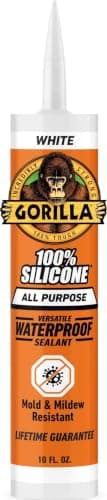
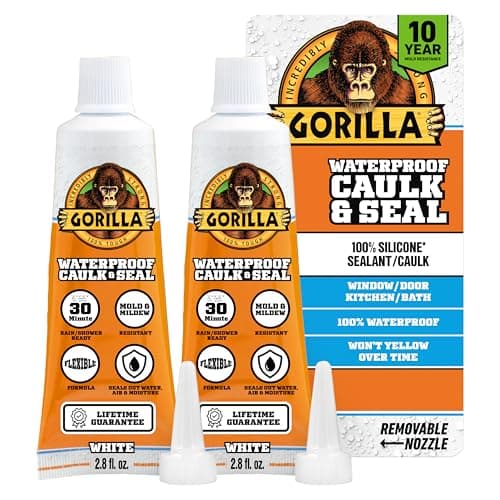
Gorilla 100% Silicone Caulk 2.8 oz Squeeze Tube: 100% silicone with a stated 10-year mold and mildew claim, in tubes that need no gun.
Key Specs
Type
100% silicone as cured, per the listing
Size
Two 2.8 oz squeeze tubes; no caulk gun needed
Color
White; a clear 2-pack is listed separately
Mold claim (stated)
10-year mold and mildew resistant
Water-ready (stated)
Water exposure in as little as 30 minutes
Full cure
Not stated on this listing
Pros
Cons
Suited to
Recaulking a standard tub or shower surround after the old, moldy bead has been cut out
Our take
For a shower, the figure on this listing that matters most is the 10-year mold and mildew claim, because it describes the cured silicone itself and puts a span on it that the GE and DAP listings do not. Read it for what it is: a mildewcide in the bead keeps growth off the bead's surface. It does nothing for spores left in the joint, which is why the old caulk has to come out completely and the gap has to dry before this goes in. The 30-minute water-ready claim helps if a stray splash reaches the joint; it is not permission to shower that evening. White suits most tub and tile, while clear lets you see any growth you missed underneath, so clean that joint more carefully.
Affiliate link — commission at no extra cost to you
Compare elsewhere
These open a search for this model. We quote prices only where we can verify them — Amazon, Sylvane and eBay.
Check price
on Amazon ↗
Listing verified 13 Oct 2026
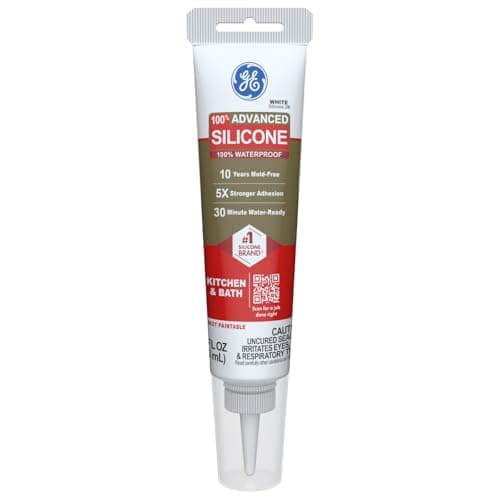
See it on Amazon ↗Best Low-Odor Pick for Small Bathrooms
Quick Verdict
GE Advanced Silicone Caulk for Kitchen & Bathroom: neutral-cure, low-odor 100% silicone for small rooms, with no mold claim in its bullets.
Key Specs
Type
100% silicone, neutral cure, per the listing
Size
2.8 fl oz tube; a 10 fl oz cartridge of the same caulk is listed separately
Odor (stated)
Low odor
Water-ready (stated)
Water resistant in 30 minutes
Flexibility (stated)
Permanently flexible; shrink and crack proof
Mold or mildew claim
Not stated in the listing's bullet points
Pros
Cons
Suited to
A small or windowless bathroom where strong curing fumes would linger, or a quick patch at a sink or tub corner
Our take
Neutral cure is the reason to choose this one. Many silicones cure by releasing acetic acid, the vinegar smell that hangs in a small bathroom for hours, and that acid can also mark some metals and natural stone. GE describes this formula as neutral cure and low odor, which makes it the easier choice for a room with no window or a joint against a stone sill or a metal shower frame. What the listing leaves out matters as much: none of its bullets claims mold or mildew resistance, so there is no promise to hold it to. If mold was the reason you are recaulking, the Gorilla tube's stated claim is the safer bet, and the fan habit in the buying guide matters with either.
Affiliate link — commission at no extra cost to you
Compare elsewhere
Check price
on Amazon ↗
Listing verified 13 Oct 2026
See it on Amazon ↗Best for a Full Tub Surround
Quick Verdict
Gorilla 100% Silicone Waterproof Caulk cartridge: ASTM C-920 Class 35 silicone for a full surround, if you have a caulk gun.
Key Specs
Type
100% silicone, indoor and outdoor
Size
10 oz cartridge; needs a standard caulk gun
Standard (stated)
Meets ASTM C-920, Class 35
Mold claim (stated)
Mold and mildew resistant; no time span given on this listing
Water-ready (stated)
Water exposure in 30 minutes
Uses named
Showers, sinks, windows, doors, gutters and vents
Pros
Cons
Suited to
Recaulking a whole tub surround or walk-in shower in one session, with a caulk gun
Our take
ASTM C-920 is the standard specification for elastomeric joint sealants, and Class 35 means the sealant is rated for joint movement of plus or minus 35% of the joint width. In a bathroom, that movement happens at the tub-to-wall joint: a tub full of water and a person settles slightly, then rises as it drains, which is why that joint cracks before any other. A sealant rated for movement keeps its grip through that cycle. By the arithmetic in the buying guide, a 10 oz cartridge lays roughly 54 ft of 3/16 in bead, so one covers a surround and its corners with plenty to spare. The trade is control, so practice a run on cardboard before the first joint that shows.
Affiliate link — commission at no extra cost to you
Compare elsewhere
Check price
on Amazon ↗
Listing verified 13 Oct 2026
See it on Amazon ↗Best Tool for Removing Moldy Caulk
Quick Verdict
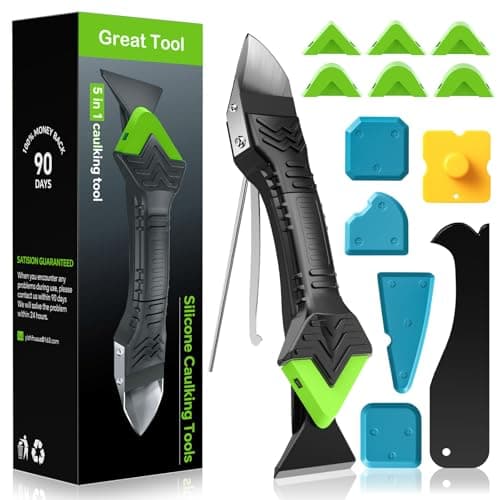
Goopreen 5-in-1 Caulking Tool: the scraper and smoothing pads for taking moldy caulk out and putting a clean bead back.
Key Specs
Type
Caulk removal and finishing tool
Remover
Stainless steel scraper head
Smoothing pads
6 silicone pads, 3R to 17R radius
Also included
Black removal scraper, 4 shaped caulking scrapers and a sealant cover
Safety (stated)
Sharp stainless steel scrapers; wear gloves and safety goggles
Caulk included
None
Pros
Cons
Suited to
Cutting out caulk that has mold inside it and tooling the new bead smooth
Our take
This is on the list because the step most shower recaulks skip is the one that decides whether the mold comes back. When black spots sit inside or under a silicone bead, no spray reaches them; the bead has to come out, down to bare tile and tub, and the joint has to be cleaned and left to dry before new caulk goes in. A purpose-made scraper is easier to control along a tub edge than a utility knife. The smoothing pads help at the other end of the job: a slightly concave, well-tooled bead sheds water instead of holding a ledge where soap film and moisture collect. Keep a few razor blades on hand for the last film of old silicone.
Affiliate link — commission at no extra cost to you
Compare elsewhere
Check price
on Amazon ↗
Listing verified 13 Oct 2026
See it on Amazon ↗Best Acrylic Option for Sinks and Backsplashes
Quick Verdict
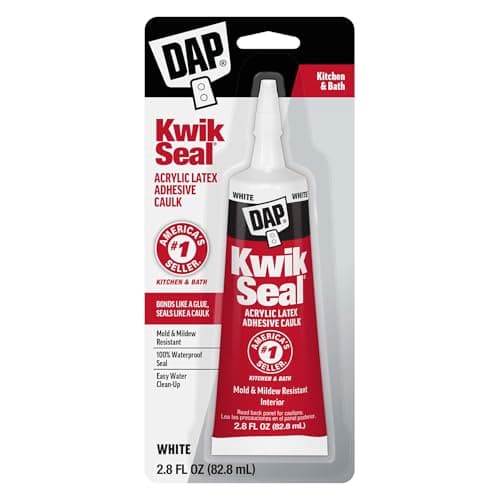
DAP Kwik Seal Kitchen & Bath: acrylic latex for sinks and backsplashes, with a 36-hour wait and no mold claim, so not for the tub joint.
Key Specs
Type
Acrylic latex adhesive caulk
Size
2.8 oz tube
Wait before water (stated)
36 hours
Application temperature (stated)
Above 40°F
Joint size (stated)
Up to 3/8 in wide by 3/8 in deep; backer rod for deeper joints
Limits (stated)
Not for continuous underwater use, high-temperature surfaces or surface defects
Pros
Cons
Suited to
A sink rim, backsplash or vanity joint outside the shower spray
Our take
DAP's listing is the clearest statement on this page of how acrylic caulk differs from silicone in a wet room. It needs 36 hours before water, it is not for continuous underwater use, and it makes no mold claim. None of that makes it a bad caulk, but it does make it the wrong one for the joint where a tub meets tile and water sits after every shower. Where it fits is a short joint that gets splashed and then dries: the back of a vanity top, the edge of a backsplash, a sink rim. Keep to its stated joint limit of 3/8 in by 3/8 in, and push backer rod into anything deeper before caulking.
Affiliate link — commission at no extra cost to you
Compare elsewhere
What to know before you buy.
For any joint that gets wet every day, such as tub to tile, shower pan to wall and the inside corners, choose 100% silicone. It stays flexible, sheds water, and the three silicones on this page all list water exposure in about 30 minutes. Acrylic latex and siliconized acrylic caulks are easier to tool and clean up with water, and are usually paintable, but they hold up less well under daily wetting. DAP's Kwik Seal listing shows the trade-off in its own words: 36 hours before water and not for continuous underwater use. Hybrid polymer caulks such as Flex Seal's Flex Caulk sit in between; its listing says fully paintable and adheres to wet or dry surfaces, but it makes no mold claim. The working rule is silicone inside the shower, and acrylic or hybrid where a bead meets painted drywall or trim.
On a caulk label, mold-resistant means a mildewcide in the cured bead keeps growth off its surface. Gorilla's kitchen and bath cartridge listing says so plainly: formulated to resist mold and mildew after curing. It does not kill mold already in the joint, and it cannot reach the gap between tile and tub where water collects once an old bead lets go. That is why black spots that return days after scrubbing usually sit under or inside the old caulk, not on top of it. EPA guidance for homeowners is direct: do not paint or caulk moldy surfaces. A new bead over a moldy joint seals the growth in with its moisture, and it shows again through a clear bead or at the edges of a white one. The resistance claim only pays off on a joint that was clean and dry when the bead went in.
Cut the old bead out completely, then scrape and razor the last film off the tile and tub, because new silicone bonds poorly to old silicone. Scrub the open joint with detergent and water, the EPA's method for mold on hard surfaces, and dry it completely. Leave the joint open with the exhaust fan running for about a day; water trapped behind a fresh bead is how the problem restarts. Just before caulking, wipe the joint with rubbing alcohol to lift soap film. Run painter's tape along both edges, fill the tub so the joint is at its widest, lay one continuous bead, and tool it into a slight curve. Pull the tape before the surface skins over, then keep the shower dry until the cure time on the tube has passed, which for Gorilla's kitchen and bath silicone is a stated 24 hours.
A round 3/16 in bead uses about 0.028 cubic inches per inch of joint, and a fluid ounce is about 1.8 cubic inches. That puts a 2.8 oz tube at roughly 15 ft of bead and a 10 oz cartridge at roughly 54 ft, consistent with Gorilla's no-caulk-gun sealant listing, which states up to 36 ft from 6.75 oz. A 1/4 in bead uses almost twice as much per foot, so halve those lengths for wide gaps. Now measure the job: a standard 60 by 30 in alcove tub has about 10 ft of tub-to-tile joint along the back and both ends, and the two inside corners of a 6 ft surround add about 12 ft more. That is about 22 ft in all, so one tube covers the tub line alone, while the full surround needs two tubes or a cartridge. Buy a little extra for waste in the nozzle.
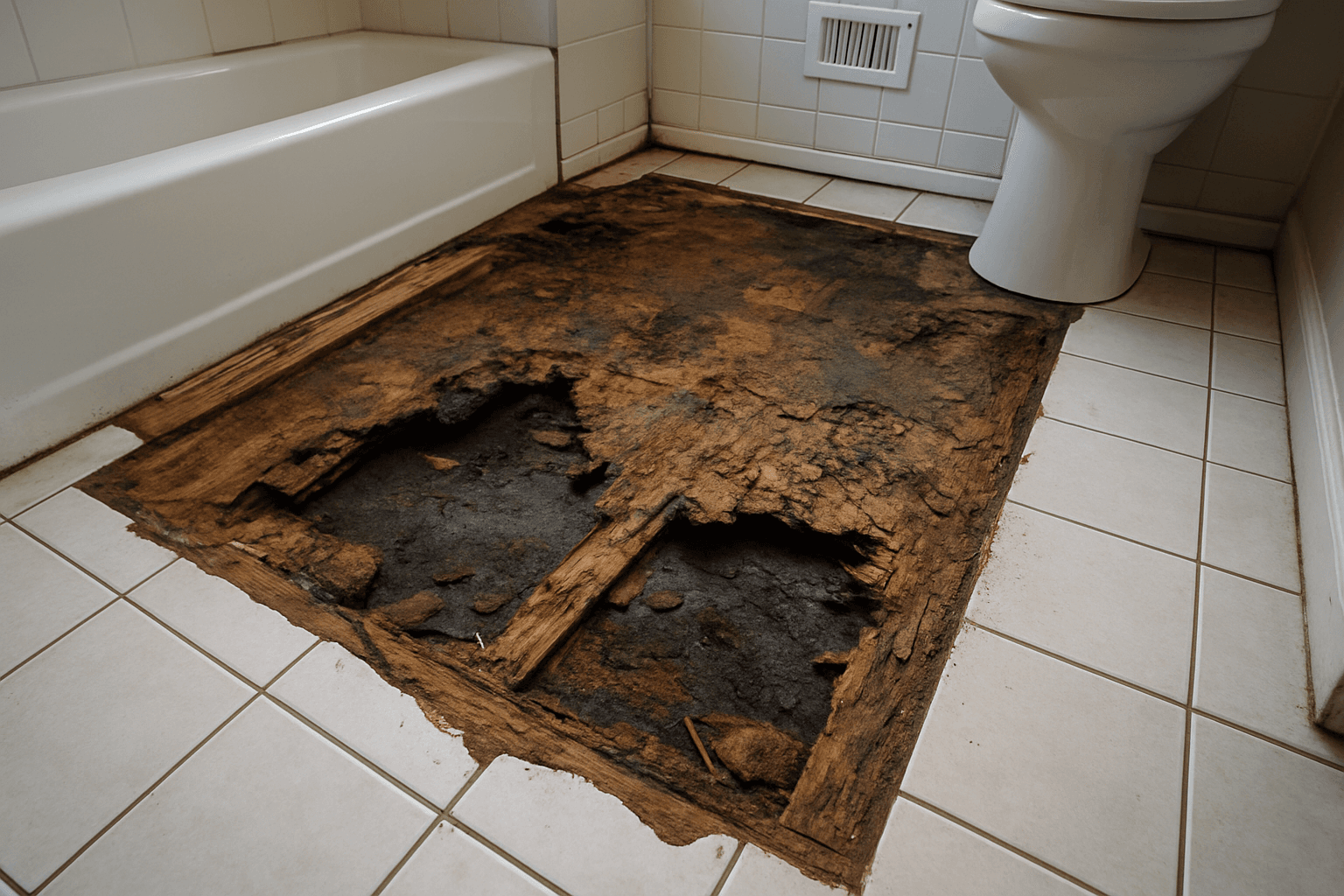
Caulk is the wrong fix when the problem is behind the tile. Tiles that sound hollow when tapped, crumbling grout, a wall that flexes when pressed, mold appearing through grout lines from behind, or a stain on the ceiling below the bathroom all point to water inside the wall or under the pan, and a fresh bead on the surface hides that while the damage continues. Renters should report recurring mold to the landlord before stripping anything, since the caulk may be a symptom of a leak the owner has to fix. Growth that has spread past about 10 square feet, onto drywall or a ceiling, is beyond what the EPA treats as a routine homeowner cleanup. In those cases, what you need is a leak diagnosis from a plumber or tile contractor, and possibly remediation, not a better tube of caulk.
A new bead stays clean as long as the shower dries out between uses. EPA guidance is to run the bathroom fan or open a window during every shower and to hold indoor humidity under 60%, with 30% to 50% as the ideal range. In practice that means the fan on during the shower and for about 20 minutes after, a squeegee across the walls and the tub ledge where water pools against the caulk, and the curtain or door left open so air reaches the corners. Check that the fan actually vents outdoors and is sized for the room; a weak fan leaves the caulk line wet for hours. In a windowless bathroom where moisture lingers anyway, a small dehumidifier helps. Wipe the bead with a mild cleaner every week or two so pink or black film never gets a hold.
Wait until the caulk has fully cured, which for most silicone means at least 24 hours, even when the tube says water-ready in 30 minutes.
The 30-minute figure covers a splash on a thin bead in mild conditions: Gorilla's no-caulk-gun sealant listing ties it to a 3/16 in bead at 70°F and 50% humidity and says to wait 24 hours otherwise. Acrylic takes longer, and DAP's Kwik Seal listing says 36 hours. A cool or humid bathroom slows every one of them.
A 100% silicone that makes a mold and mildew claim on its label, such as the Gorilla 100% Silicone Caulk 2.8 oz Squeeze Tube, whose listing claims 10-year resistance. Choose silicone over acrylic for any joint that stays wet.
The resistance protects the cured bead only, so it works when the old caulk was removed completely and the joint was cleaned and dried first. How long it stays clean after that depends mostly on ventilation.
NoNot over caulk that has mold in it or is peeling, and new silicone does not bond well to old silicone in any case.
A bead laid on top seals the old growth and any trapped water underneath it, and it tends to lift at the edges where it meets the old layer. Cut the old bead out completely, scrape off the residue, clean and dry the joint, and then caulk once.
Usually because it is growing under or inside the old bead, or because the shower never dries out between uses. Scrubbing bleaches the surface, but the colony in the gap behind loosened caulk survives and shows again within days.
Replace the bead after a full cleanout, then deal with the humidity: run the exhaust fan through the shower and for about 20 minutes after, and squeegee the tub ledge. If spots return through new caulk, look for a leak behind the tile.
Silicone is better for joints inside the shower, and acrylic is better where the bead will be painted. A tub-to-tile joint is soaked daily and moves a little every time the tub fills, and silicone keeps both its seal and its stretch under those conditions.
Acrylic latex tools more easily and usually takes paint, but it cures more slowly and wears faster where water stands. Many bathrooms use both: silicone at the tub and tile, acrylic where trim meets drywall.
For most healthy people a small patch on shower caulk is a repair job rather than an emergency, but it should not be left in place. The EPA notes that mold can cause allergic reactions and asthma attacks in sensitive people, and spots inside the bead mean water is getting behind it.
Color does not identify the species. Cut the caulk out, clean and dry the joint, and recaulk; growth over about 10 square feet calls for the EPA's guidance on larger cleanups.
Call (888) 840-6512. The line is answered 24 hours a day, seven days a week, and connects you with an IICRC-certified water damage restoration company that serves your area. A recorded menu picks up first: choose water damage or mold, key in your 5-digit ZIP code, and hold through the short silence while the call is passed to the company.
Describe what you can see — where the water is coming from, how long it has been there, and whether it smells — the more specific you are, the faster the right company is on the line. If the source is a pipe or an appliance, shut the main water valve first. Have four things ready and the call goes quickly: the address, when the water started, what is wet now, and whether you have filed an insurance claim.
Still not sure which of these is your situation? (888) 840-6512 · toll-free · answered 24/7
Methodology: How we source and verify data · Report an error
Free 2-day shipping
Amazon Prime members pay no shipping on restoration equipment
Dehumidifiers, air movers, and moisture meters qualify for free Prime delivery — bulk items that otherwise cost $15–$40 to ship.
Affiliate link — HearthDry earns a bounty if you sign up; costs you nothing extra.

Most black marks in a shower are stains sitting on tile and grout, and a bleach foam or gel removes them in minutes to hours. The marks that come back within weeks are living in the caulk, the grout pores or the ceiling paint, and those need cutting out, sealing or drying, not a stronger spray.
Read the comparisonIn a bathroom with mold, the exhaust fan is the thing to fix first, because it clears the steam before it condenses on the ceiling, the grout and the window. These picks are compared on the airflow and noise each listing states, humidity sensing and the duct each fan needs, alongside the sizing rule, the 20-minute habit and the attic-venting mistake that undoes any fan.
Read the comparisonA mold-killing primer kills the mold it coats and keeps new growth off its own film, but it cannot dry a wet wall or reach growth inside one. These picks are judged on that narrow job: sealing a bathroom, basement wall or window frame after the leak is fixed and the surface is clean and dry.
Read the comparisonAn exhaust fan ducted outdoors is the real fix for a steamy bathroom, and a plug-in dehumidifier is what you add when there is no fan or the one you have barely pulls. The units small enough for a bathroom remove ounces of water a day, so their job is drying the walls, ceiling and grout sooner after the steam clears, not clearing the steam.
Read the comparisonNo single product removes mold from a house; each one does one job, and the order you use them in matters more than the brand. This roundup picks the strongest product for each job, from killing growth on tile to sealing a cleaned ceiling, and says plainly what each one cannot do.
Read the comparisonGrout sealer keeps water and stains from soaking into cement grout, but only when it goes onto clean, dry grout with no mold in it, and it cannot fix cracked grout or a leaking shower pan. These five sealers are compared on what each listing states about type, coverage and resealing, alongside the water drop test and the grout arithmetic that tell you when to seal and how much to buy.
Read the comparisonWindow caulk seals the joint where the frame meets siding or trim, and the right type depends on whether that joint will be painted, how wide it is and how much it moves. These picks are compared on what each listing states about joint width, movement, rain-ready and paint-ready times, alongside where caulk belongs on a window, where it must never go, and the leaks it cannot stop.
Read the comparison