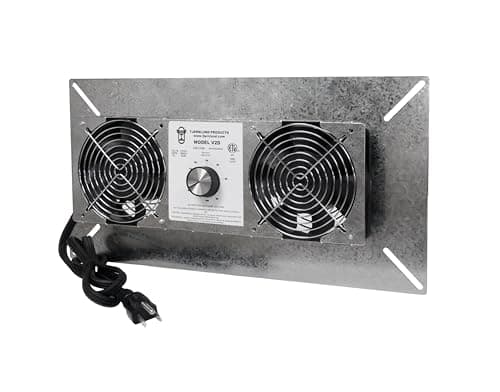
Best for: A vented crawl space under a small or mid-size house, in a climate with regular dry spells
- Airflow (stated):
- 220 CFM, exhaust (air out)
- Power (stated):
- 40 W
Listing verified 13 Oct 2026

Vent-Mounted Fans With Humidistats, and When Outside Air Makes the Crawl Space Wetter
4 picks compared · prices, ratings and stock checked October 12, 2026
Our Top Pick
For a vented crawl space that stays damp, the Tjernlund V2D UnderAire Crawlspace Ventilator: two fans moving 220 CFM on 40 W, with a thermostat and dehumidistat included per its listing. For a crawl space too big for 220 CFM, the ALORAIR VentirPro 540 moves 540 CFM through one 8.7 in fan.
4.5 on Amazon · 840 ratings
Quick answer
A crawl space ventilation fan is worth buying if your crawl space has open foundation vents, no standing water and outdoor air that is often drier than the air under the house, and for that job the Tjernlund V2D UnderAire Crawlspace Ventilator is the pick, rated 4.5 stars across 840 Amazon ratings. Its listing states 220 CFM on 40 W, two fans, a thermostat and a dehumidistat. In humid summer weather, outside air pulled into a cool crawl space can add moisture instead of removing it, which is why the humidistat matters. If the crawl space is sealed or encapsulated, buy a dehumidifier instead.
Every pick below is currently stocked — ratings and stock read from Amazon on 12 October 2026.
Best for: A vented crawl space under a small or mid-size house, in a climate with regular dry spells
Listing verified 13 Oct 2026
Best for: A standard foundation vent in a small or mid-size crawl space, where you want the control settings printed in numbers
Listing verified 13 Oct 2026
Best for: A large vented crawl space, or one with a single usable vent, in a climate with long dry spells
Listing verified 13 Oct 2026
Best for: A small or mid-size crawl space whose vent sits near a bedroom, deck or patio, where fan noise carries
Listing verified 13 Oct 2026
How this page was made: we compare the current Amazon listings, the makers' published specs and what verified buyers report, then rank by fit for the job. Ratings, review counts and stock are read from Amazon and dated. We earn a commission on purchases through our links; it does not change the order. Reviewed by Marcus Reed, IICRC-certified Water Restoration Technician.
Full Reviews
Each pick in detail: what the listing states, what buyers report, and where it falls short.
Check price
on Amazon ↗
Listing verified 13 Oct 2026
See it on Amazon ↗Best Overall
Quick Verdict
Tjernlund V2D UnderAire Crawlspace Ventilator: 220 CFM on 40 W with a thermostat and dehumidistat, the steady choice for a vented crawl space.
Key Specs
Airflow (stated)
220 CFM, exhaust (air out)
Power (stated)
40 W
Fans
Two fans on one face plate
Controls (stated)
Thermostat and dehumidistat included
Fit (stated)
Face plate sized for standard foundation vent openings; the listing mentions both brick and block foundations
Cord (stated)
Pre-wired; length is listed as 6 in, so confirm it before planning the outlet
Pros
Cons
Suited to
A vented crawl space under a small or mid-size house, in a climate with regular dry spells
Our take
The two numbers on this listing that matter are 220 CFM and 40 W. At 220 CFM, the fan exchanges the air in a 1,000 sq ft crawl space with 3 ft of headroom about every 14 minutes. At 40 W, it can run for weeks on very little power. What the listing leaves out matters as much: no humidistat range, no thermostat cutoff and no noise figure. Set the dehumidistat by watching a separate hygrometer for a week, not by the dial marks. Before mounting it, measure the vent opening, because the listing describes the face plate in terms of both brick and block foundations. Seal any gap around the plate, or the fan partly recirculates outside air at the vent instead of drawing air across the crawl space.
Affiliate link — commission at no extra cost to you
Compare elsewhere
These open a search for this model. We quote prices only where we can verify them — Amazon, Sylvane and eBay.
Check price
on Amazon ↗
Listing verified 13 Oct 2026
See it on Amazon ↗Best Dual-Fan Alternative
Quick Verdict
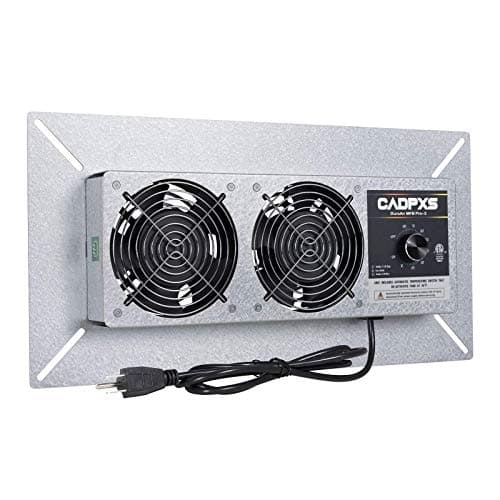
CADPXS Crawlspace Ventilation Fan: a 220 CFM dual-fan unit with its 20% to 80% RH and 35°F settings printed on the listing.
Key Specs
Airflow (stated)
220 CFM, air out
Size (stated)
18 x 9 x 2 in
Fans
Two
Humidistat (stated)
20% to 80% RH
Freeze cutoff (stated)
Will not run when outdoor temperatures fall below 35°F
Cord (stated)
6.56 ft grounded cord
Pros
Cons
Suited to
A standard foundation vent in a small or mid-size crawl space, where you want the control settings printed in numbers
Our take
Freeze cutoff is the spec to understand here. The listing says the dehumidistat will not run the fan when the thermostat senses outdoor temperatures below 35°F. That protects the water pipes under the floor: the American Red Cross lists supply pipes in unheated areas such as crawl spaces among those most at risk of freezing, and a fan pulling 220 CFM of winter air across them would make that worse. The 20% to 80% RH dehumidistat range covers every useful setting, though the low end is pointless under a house; a setting near 55% to 60% fits EPA's advice to keep indoor humidity below 60%. Its 18 x 9 x 2 in body suits a common block vent, but measure yours first, since the listing does not say the plate can be trimmed.
Affiliate link — commission at no extra cost to you
Compare elsewhere
Check price
on Amazon ↗
Listing verified 13 Oct 2026
See it on Amazon ↗Best for Large Crawl Spaces
Quick Verdict
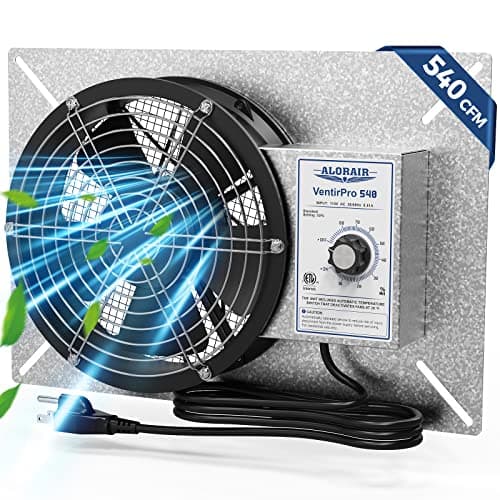
ALORAIR VentirPro 540: 540 CFM with a 10% to 80% RH humidistat and 35°F cutoff, for crawl spaces too large for 220 CFM.
Key Specs
Airflow (stated)
540 CFM, air out
Fan (stated)
One 8.7 in axial fan, IP-55 rated, with an isolation mesh on the back
Size (stated)
15 x 10.2 x 2.8 in; faceplate can be trimmed
Humidistat (stated)
10% to 80% RH
Freeze cutoff (stated)
Will not run when outdoor temperatures fall below 35°F
Electrical (stated)
115 V, 0.51 A
Pros
Cons
Suited to
A large vented crawl space, or one with a single usable vent, in a climate with long dry spells
Our take
Airflow is why this one is here. At 540 CFM, the fan turns over the air in a 2,000 sq ft crawl space with 3 ft of headroom about every 11 minutes, against about 27 minutes for the 220 CFM picks. That speed helps when the outside air is dry, because the crawl space dries faster. It cuts the other way in a humid spell, when the fan brings in moisture faster as well, so treat the 10% to 80% RH humidistat as essential rather than a nice extra. ALORAIR does not say whether 540 CFM was measured in free air or through the faceplate and mesh, so expect less once it is mounted. Its listed 0.51 A draw is small enough to share a circuit, but the outlet still needs GFCI protection.
Affiliate link — commission at no extra cost to you
Compare elsewhere
Check price
on Amazon ↗
Listing verified 13 Oct 2026
See it on Amazon ↗Quietest
Quick Verdict
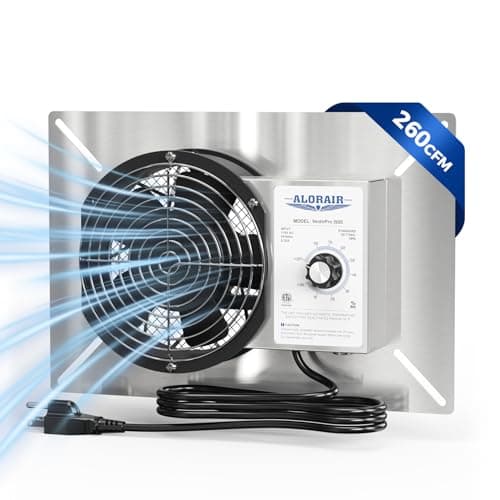
ALORAIR VentirPro 260S: a stainless 260 CFM fan with the lowest stated noise here, under 40 dB.
Key Specs
Airflow (stated)
260 CFM, air out
Noise (stated)
Under 40 dB
Housing (stated)
Stainless steel, IP-55 rated axial fan
Size (stated)
13.4 x 9.1 x 2.5 in; faceplate can be trimmed
Humidistat (stated)
10% to 80% RH
Freeze cutoff (stated)
Factory thermostat stops the fan below 35°F outdoors
Pros
Cons
Suited to
A small or mid-size crawl space whose vent sits near a bedroom, deck or patio, where fan noise carries
Our take
Stated noise is the reason to pick this ALORAIR over the larger one. Under 40 dB against under 55 dB is a big step, since a common rule of thumb is that every 10 dB sounds about twice as loud, and a fan on a humidistat may run through the night all summer. The stainless housing is the other difference from the aluminum-zinc VentirPro 540. At 260 CFM it exchanges the air in a 1,000 sq ft, 3 ft high crawl space about every 12 minutes, enough for a space that is damp rather than wet. The body is 13.4 x 9.1 in, so measure the vent opening, then trim the faceplate or close any gap around it so the fan draws air from across the crawl space rather than from the edges of the vent.
Affiliate link — commission at no extra cost to you
Compare elsewhere
What to know before you buy.
A vent fan swaps the air under your house for outside air. That only helps when the outside air holds less water than the air it replaces. The number that tells you is dew point, the temperature at which air starts to drop water as condensation. On a humid summer afternoon, outdoor air at 88°F can carry a dew point of 72°F. The soil keeps a crawl space cool, so joists, ducts and the underside of the floor may sit near 68°F to 70°F. Pull that outdoor air across them and it cools below its dew point, and water beads on the wood. In that weather, the fan adds moisture. The same fan works well in spring, fall and dry spells, when outdoor dew points sit below the crawl space surface temperatures. Put one hygrometer in the crawl space and another outside, and compare them through a week of typical weather before you buy.
Every pick here has a built-in dehumidistat, and three of the four listings print its range. It switches the fan on when the air at the fan rises above your setting and off when it drops below, which stops the fan running all day in a crawl space that is already dry. What it cannot do is compare the air inside with the air outside. None of these listings says the control reads outdoor humidity, so on a muggy day a damp crawl space keeps the fan running while it pulls in wetter air. Two habits close that gap. Set the dial near 55% to 60% rather than at the bottom of its range, in line with EPA's advice to keep indoor humidity below 60 percent. And during long humid stretches, read your hygrometers; if the crawl space reading climbs while the fan runs, switch the fan off.
Work out the crawl space volume first: length times width times average height. A 40 x 50 ft crawl space with 3 ft of headroom holds 6,000 cubic feet. Divide that by the fan's CFM to get the minutes it takes to replace all the air once: about 27 minutes at 220 CFM, about 11 at 540 CFM. There is no single correct rate, and faster is not automatically better, since a bigger fan also brings in humid air faster on bad days. A reasonable split is a 220 to 260 CFM fan under a small or mid-size house, and a 540 CFM fan for a large crawl space or a long, narrow one with only one usable vent. Two cautions apply. None of these listings says whether its CFM was measured through the mounted faceplate and mesh, and a fan with no open vent on the far side moves far less air than its rating.
All four picks are air-out fans: they mount inside a foundation vent and push crawl space air outdoors. The replacement air has to come from somewhere, so leave at least one vent open on the far side, ideally across the longest dimension of the crawl space. If every other vent is closed, the fan draws its replacement air from the house above through gaps around pipes and ducts, which pulls heated or cooled air into the crawl space and wastes energy. Seal the edges of the faceplate so the fan does not simply recirculate outdoor air at the vent. Plug it into a GFCI-protected outlet, which the National Electrical Code calls for on crawl space receptacles, and keep the cord off wet soil. If a gas furnace or water heater sits in the crawl space, ask an HVAC technician before adding any exhaust fan, because lowering the air pressure around a natural-draft appliance can pull flue gases back down its vent.
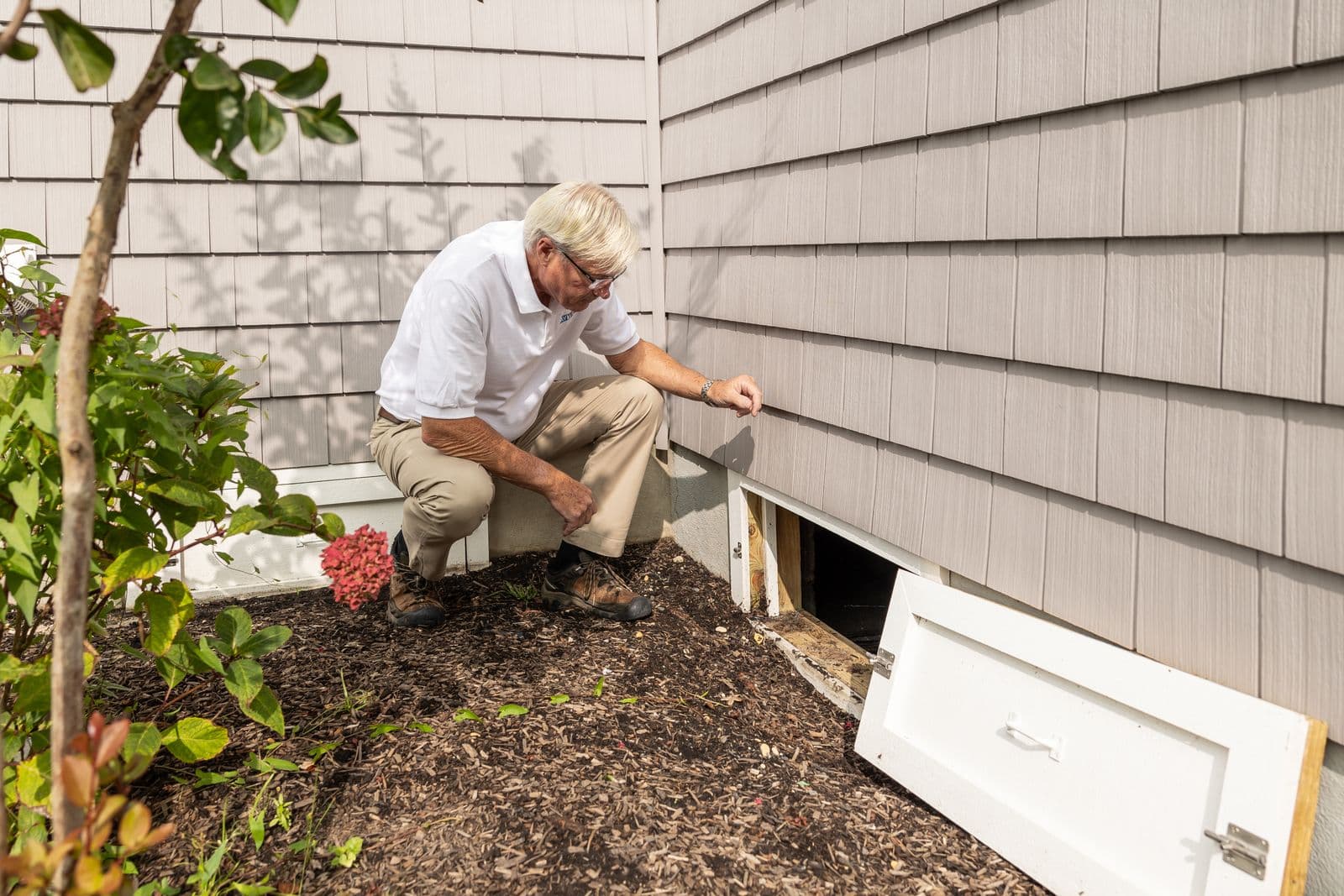
Skip the fan if the crawl space is sealed or encapsulated. Those designs close the vents on purpose and use a dehumidifier, and a fan cut into one undoes the seal. If water stands on the soil after rain, a fan is the wrong first step; the water has to go first, through gutters, downspouts, grading and sometimes a sump pump. EPA's advice is to make sure the ground slopes away from the foundation so water does not enter or collect around it. Bare soil comes next: a vapor barrier stops ground moisture that a fan can only chase once it is in the air. In a humid climate where the crawl space is damp mainly in summer, a sealed crawl space with a dehumidifier usually holds humidity more steadily than outside air can. And if mold covers more than about 10 square feet of joists, EPA treats that as more than a routine homeowner job, so the cleanup comes before the fan.
Two of these listings say the fan vents radon along with wood treatment gases and odors. Treat the radon claim with care. A vent fan changes the air in the crawl space, but no listing here states a measured radon reduction, and moving air is not the same as a mitigation system designed and checked for your house. The only way to know your level is to test, before and after any change. EPA's guidance is to fix the home when radon is 4 pCi/L or higher and to consider fixing between 2 and 4 pCi/L, and it points homeowners to their state radon program to find credentialed mitigation professionals. Musty odors are a fairer test of a crawl space fan. If the smell fades as the space dries out, the fan is doing its work; if it stays, look for mold on the joists, wet insulation or a slow plumbing leak.
YesWhen the outside air is drier than the crawl space air and there is no standing water. A fan replaces damp crawl space air with outdoor air, so it dries the space in spring, fall and dry spells.
In humid summer weather, outdoor air can condense on cool joists and add moisture. A fan also cannot keep up with water pooling on the soil or a leaking pipe; those need fixing first, and a sealed crawl space needs a dehumidifier instead.
Out, for moisture control. All four picks here are air-out fans that mount inside a foundation vent and push crawl space air outdoors, with fresh air coming in through an open vent on the far side.
Blowing air in pushes crawl space air up into the house through gaps in the floor, musty odor included. Keep at least one vent open opposite the fan so the replacement air comes from outside rather than from your living space.
Divide your crawl space volume by the fan's CFM to see how many minutes one full air change takes. A 1,500 sq ft crawl space with 3 ft of headroom holds 4,500 cubic feet, so a 220 CFM fan replaces that air about every 20 minutes and a 540 CFM fan about every 8.
A 220 to 260 CFM fan suits most small and mid-size crawl spaces; choose 540 CFM for a large space or a long, narrow one with a single usable vent.
Only above freezing, which is what the freeze cutoff is for. The CADPXS and both ALORAIR listings say a factory thermostat stops the fan when outdoor temperatures fall below 35°F.
That protects the supply pipes under the floor, which the American Red Cross lists among the pipes most at risk of freezing. Cold air holds little water, so on mild winter days above the cutoff a fan can still help dry a damp crawl space.
A dehumidifier is better in a sealed crawl space or a humid climate, and a fan is the simpler fix in a vented crawl space where the outdoor air is often dry. A fan can only bring in outdoor air, so the weather limits it.
A dehumidifier removes water from the air already under the house, whatever the weather, but it needs the vents closed and ideally a vapor barrier on the soil. If your crawl space reads above 60% for most of the summer with a fan running, switch approaches.
Start near 55% to 60% relative humidity and adjust after a week of readings. EPA advises keeping indoor humidity below 60 percent, and a crawl space feeds air into the rooms above it.
Setting the dial at the bottom of its range keeps the fan running almost constantly, including in muggy weather when it brings moisture in. Check the setting against a separate hygrometer, since none of these listings describes its dial markings as calibrated.
Call (888) 840-6512. The line is answered 24 hours a day, seven days a week, and connects you with an IICRC-certified water damage restoration company that serves your area. A recorded menu picks up first: choose water damage or mold, key in your 5-digit ZIP code, and hold through the short silence while the call is passed to the company.
Describe what you can see — where the water is coming from, how long it has been there, and whether it smells — the more specific you are, the faster the right company is on the line. If the source is a pipe or an appliance, shut the main water valve first. Have four things ready and the call goes quickly: the address, when the water started, what is wet now, and whether you have filed an insurance claim.
Still not sure which of these is your situation? (888) 840-6512 · toll-free · answered 24/7
Methodology: How we source and verify data · Report an error
Free 2-day shipping
Amazon Prime members pay no shipping on restoration equipment
Dehumidifiers, air movers, and moisture meters qualify for free Prime delivery — bulk items that otherwise cost $15–$40 to ship.
Affiliate link — HearthDry earns a bounty if you sign up; costs you nothing extra.

A damp crawl space feeds mold and wood rot in the framing above it. These four crawl space dehumidifiers are ranked on published specifications, buyer records and how honestly each states its capacity for the cool, damp conditions under a house.
Read the comparisonA properly installed vapor barrier is the most cost-effective way to keep ground moisture out of a crawl space, and most failures come from thin film and untaped seams rather than the wrong brand. This guide compares 6-mil, 10-mil and 20-mil woven liners on the specifications you can actually check, and covers the tape and overlaps that decide whether the barrier works.
Read the comparisonA hygrometer is the small, inexpensive instrument that tells you whether a room needs a dehumidifier, a humidifier or nothing at all. These picks are judged on the accuracy each listing states, how easily you can read them, and whether they can warn you about a damp basement before you smell it.
Read the comparisonA powered attic fan lowers attic heat only when the soffit vents can feed it and the ceiling below is sealed; otherwise it pulls cooled air and moisture up from the rooms and can upset gas appliance flues. These picks are compared on what each listing states about airflow, watts, thermostats and humidistats, with the sizing arithmetic for fan and intake and the moisture fixes that come first.
Read the comparison