
Quick answer
Hidden water damage announces itself before you see it: a musty smell that returns, paint bubbling or peeling in patches, warped or spongy flooring, discolored drywall seams, cold spots on walls, unexplained increases in the water bill, and warped baseboards. A moisture meter turns any of these from a suspicion into a number, and thermal imaging maps how far the water travelled. Call (888) 840-6512 to reach a certified water damage restoration company in your area; the line is answered 24/7.
Written & reviewed by Marcus ReedIICRC WRT
Reviewed June 28, 2026· Next review Dec 2026
Hidden Water Damage: 11 Signs Inside Your Walls and Under Your Floors
Most serious water damage is not dramatic flooding — it is a slow pipe leak or chronic moisture intrusion that goes undetected for weeks or months until a professional inspection, a musty smell that won't go away, or a soft spot in the floor finally forces the issue.
By the time hidden water damage becomes obvious to the homeowner, it has almost always caused structural damage, mold growth, or both. Here are the 11 signs that restoration professionals check first.
Why Hidden Water Damage Happens
Water follows the path of least resistance. A dripping pipe inside a wall first saturates the framing around it, then wicks into insulation, then spreads along the subfloor, then appears as staining on the drywall surface — often weeks or months after the initial leak began. By the time the stain is visible, the damage behind the wall can be extensive.
Common sources of hidden water damage:
- Slow supply line leaks inside walls at fittings or elbows
- Drain pipe leaks at connections inside floors and walls
- Roof flashing failures that allow slow moisture intrusion over months
- AC condensate pans that overflow slowly without triggering the shutoff float
- Shower and tub tile grout failures allowing water into wall cavities during every use
The 11 Signs Professionals Look For
1. Musty or earthy smell that doesn't go away
Mold produces volatile organic compounds (MVOCs) as it grows. These compounds have a distinct earthy, musty odor that penetrates drywall and cannot be eliminated by air fresheners. If a room consistently smells musty — especially after being closed for a few days — professional moisture testing is warranted.
2. Soft spots or springiness in flooring
Step across your hardwood, tile, or vinyl flooring slowly and feel for areas that give slightly underfoot. This "springiness" indicates saturated subfloor material — OSB or plywood subfloor that has absorbed water loses its rigidity before it becomes visibly damaged. This is often the first detectable sign of a leak under the floor.
3. Discoloration or staining on walls and ceilings
Brown ring stains on ceilings are classic roof leak or pipe leak indicators. On walls, look for discoloration along the baseboard, around electrical outlets, or at ceiling-wall junctions. The stain's location often tells you where the water is running, not necessarily where the leak source is.
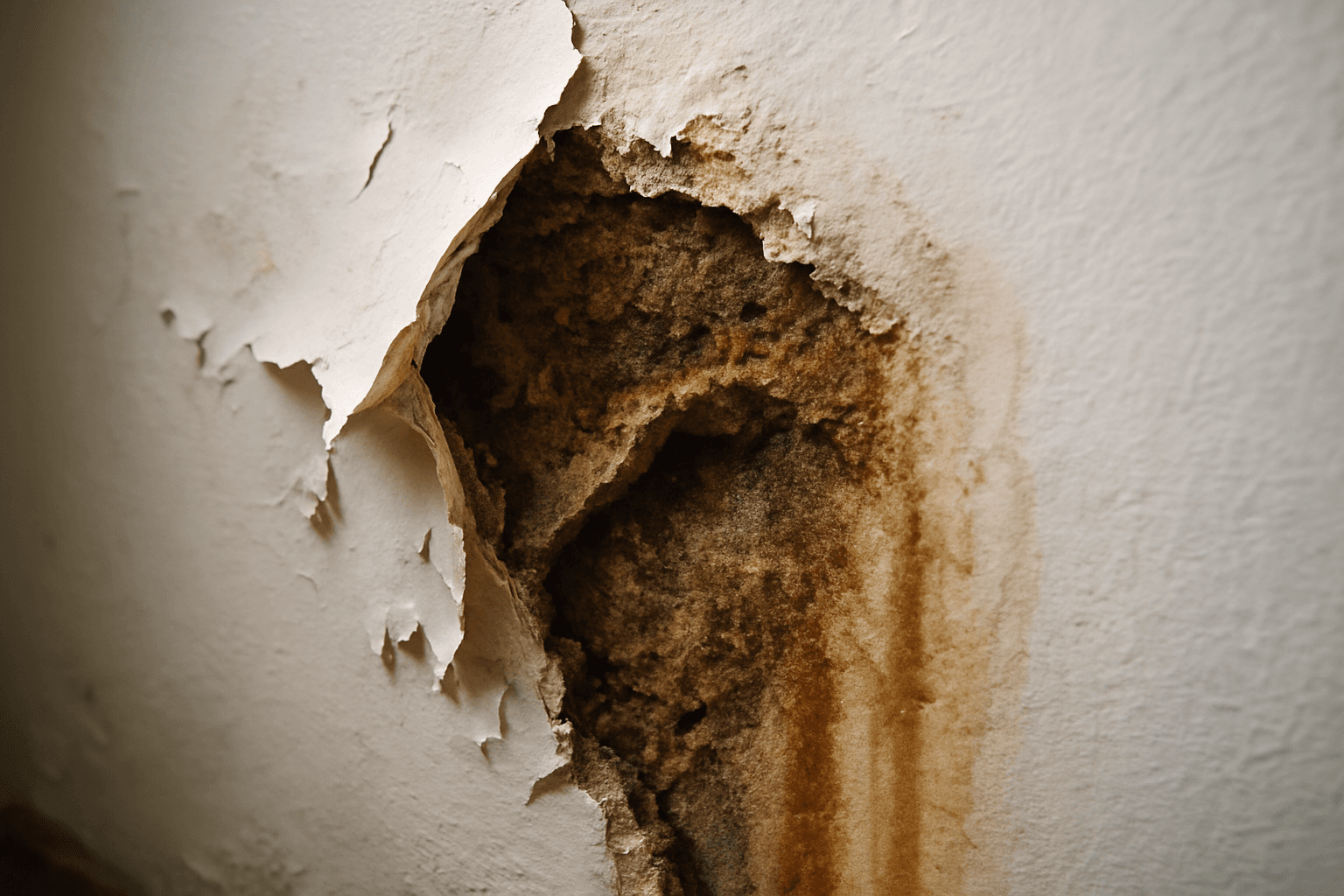
4. Paint bubbling, peeling, or blistering
Moisture trapped behind paint causes it to lose adhesion to the substrate. Bubbling or blistering paint — particularly in areas away from direct water exposure — indicates moisture is coming from within the wall, not from surface contact.
5. Warped or buckling hardwood floors
Hardwood floor boards absorb moisture from below (subfloor) or above (surface spills) and expand. Warping, cupping (edges raised, center low), or crowning (center raised, edges low) indicates moisture imbalance. A simple moisture meter reading can distinguish seasonal humidity changes from active water damage.
6. Grout or caulk discoloration in bathrooms
Shower and tub grout and caulk that shows persistent dark staining — especially black — is almost always active mold growth feeding on chronic moisture intrusion. Failed grout allows water to reach the substrate with every shower. A shower wall that has had failed grout for more than a few months likely has saturated substrate and mold behind the tile.
7. Doors and windows that stick or won't close properly
Wood door frames and window frames swell when their framing absorbs moisture. A door or window that has recently started sticking without any obvious seasonal temperature change can indicate water damage in the surrounding framing — often from a nearby pipe leak or exterior moisture intrusion.
8. Rust stains on walls, ceilings, or fixtures
Rust streaking on walls, particularly around nail or screw locations, indicates that the fasteners behind the wall surface have been wet. This requires moisture contact, not just humidity — it points to active or recent water saturation.
9. Visible mold growth on surfaces
Any visible mold growth — black spots, white fuzzy growth, orange or pink staining on grout — indicates that moisture conditions are sufficient to sustain mold. Visible surface mold is almost always accompanied by substantially larger mold colonies hidden behind the surface.
10. Unexplained increases in water bills
A sudden unexplained increase in water usage — particularly if you haven't changed your household habits — can indicate an active hidden leak. Use your meter: shut off all water in the house and read the meter. Wait 2 hours. Read the meter again. If the number has changed, you have an active leak somewhere in the system.
11. Sounds of dripping or running water when no fixtures are in use
Listen in your home during a quiet period. Sounds of running water, dripping, or water movement when all fixtures are off indicates an active leak. Track the sound to its origin — often you can narrow it down to a specific wall or floor area.
What to Do If You Find Hidden Water Damage
- 1Do not open walls yourself. Disturbing mold-contaminated drywall without HEPA containment spreads spores throughout the home.
- 2Call a restoration company for a professional moisture assessment. Thermal imaging cameras and calibrated moisture meters can map hidden moisture without destructive opening.
- 3Document everything before any work begins — photos, videos, moisture meter readings.
- 4Call your insurer — if the source is a pipe leak or appliance failure, this may be a covered event.
Do not wait. Mold doubles in biomass every 4–8 hours under favorable conditions. A 10-square-foot mold colony behind a wall becomes a 40-square-foot colony within 24 hours if conditions are right. The cost of professional assessment is a fraction of the remediation cost if hidden damage is left undiscovered.
Talk to a water damage pro now
Answered 24/7 · Toll-free · answered 24/7 · no obligation
(888) 840-6512- Describe the damage & give your ZIP
- You're routed to the on-call local crew
- They quote — you decide, no obligation
Reading to confirm what you already suspect?
Confirm it in two minutes instead — the pro on this line answers questions about YOUR situation all day: what it is, what it should cost, whether you even need service. If you want, they'll set the appointment on the same call.
Toll-free · no obligation · asking costs nothing
Frequently Asked Questions
- 1musty or earthy smell with no visible mold -- spores release VOCs before visible growth
- 2soft or spongy drywall to the touch
- 3paint bubbling, peeling, or blistering
- 4baseboards separating from walls or swelling
- 5subtle discoloration or staining without an obvious source. A moisture meter applied to drywall surfaces above 17% indicates active moisture. Thermal imaging cameras (rentable) can detect temperature differences indicating wet insulation or framing behind finished walls.
- 1Thermal imaging (infrared cameras) — wet materials cool as water evaporates, creating detectable temperature differentials vs. dry surrounding materials. Particularly effective for active leaks and recently wet areas; less effective for dried-but-stained areas
- 2Pinless moisture meters — measure electrical impedance through wall surfaces to detect moisture in cavities behind drywall without penetration. Calibrated against material baselines (a dry drywall section in an unaffected area)
- 3Acoustic leak detection — uses amplified listening devices to locate running or dripping water inside walls, particularly effective for active supply line leaks. After non-destructive mapping, targeted inspection openings (1–2 inch probe holes at meter-detected hot spots) confirm findings before committing to full wall opening. This approach minimizes unnecessary demolition and gives your insurance adjuster documentation showing that wall opening was diagnostically necessary — not speculative. Request the thermal scan report and moisture map before authorizing any demolition; this documentation also supports your supplement claim for additional scope discovered inside walls.
What are the first signs of hidden water damage in walls?
The earliest signs of hidden water damage in walls include:
How do I find a hidden water leak behind my walls?
Step 1: Check your water meter. Turn off all water in the house and watch the meter dial for 15 minutes. If it moves, you have a leak. Step 2: Inspect under sinks and around appliances for dampness. Step 3: Check your water bill for unexplained increases (50+ extra gallons/day suggests a significant leak).
Step 4: Use a moisture meter on walls in areas adjacent to plumbing. Step 5: Listen for dripping sounds when all water is off. A licensed plumber with a leak detection camera can locate most hidden leaks without demolition.
Can I have water damage under my floors without knowing?
YesSubfloor water damage can be extensive and invisible for months.
Common signs: flooring that feels soft or bounces when walked on, cupping or buckling in hardwood, grout cracking or tiles loosening, musty smell from below, unexplained termite or ant activity (insects are attracted to wet wood). Water can travel horizontally 6-8 feet from a source before becoming visible. A moisture meter probe inserted through small drill holes into the subfloor can confirm hidden moisture without major demolition.
How much hidden water damage is too much to repair?
The economic threshold typically shifts when structural members (joists, sill plates, wall studs) have active rot or mold penetration exceeding 10% of the material. Surface moisture in drywall or subfloor caught within 24-48 hours is almost always worth drying.
Once framing is compromised, mold has colonized insulation, or there is extensive subfloor rot, replacement is more cost-effective than salvage. A licensed restoration company can use probes and thermal imaging to map damage extent before committing to a demolition-heavy approach.
How do professionals find water damage hidden inside walls without opening them up?
Professional leak detection uses three non-destructive methods before any wall opening:
Who do I call right now for water damage?
Call (888) 840-6512. The line is answered 24 hours a day, seven days a week, and connects you with an IICRC-certified water damage restoration company that serves your area. Describe what you can see — where the water is coming from, how long it has been there, and whether it smells — the more specific you are, the faster the right company is on the line.
If the source is a pipe or an appliance, shut the main water valve first. Have four things ready and the call goes quickly: the address, when the water started, what is wet now, and whether you have filed an insurance claim.
Still not sure which of these is your situation? (888) 840-6512 · toll-free · answered 24/7
Sources
- IICRC S500 — Water Damage Restoration(retrieved 2026-07-02)
- EPA — Mold and Water Cleanup Guidance(retrieved 2026-07-02)
Methodology: How we source and verify data · Report an error
Disclaimer: HearthDry is an independent educational resource. This article is for informational purposes only and does not constitute professional, legal, or insurance advice. Consult licensed professionals before making decisions about your property or insurance claims.
Professional Equipment
Find Hidden Moisture Before It Becomes Mold
The only way to confirm hidden water damage in walls and floors is with a moisture meter or thermal camera. Pin-type meters detect moisture through paint; IR cameras reveal cold wet spots that dry surfaces hide.
Affiliate link — HearthDry earns a commission from Sylvane via CJ at no extra cost to you
Watch
Source: Aqviz Waterproofing — YouTube
Free 2-day shipping
Amazon Prime members pay no shipping on restoration equipment
Dehumidifiers, air movers, and moisture meters qualify for free Prime delivery — bulk items that otherwise cost $15–$40 to ship.
Affiliate link — HearthDry earns a bounty if you sign up; costs you nothing extra.
Equipment
What each machine actually does
Removes the moisture the structure is still giving off — the machine that decides how long drying takes
See the picks →Moves air across wet surfaces so the dehumidifier has something to take out of the air
See the picks →Finds water behind walls and under floors, and tells you when a material is actually dry
See the picks →Alerts you the moment a leak starts — the cheapest thing on this list and the only preventive one
See the picks →Those pages carry affiliate links. As an Amazon Associate, HearthDry earns from qualifying purchases; it costs you nothing extra.
Our Amazon storefront →Advertisement
