Best HEPA Vacuums in 2026 — Sealed Machines for Mold and Dust Cleanup, Wet/Dry Shop Vacs, and What a HEPA Label Does Not Promise

Best HEPA Vacuums in 2026

Sealed Machines for Mold and Dust Cleanup, Wet/Dry Shop Vacs, and What a HEPA Label Does Not Promise

5 picks compared · prices, ratings and stock checked October 12, 2026

Our Top Pick

For HEPA vacuuming around the house, the Shark Navigator Lift-Away NV356E, whose listing gives a filtration figure for the whole vacuum rather than the filter alone. For a basement where you also have water to pick up, the WEN VC4710 5-Gallon HEPA Wet/Dry Shop Vacuum, with the filter caveat explained in its card.

4.3 on Amazon · 42,435 ratings

Quick answer

If you need a HEPA vacuum for dust and mold cleanup in the house, choose a sealed machine whose listing states a filtration figure for the whole vacuum, such as the Shark Navigator Lift-Away NV356E, rated 4.3 stars across 42,435 Amazon ratings. Shark states it traps 99.9% of dust and allergens 0.3 microns and larger in an ASTM F1977 test of the complete vacuum. After mold, dry the area first: EPA guidance treats HEPA vacuuming as the final cleanup step once materials are thoroughly dried. The vacuum lifts settled spores and dust; it does nothing about the moisture that grew the mold.

Our Picks at a Glance

Every pick below is currently stocked — ratings and stock read from Amazon on 12 October 2026.

Best Overall
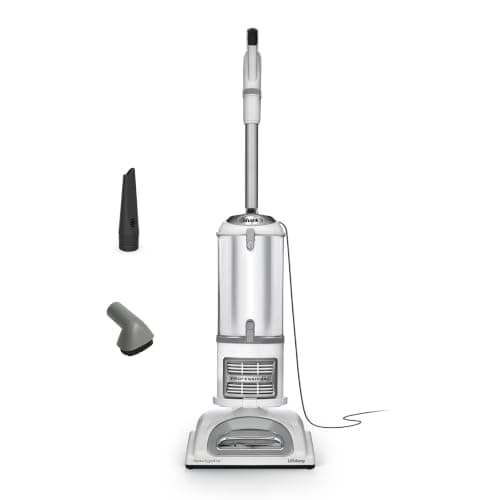
Shark Navigator Lift-Away NV356E Upright Vacuum (HEPA Filter, Anti-Allergen Complete Seal, Bagless)
4.3 from 42,435 Amazon ratings · checked 12 OctAmazon's Choice

Best for: Whole-house HEPA vacuuming of floors, rugs, stairs and baseboards once a damp room has been cleaned and dried

Type:
Bagless upright with a detachable Lift-Away pod
Filtration claim (stated):
Traps 99.9% of dust and allergens 0.3 microns and larger, per ASTM F1977-22, a test of the whole vacuum system, run by IBR Laboratories in 2024

Listing verified 13 Oct 2026

How this page was made: we compare the current Amazon listings, the makers' published specs and what verified buyers report, then rank by fit for the job. Ratings, review counts and stock are read from Amazon and dated. We earn a commission on purchases through our links; it does not change the order. Reviewed by Marcus Reed, IICRC-certified Water Restoration Technician.

Full Reviews

Each pick in detail: what the listing states, what buyers report, and where it falls short.

#1
Best Overall

Check price

on Amazon ↗

Listing verified 13 Oct 2026

Shark Navigator Lift-Away NV356E Upright Vacuum (HEPA Filter, Anti-Allergen Complete Seal, Bagless)See it on Amazon ↗

Quick Verdict

Shark Navigator Lift-Away NV356E: a sealed bagless upright with a stated whole-vacuum filtration test, for dry cleanup around the house.

Key Specs

Type

Bagless upright with a detachable Lift-Away pod

Filtration claim (stated)

Traps 99.9% of dust and allergens 0.3 microns and larger, per ASTM F1977-22, a test of the whole vacuum system, run by IBR Laboratories in 2024

Seal (stated)

Anti-Allergen Complete Seal working with a HEPA filter

Dust cup (stated)

0.87 L

Filter care (stated)

Washable HEPA filter; rinse until the water runs clear, then air dry for 24 hours

Brushroll (stated)

Can be switched off for hard floors

Pros

  • Gives a filtration figure for the whole machine, tested to ASTM F1977, not just a rating for the filter
  • The Lift-Away pod comes off for shelves, baseboards and stairs, where settled dust collects after a cleanup
  • Brushroll shutoff lets it clean bare concrete and hard floors without scattering grit
  • The HEPA filter is washable, so routine care needs no replacement filter

Cons

  • Bagless, so emptying the cup releases some dust; do it outdoors with a mask on
  • A washed filter needs a full day to air dry, which leaves the vacuum idle unless you keep a spare
  • A household upright for dry debris only; standing water and wet carpet need a wet/dry vac

Suited to

Whole-house HEPA vacuuming of floors, rugs, stairs and baseboards once a damp room has been cleaned and dried

Our take

The most useful line on this listing is the footnote. Shark says its 99.9% figure comes from ASTM F1977, a method that measures what gets out of the complete vacuum, run by IBR Laboratories in 2024. That matters because a good filter inside a leaky housing lets fine dust escape through gaps and seams. The figure is 99.9%, not the 99.97% used to define a HEPA filter, and the two come from different tests, so do not read them as one claim. In a room that had mold, use it after the moldy material is gone and the surfaces are dry, and tip the cup into a trash bag outside.

Check today's price on Amazon →

Affiliate link — commission at no extra cost to you

Compare elsewhere

These open a search for this model. We quote prices only where we can verify them — Amazon, Sylvane and eBay.

#2
Best Wet/Dry Shop Vac

Check price

on Amazon ↗

Listing verified 13 Oct 2026

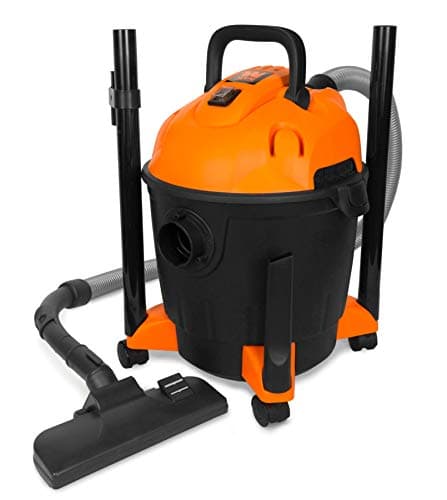
WEN VC4710 5-Gallon Portable HEPA Wet/Dry Shop Vacuum and Blower (10 Amp, 0.3 Micron Filter)See it on Amazon ↗

Quick Verdict

WEN VC4710 5-Gallon HEPA Wet/Dry Shop Vacuum: one compact machine for water and fine dust, though its filter claim stops short of a stated HEPA efficiency.

Key Specs

Type

Wet/dry shop vacuum that doubles as a blower

Tank (stated)

5 gallons

Motor (stated)

10 amps

Filter (stated)

F9 HEPA filter for particles as small as 0.3 microns

Capture percentage

Not stated on the listing

Hose and tools (stated)

5 ft hose, two extension tubes, a utility nozzle and a crevice nozzle

Pros

  • Picks up water and dry debris, so one machine handles a wet basement floor and the dust after it dries
  • Names a 0.3 micron particle size for its filter, which basic shop vac cartridges do not
  • Compact body and carrying handle suit a basement or utility closet
  • Onboard storage keeps the nozzles with the vacuum

Cons

  • The listing calls the filter both F9 and HEPA but gives no capture percentage, and F9 is a fine-dust grade rather than a HEPA grade
  • A shop vac fitted with a HEPA-type filter is not necessarily sealed around it, a point EPA makes about renovation work
  • The 5 ft hose is short for reaching across a large basement

Suited to

A basement or garage where you need to pick up water first and fine dust later, with one compact machine

Our take

This is the practical pick rather than the strictest one. WEN describes an F9 HEPA filter for particles down to 0.3 microns but gives no capture percentage, and F9 is a fine-dust class on the older European EN 779 scale, below the H grades used for HEPA filters. EPA's lead-safe renovation guidance makes a related warning: a shop vacuum fitted with a HEPA filter is not necessarily sealed so that all the air passes through it. Use it for water and general dust. After a mold cleanup, empty the tank outdoors, then wash and dry the tank, hose and nozzles, because spores cling to damp surfaces.

Check today's price on Amazon →

Affiliate link — commission at no extra cost to you

#3
Best for Renovation Dust

Check price

on Amazon ↗

Listing verified 13 Oct 2026

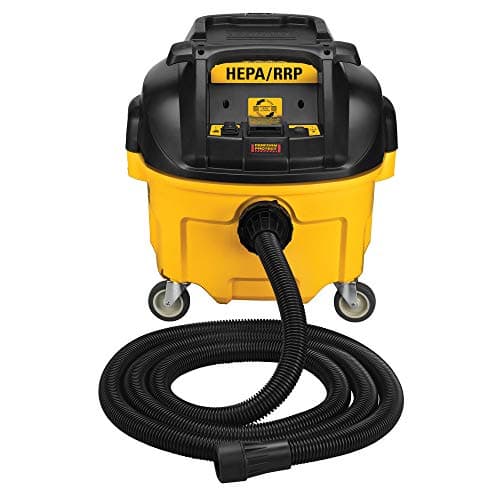
DEWALT DWV010 8-Gallon HEPA Dust Extractor (Automatic Filter Cleaning, 150 CFM)See it on Amazon ↗

Quick Verdict

DEWALT DWV010 8-Gallon HEPA Dust Extractor: renovation-grade, with RRP compliance stated when DWV9330 filters are fitted.

Key Specs

Type

HEPA dust extractor

Tank (stated)

8 gallons

Airflow (stated)

150 CFM from a 15 amp motor

Filter cleaning (stated)

Automatic pulse every 30 seconds

EPA RRP rule (stated)

Meets the EPA lead renovation (RRP) rule for HEPA vacuums only when DWV9330 filters are used

Hose (stated)

15 ft anti-static hose, 1.25 in diameter

Pros

  • Ties its HEPA claim to the EPA renovation rule, which requires all intake air to leave through the HEPA filter
  • The filter pulses itself clean every 30 seconds, so suction holds up through fine drywall and plaster dust
  • Starts and stops with a connected power tool, catching dust at the cut when damaged drywall comes out
  • A 15 ft hose reaches across most rooms from one spot

Cons

  • The RRP claim holds only with DWV9330 filters fitted, so check which filter is installed
  • Built around tool dust collection; the listing bullets mention no floor or upholstery tools
  • The bullets do not say whether it can pick up water

Suited to

Cutting out and cleaning up damaged drywall, trim or plaster during repairs, where fine dust has to be caught at the source

Our take

DEWALT's HEPA claim comes with a condition, which is a good sign rather than a weakness: the listing says the extractor meets EPA's lead renovation rule for HEPA vacuums only when DWV9330 filters are fitted. That rule defines a HEPA vacuum as one where all the air drawn in leaves through the HEPA filter, with none leaking past it, the sealing question most household labels skip. The automatic pulse keeps the filter from clogging during long sessions. After a leak, it earns its place twice: attached to the saw while wet drywall is cut out, then for the final pass once the room has dried.

Check today's price on Amazon →

Affiliate link — commission at no extra cost to you

#4
Best Lightweight Stick

Check price

on Amazon ↗

Listing verified 13 Oct 2026

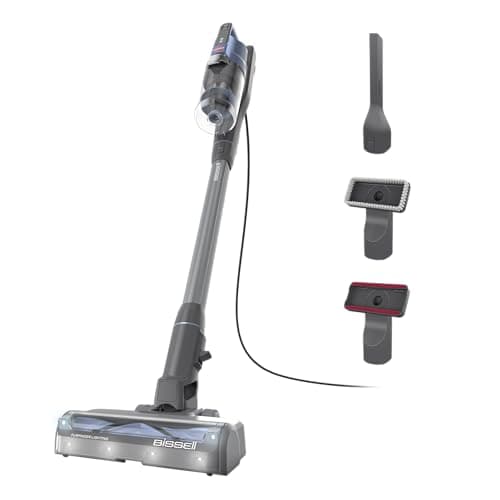
Bissell PowerClean FurFinder 4282K Corded Stick Vacuum (Sealed HEPA, 30 ft Cord)See it on Amazon ↗

Quick Verdict

Bissell PowerClean FurFinder 4282K: a light corded stick with a sealed HEPA claim, though the test behind its number is not stated.

Key Specs

Type

Corded stick vacuum that converts to a handheld

Filtration claim (stated)

Sealed HEPA system that captures and holds 99.97% of dust, dander and pet allergens

Particle size and test method

Not stated on the listing

Cord (stated)

30 ft

Brush roll (stated)

Tangle-free, for hair up to 8 in long

Tools included (stated)

Pet upholstery tool, crevice tool, dusting brush and mesh storage bag

Pros

  • Describes the whole system as sealed, not only the filter
  • Converts to a handheld for sills, shelves and stairs
  • A 30 ft cord covers several rooms from one outlet, with no battery to run down
  • Stands on its own when you pause mid-job

Cons

  • The 99.97% figure comes with no particle size or test method
  • Bagless, so the bin is emptied by hand; take it outdoors after any mold cleanup
  • Amazon showed limited stock when the listing was checked

Suited to

Quick HEPA passes over hard floors, window sills and shelves in apartments and small rooms

Our take

A corded stick suits the small jobs that follow a cleanup: a window sill where condensation grew mildew, a closet floor, the cabinet base under a sink after a slow leak. Bissell describes a sealed HEPA system that captures and holds 99.97% of dust, dander and pet allergens, but it does not give the particle size or the test behind the number, so treat it as a claim without the detail Shark provides. The handheld mode lets you vacuum surfaces you might otherwise brush, and dry brushing tends to lift fine residue into the air. Run the crevice tool along the baseboards, then wipe them with a damp cloth.

Check today's price on Amazon →

Affiliate link — commission at no extra cost to you

#5
Best Remediation-Grade Backpack

Check price

on Amazon ↗

Listing verified 13 Oct 2026

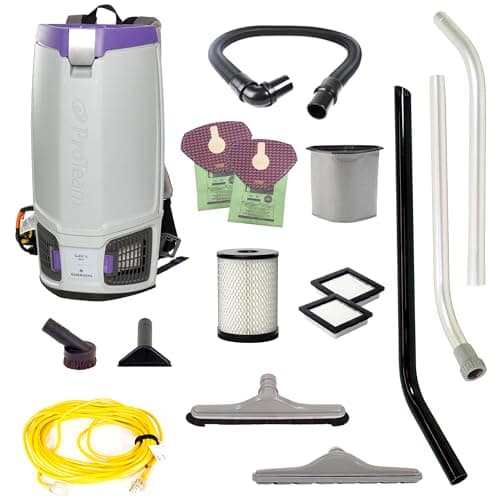
ProTeam GoFit 6 HEPA Commercial Backpack Vacuum with Remediation Tool Kit (6 qt, Model 107766)See it on Amazon ↗

Quick Verdict

ProTeam GoFit 6 HEPA Backpack Vacuum: remediation-grade filtration and an RRP-compliant design, with a short buyer record so far.

Key Specs

Type

Commercial backpack vacuum

Capacity (stated)

6 qt

Filtration (stated)

Captures 99.97% of airborne particulates as small as 0.3 microns

EPA RRP rule (stated)

Meets EPA's definition of a HEPA vacuum under the lead RRP rule

Kit (stated)

Remediation tool kit included

Uses named (stated)

Remediation projects, jobsite cleanup, water damage, soot and smoke removal

Pros

  • States both the 99.97% at 0.3 microns filter figure and compliance with EPA's renovation-rule definition of a HEPA vacuum
  • Ships with a remediation tool kit and names water damage among its uses
  • Worn on the back, so nothing drags behind you on stairs, shelving or a stepladder
  • The longest stated warranty on this page

Cons

  • A short buyer record next to the household picks
  • The listing does not mention wet pickup, and 6 qt is sized for fine dust rather than heavy debris
  • Commercial equipment with a harness to fit, more machine than one small room needs

Suited to

Detailed HEPA vacuuming of exposed framing, shelving and stairs during a large cleanup, or for landlords with several units

Our take

This is the one pick here built for remediation work rather than adapted to it. ProTeam's listing pairs the 99.97% at 0.3 microns filter figure with a statement that the machine meets EPA's definition of a HEPA vacuum under the lead renovation rule, a design standard for the whole vacuum. It ships with a remediation tool kit, and wearing it lets you work over exposed studs, shelving and stair treads without dragging a canister. The catch is a thin buyer record so far. It makes most sense for a large dried-out basement, a landlord with several units, or someone who would rather own the tool than rent one.

Check today's price on Amazon →

Affiliate link — commission at no extra cost to you

Buyer's Guide

What to know before you buy.

A HEPA Filter Is Not the Same as a Sealed HEPA Vacuum

EPA describes a HEPA filter as one that can, in theory, remove at least 99.97% of airborne particles 0.3 microns in size. That number belongs to the filter, not the machine. If the housing, the filter gasket or the hose joints leak, some air goes around the filter and fine dust comes out of the exhaust. EPA's lead renovation rule closes that gap with a stricter definition: a HEPA vacuum must be designed so that all the air drawn in leaves through the HEPA filter, with none leaking past it. On a listing, look for one of three things: a stated sealed system, a whole-vacuum test such as ASTM F1977, or compliance with the RRP rule. Words like HEPA-type or HEPA-style carry no defined standard at all.

Where HEPA Vacuuming Fits in Mold Cleanup

A HEPA vacuum is the last step, not the first. EPA's homeowner guide says to dry water-damaged areas within 24 to 48 hours, and that cleaning up mold always goes with fixing the water problem. Its cleanup page adds that porous materials such as ceiling tiles and carpet may have to be thrown away if they become moldy, and that hard surfaces are scrubbed with detergent and water and dried completely. EPA's remediation guidance for schools and commercial buildings then recommends HEPA vacuums for final cleanup after materials have been thoroughly dried. In practice: remove what cannot be saved, wash what can, dry the room, then vacuum floors, sills and shelves to pick up the spores and dust the work left behind.

Wet/Dry Shop Vacs: Water First, HEPA Later

A wet/dry vac and a HEPA vacuum do two different jobs. EPA's commercial remediation guidance says wet vacuums should be used only while materials are still wet, because they may spread spores if there is not enough liquid, and that they should not be used on porous materials such as gypsum board. The same guidance says to clean and dry the tank, hoses and attachments after use, since spores stick to them. If one machine has to do both jobs, as the WEN can, pick up the water first, clean and dry the tank, then fit a dry filter as the manual directs before vacuuming dust. Be honest about what the filter is: a cartridge sold for a shop vac is not the same as a sealed HEPA system.

Emptying Bins and Changing Filters Without Spreading Spores

The dirtiest moment in vacuuming is emptying the vacuum. EPA's remediation guidance says to wear protective gear when changing a vacuum filter and to bag the filter and contents in well-sealed plastic bags. At home that means doing it outdoors, away from open windows, with an N-95 respirator, gloves and goggles, the gear EPA's homeowner guide suggests for mold work. Bagless cups should be tipped slowly into a trash bag held close, then the bag tied off. A washable filter, like Shark's, must be fully dry before it goes back in; Shark's listing allows 24 hours. EPA's air cleaner guide makes the general point that all filters need regular replacement on the maker's schedule, so keep a spare on hand.

Who Should Not Rely on a HEPA Vacuum

A HEPA vacuum cleans surfaces. It does not dry a room, kill mold or reach growth inside a wall. If mold covers more than about 10 sq ft, or there has been a lot of water damage, EPA's homeowner page points you to its larger-job guidance and to contractors with mold experience. If the drywall, carpet pad or insulation is still wet, you need extraction and drying first, not vacuuming. If spores are being stirred up by demolition, an air scrubber that filters the room's air is the tool, and the vacuum follows it. And if the musty smell returns after cleaning, the moisture source is still active, so look for the leak or humidity problem before buying anything.

Matching the Machine to the Job

Pick by the mess, not the motor. For a house that needs regular dust control after a cleanup, a sealed upright such as the Shark covers carpet and hard floors and lifts off for stairs. For a basement that floods now and then, a wet/dry shop vac handles water, provided you treat its filter claim with caution. During repairs, when drywall or trim is cut out, a dust extractor that connects to the tool catches dust before it spreads. A corded stick suits apartments and small rooms where hauling a canister is a nuisance. A backpack HEPA vacuum is commercial gear, worth it for large or repeated jobs. Whichever you choose, read the listing for a sealing claim, not only the word HEPA.

Frequently Asked Questions

Does a HEPA vacuum remove mold spores?

YesA sealed HEPA vacuum picks up spores that have settled on floors, sills and shelves, which is why EPA's remediation guidance uses one for final cleanup.

It does not kill mold or remove growth rooted in drywall, wood or carpet backing. Clean or remove the moldy material and dry the area first, then vacuum. Empty the vacuum outdoors so the spores you collected do not go back into the room.

Can I use a regular vacuum to clean up mold?

It is better not to. A vacuum without a HEPA filter, or one with a HEPA filter but a leaky housing, can blow fine particles back out through its exhaust, spreading spores into the rest of the room.

Use a vacuum whose listing states a sealed system, a whole-vacuum test or EPA renovation-rule compliance. For a small patch of mold on a hard surface, scrubbing with detergent and water does more than any vacuum.

What is the difference between a HEPA filter and a true HEPA vacuum?

A HEPA filter is rated by itself, at 99.97% of particles 0.3 microns in size; a true HEPA vacuum is sealed so all its air passes through that filter. EPA's lead renovation rule uses that second, stricter definition.

A machine can contain a genuine HEPA filter and still leak around it. Look for words such as sealed system, complete seal, an ASTM F1977 whole-vacuum test or RRP compliance on the listing.

Can you use a shop vac with a HEPA filter for mold?

For water and rough cleanup, yes; for final HEPA cleanup, only if the machine is designed and sealed for it. EPA's renovation guidance warns that a shop vacuum fitted with a HEPA filter in place of its original filter is not necessarily sealed.

Use the shop vac on standing water while materials are still wet, then clean and dry its tank and hose, and finish dried surfaces with a sealed HEPA vacuum.

Should you vacuum mold before or after cleaning it?

After. EPA's remediation guidance recommends HEPA vacuuming for final cleanup once materials have been thoroughly dried. Vacuuming active growth first can disturb it and send spores into the air.

The order that works: fix the leak, remove porous materials that cannot be saved, scrub hard surfaces with detergent and water, dry everything, then HEPA-vacuum floors, sills and shelves to collect what the work loosened.

How often should you change a HEPA vacuum filter?

On the schedule the vacuum maker gives, and sooner after a dusty or moldy job. EPA's guide to air cleaners says all filters need regular replacement according to the manufacturer's recommendations.

Washable filters, like Shark's, can be rinsed and must dry for the time the listing states, 24 hours in Shark's case, before going back in. Change or wash filters outdoors, wearing a mask, and bag the old one.

Who do I call right now for water damage?

Call (888) 840-6512. The line is answered 24 hours a day, seven days a week, and connects you with an IICRC-certified water damage restoration company that serves your area. A recorded menu picks up first: choose water damage or mold, key in your 5-digit ZIP code, and hold through the short silence while the call is passed to the company.

Describe what you can see — where the water is coming from, how long it has been there, and whether it smells — the more specific you are, the faster the right company is on the line. If the source is a pipe or an appliance, shut the main water valve first. Have four things ready and the call goes quickly: the address, when the water started, what is wet now, and whether you have filed an insurance claim.

Still not sure which of these is your situation? (888) 840-6512 · toll-free · answered 24/7

Sources

  1. EPA — A Brief Guide to Mold, Moisture, and Your Home
  2. EPA — Mold Cleanup in Your Home
  3. EPA — Guide to Air Cleaners in the Home

Methodology: How we source and verify data · Report an error

How we chose these picks

  • Every pick is a current listing. Stock, star ratings and rating counts are read from Amazon by script and carry the date they were read.
  • Nothing under 4.0 stars makes the list, and the top pick needs a large rating count, so one good week of reviews cannot put it there.
  • Specs are quoted from the listing or the maker, with the test condition behind the number where there is one, and sized against the job rather than the room on the box.
  • We do not run lab or field tests. Where a spec matters, we say what it is measured under and what it cannot tell you.

Free 2-day shipping

Amazon Prime members pay no shipping on restoration equipment

Dehumidifiers, air movers, and moisture meters qualify for free Prime delivery — bulk items that otherwise cost $15–$40 to ship.

Try Prime free →

Affiliate link — HearthDry earns a bounty if you sign up; costs you nothing extra.

Also Worth Comparing

Best HEPA Air Scrubbers in 2026 — For Mold, Water Damage and Renovation Dust

During mold remediation, disturbed spores become airborne and spread through the HVAC system. A HEPA air scrubber captures 99.97% of particles down to 0.3 microns — including mold spores — protecting your family and containing the remediation zone.

Read the comparison

Best Wet/Dry Vacs for Home and Garage in 2026 — Sized by the Weight You Can Lift

A wet/dry vac is sized by what you can lift, not by what the label promises: water weighs about 8.3 lb a gallon, so a full 6-gallon drum is a 50 lb load. These five picks run from a cordless 2-gallon vac for the car to a 16-gallon drum with a drain port for the garage.

Read the comparison

Best Air Purifiers for Mold in 2026 — HEPA Units Compared on Verified Airflow

An air purifier is the right tool for airborne spores and the allergy symptoms they cause, and the wrong one for the colony and the damp that feeds it. These five HEPA units are compared on the figures that decide how much air they really clean: verified CADR, the stated filter rating and the room size at about five air changes an hour.

Read the comparison

Best PPE for Sewage Cleanup in 2026 — Category 3 Safety Gear

Sewage water (Category 3) contains E. coli, hepatitis A, Norovirus, and dozens of other pathogens. The right PPE is not optional — it's the difference between a cleanup job and a biohazard exposure.

Read the comparison

Best Mold Removal Products in 2026 — One Pick for Each Job, From Killer Spray to Final Coat

No single product removes mold from a house; each one does one job, and the order you use them in matters more than the brand. This roundup picks the strongest product for each job, from killing growth on tile to sealing a cleaned ceiling, and says plainly what each one cannot do.

Read the comparison