
Quick answer
To hear about a leak under a sink, boiler or washing machine before it soaks the floor, a battery leak sensor with a phone alert is the most useful type, and the SwitchBot WiFi Water Leak Detector is our pick: rated 4.5 stars across 1,061 Amazon.co.uk ratings, it needs no hub, detects 0.5 mm of water and sends app and email alerts. If you just want a loud local alarm with no app, the SEBSON mini runs on a 10-year sealed battery.
Most household water damage starts small: a weeping washing machine hose, a dripping compression joint under the sink, a combi boiler's pressure relief valve. A leak detector is a small sensor that sits on the floor and sounds an alarm, or sends a phone notification, the moment its probes touch water. That turns a ruined kitchen floor into a wiped-up puddle. These four were read on Amazon.co.uk on 15 October 2026, covering Wi-Fi sensors and simple standalone alarms.
Our picks

Pick 1 · Best overall, no hub needed
SwitchBot WiFi Water Leak Detector
Best for: Kitchens, boiler cupboards and anyone who travels or works away.
Check price on Amazon.co.ukAn alarm only helps if someone hears it, which is why a Wi-Fi sensor is the best first buy for most homes. SwitchBot's connects straight to your router and sends app and email alerts, so a leak on day one of a holiday is caught. The 1 metre extension probe is useful for the gap behind a washing machine or under a dishwasher where the sensor itself will not fit. Check the Wi-Fi signal at the spot before you rely on it; boiler cupboards and under-stairs spaces can be weak.
Pros
- Phone alerts when you are away
- No hub to buy
- Extension probe reaches behind appliances
- Sealed IP67 case
Cons
- Needs a reliable Wi-Fi signal where it sits
- App account required
Key specs (from the listing)
- Connection:
- Wi-Fi, no hub needed
- Alerts:
- App and email notifications, local alarm
- Sensitivity:
- 0.5 mm of water
- Probes:
- 4 (top and bottom), plus 1 m extension probe
- Waterproofing:
- IP67
- Battery:
- 2 × AAA included, up to 24 months
- Integrations:
- Alexa and Google Assistant (listing)

Pick 2 · Longest battery, no app
SEBSON Water Alarm Mini GS153
Best for: Under sinks and in utility rooms in a home that is usually occupied.
Check price on Amazon.co.ukIf you do not want another app, this is the simplest leak alarm on the market: no setup, an 85 dB alarm and a sealed battery rated for ten years. Put one under the kitchen sink, one behind the washing machine and one by the boiler. The limit is obvious: it only works if someone is in to hear it. For a home that is often empty, pair it with a Wi-Fi sensor in the highest-risk spot.
Pros
- Fit and forget for ten years
- No app, no Wi-Fi, no setup
- Small enough for tight spaces
Cons
- Only audible inside the home
- Battery is not replaceable
Key specs (from the listing)
- Alarm:
- 85 dB
- Battery:
- Built-in 10-year lithium
- Low battery warning:
- Yes
- Size:
- 60 × 60 × 24.2 mm
- Connection:
- None, standalone
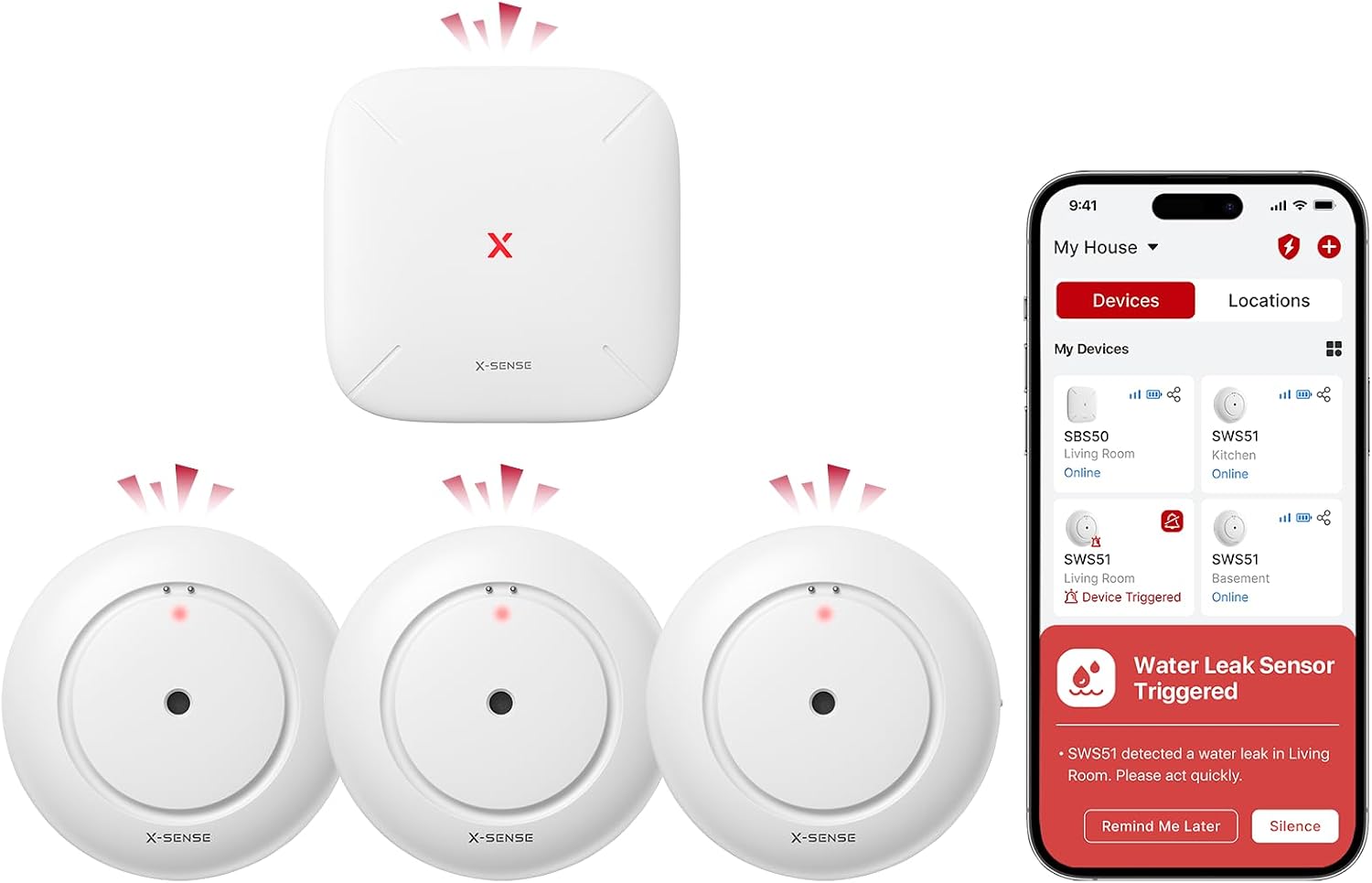
Pick 3 · Best multi-room kit
X-Sense Wi-Fi Water Leak Detector Kit, 3 Sensors + Base Station
Best for: Larger homes with a boiler, kitchen and bathroom to cover.
Check price on Amazon.co.ukA base station with separate sensors gets round weak Wi-Fi: the sensors talk to the base by their own radio, and only the base needs Wi-Fi. That makes this kit a good fit for a boiler in a garage or a loft tank far from the router. The base also sounds when a sensor detects water, so you hear it in the hall. The listing quotes 110 dB in the title and 120 dB in the bullets; either is very loud. Remember it needs a 2.4 GHz network.
Pros
- Three sensors plus a base that also sounds
- Long wireless range from sensor to base
- Alerts can be shared with family
Cons
- Does not work with 5 GHz-only Wi-Fi
- Listing gives two different alarm volumes
Key specs (from the listing)
- Kit:
- 3 sensors and a base station
- Probes:
- 2 top, 4 bottom; detects 0.4 mm
- Alarm:
- Sensor and base station sound together (listing states 110 dB in the title, 120 dB in the bullets)
- Range:
- Up to 550 m in open areas
- Waterproofing:
- IP66
- Wi-Fi:
- 2.4 GHz only
- Sharing:
- Up to 12 users

Pick 4 · Loud budget alarm
Geevon Water Leak Detector, 100 dB
Best for: Cellars, garages and loft tanks where a loud alarm is enough.
Check price on Amazon.co.ukGeevon's alarm is about volume: 100 dB from a small puck that floats if water keeps rising, so it keeps sounding. It runs on a 9 V battery supplied in the box. Use it where you are likely to hear it, such as a utility room, a cellar or under the loft hatch below a cold water tank. Test it monthly by touching the prongs with a damp cloth.
Pros
- Loud enough to hear across a house
- Battery included
- Floats instead of drowning
Cons
- No phone alerts
- 9 V battery needs replacing over time
Key specs (from the listing)
- Alarm:
- 100 dB
- Probes:
- 3 metal prongs underneath
- Size:
- 80 mm across, 30 mm high
- Battery:
- 9 V (6F22), supplied
- Design:
- Floats if water rises
Buying guide
Where to put leak detectors
The highest-risk spots in a British home are under the kitchen sink, behind the washing machine and dishwasher, below a combi boiler or hot water cylinder, beside the toilet cistern and under the loft hatch where a cold water tank sits. Place sensors on the floor at the lowest point where water would run, not on a shelf. If you can only buy one, put it by the appliance with a flexible hose, which is the most common source of sudden leaks.
Wi-Fi alerts or standalone alarm?
A standalone alarm only helps if someone is home to hear it. Wi-Fi sensors send a notification to your phone wherever you are, which matters for holidays, second homes, rentals and anyone out at work all day. Wi-Fi sensors need a signal at the spot and a battery that you change every year or two. A mix works well: Wi-Fi in the riskiest place, simple alarms elsewhere.
What to do when the alarm goes off
Turn off the water at the stopcock, usually under the kitchen sink or where the main pipe enters the house; find it before you need it. Switch off electrics near the water if it is safe to do so. Find the source, move belongings, and soak up the water. If water has gone under flooring or into a ceiling below, a moisture meter and a dehumidifier help confirm it dries out.
Who should not rely on a leak detector alone
A sensor only detects water that reaches it. It will not catch a slow leak inside a wall or under a floor, a leaking roof, or a pipe that bursts away from the sensor. For homes left empty for long periods, an automatic shut-off valve that closes the water supply when a leak is detected gives far better protection. A plumber can fit one on the incoming main.
Questions people ask
Are water leak detectors worth it?
Yes, for the cost of a sensor they can save a kitchen floor or a ceiling below. Most domestic leaks start slowly at hoses, joints and boilers, and an alarm gives you minutes or hours to turn off the stopcock before serious damage.
Where is the best place to put a water leak detector?
On the floor beside the washing machine, under the kitchen sink and below the boiler or hot water cylinder. Those are the most common leak points. Place the sensor at the lowest spot where water would collect.
Do water leak detectors need Wi-Fi?
No. Standalone alarms such as the SEBSON and Geevon need no Wi-Fi and simply sound locally. Wi-Fi models like the SwitchBot add phone alerts, which is the only way to know about a leak when nobody is home.
How long do leak detector batteries last?
Between about two and ten years depending on the model. SwitchBot rates its AAA batteries for up to 24 months, while the SEBSON mini has a sealed lithium battery rated for ten years. Test any detector monthly.
Can a leak detector shut off the water?
Not on its own. A sensor only raises an alarm. To shut off the supply automatically, you need a smart shut-off valve on the incoming main that the sensor can trigger, fitted by a plumber.