
Best Dryer Vent Cleaning Kits in 2026 — Rod Length, Drill Brushes and Lint-Trap Vacuum Hoses for a Dryer That Takes Two Cycles or Shuts Off Hot

Best Dryer Vent Cleaning Kits in 2026

Rod Length, Drill Brushes and Lint-Trap Vacuum Hoses for a Dryer That Takes Two Cycles or Shuts Off Hot

5 picks compared · prices, ratings and stock checked November 5, 2026

Our Top Pick

For most vents up to 30 ft, the Holikme 30 ft Dryer Vent Cleaner Kit: flexible rods, two synthetic brush heads, and a drill attachment, with the largest rating count in the category. For runs past 30 ft or a roof termination, the Sealegend 60 ft Dryer Vent Cleaner Kit with snap-lock rods.

4.4 on Amazon · 38,205 ratings

Quick answer

The best dryer vent cleaning kit for most homes is a drill-driven rod and brush that is longer than your vent run: the Holikme 30 ft Dryer Vent Cleaner Kit, rated 4.4 stars across 38,205 Amazon ratings, reaches 30 ft with two synthetic brush heads and works by hand or on a power drill, per the listing. If your vent runs farther than 30 ft or ends on the roof, buy the Sealegend 60 ft kit instead. To reach lint below the filter slot, add a vacuum hose attachment. Measure the duct before you order, and clean the vent before replacing a blown thermal fuse.

Our Picks at a Glance

Every pick below is currently stocked — ratings and stock read from Amazon on 5 November 2026.

Best Kit With a Vacuum Hose
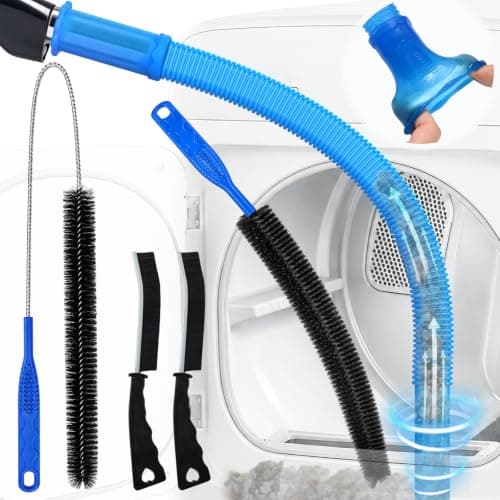
Holikme 35 ft Dryer Vent Cleaner Kit, 58 Pieces (Rods and Brush, 31.5 in Vacuum Hose, Lint Trap Brush)
4.5 from 9,605 Amazon ratings · checked 5 Nov

Best for: A first full clean of both the vent and the dryer's lint-trap cavity, with a corded shop or canister vacuum

Reach (stated):
35 ft of nylon rods
Vacuum hose (stated):
31.5 in blue hose plus a 5.5 in adapter and 7.5 in connection piece, over 3.5 ft in total

Listing verified 5 Nov 2026

Best Lint-Trap Vacuum Add-On
PetOde Dryer Vent Cleaner Vacuum Attachment, 5 Pack (31.5 in Hose, Stretch Connector, Four Brushes)
4.3 from 1,966 Amazon ratings · checked 5 NovAmazon's Choice

Best for: Owners who already have a rod kit, or whose vent is cleaned by a pro, and want to clear the lint-trap slot between visits

Hose (stated):
31.5 in, 0.4 in inner and 0.73 in outer diameter, anti-collapse design
Connector (stated):
Elastic stretch connector for most vacuum cleaners

Listing verified 5 Nov 2026

How this page was made: we compare the current Amazon listings, the makers' published specs and what verified buyers report, then rank by fit for the job. Ratings, review counts and stock are read from Amazon and dated. We earn a commission on purchases through our links; it does not change the order. Reviewed by Marcus Reed, IICRC-certified Water Restoration Technician.

Full Reviews

Each pick in detail: what the listing states, what buyers report, and where it falls short.

#1
Best Overall

Check price

on Amazon ↗

Listing verified 5 Nov 2026

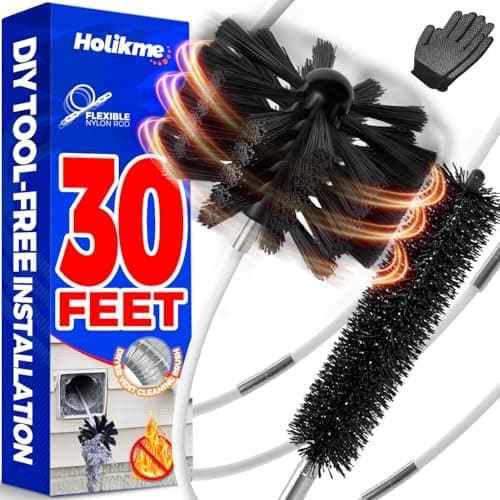
Holikme 30 ft Dryer Vent Cleaner Kit (Flexible Rods, Two Synthetic Brush Heads, Drill Attachment)See it on Amazon ↗

Quick Verdict

Holikme 30 ft Dryer Vent Cleaner Kit: the rod-and-brush default for side-wall vents up to 30 ft, with taped joints.

Key Specs

Reach (stated)

Flexible rods that extend up to 30 ft

Brush heads (stated)

Two synthetic brush heads

Drive (stated)

By hand or with any power drill

Joint advice (stated)

Seal rod connections with tape to reduce the risk of a rod coming loose

Also sold for

Fireplace and chimney brushing, per the listing title

Rod material

Not stated on the listing bullets

Pros

  • 30 ft covers the typical run from a laundry room to an outside wall
  • Two brush heads, so a worn or snagged head is not the end of the job
  • Drill or hand use, so you can go slowly through bends

Cons

  • Threaded rods can unscrew if the drill runs in reverse, which is why the listing says to tape the joints
  • Too short for many roof terminations and long basement runs
  • No vacuum hose for the lint-trap cavity, which the 35 ft Holikme kit adds

Suited to

Vents up to about 30 ft that run from the dryer to a side-wall hood

Our take

This kit's case is buyer evidence: it has far more ratings than any other kit in the category, and the design is the familiar one, short flexible rods that thread together behind a spinning brush. The listing's advice to tape each joint is the most useful line on it. Threaded rods spun backward by a drill can unscrew and leave a brush inside the duct, so set the drill to forward, keep the speed low, and push and pull in short strokes. Measure your vent before relying on 30 ft; add 2 or 3 ft for the length you lose at the dryer and the hood. If the brush will not pass a bend or tears the duct, stop: that is a crushed or foil section that needs replacing with semi-rigid or rigid metal duct, not more brushing.

Check today's price on Amazon →

Affiliate link — commission at no extra cost to you

Compare elsewhere

These open a search for this model. We quote prices only where we can verify them — Amazon, Sylvane and eBay.

#2
Best for Long or Roof Runs

Check price

on Amazon ↗

Listing verified 5 Nov 2026

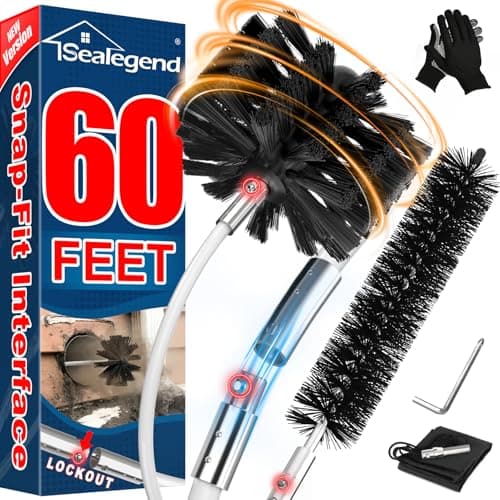
Sealegend 60 ft Dryer Vent Cleaner Kit (44 Snap-Lock Rods, Two Brush Heads, Collection Bag)See it on Amazon ↗

Quick Verdict

Sealegend 60 ft Dryer Vent Cleaner Kit: the long-run kit with snap-lock rods that hold in reverse.

Key Specs

Reach (stated)

44 flexible rods that extend up to 60 ft

Rod joints (stated)

Quick-snap rods that do not come apart turning clockwise or counterclockwise

Brush heads (stated)

Two synthetic brush heads

Included (stated)

Drill bit, lint collection bag and a disassembly helper

Drive (stated)

Works with a cordless drill

Rod material

Not stated on the listing bullets

Pros

  • Twice the reach of the Holikme 30 ft kit, for long basement or attic runs
  • Snap-lock joints that the listing says hold in either rotation, the common failure on threaded rods
  • A collection bag to catch what comes out at the dryer end

Cons

  • Far fewer ratings than the Holikme kits, though the same 4.4 star average
  • 44 rods take time to assemble and take apart, and 60 ft of rod is hard to steer
  • A long run that needs 60 ft is often longer than the dryer maker allows

Suited to

Vents longer than 30 ft, and runs that end on the roof where you work from inside

Our take

Lint builds fastest in long vents, where air slows and every bend drops more of it. This kit's two features address that: 60 ft of rod, and joints the listing says stay locked in either rotation, so reversing the drill to release a stuck brush does not leave half the rods in the duct. Work from the dryer end on a roof run rather than climbing, and keep a hand on the rods as they go in, since a long rod whips if it binds. Before relying on 60 ft, check the dryer manual's maximum vent length: if your run is longer than the maker allows, cleaning helps but the dryer will still run long, and the fix is a shorter route or a listed booster fan.

Check today's price on Amazon →

Affiliate link — commission at no extra cost to you

#3
Best Kit With a Vacuum Hose

Check price

on Amazon ↗

Listing verified 5 Nov 2026

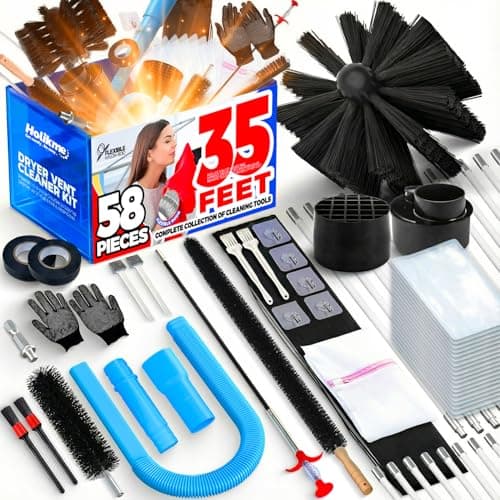
Holikme 35 ft Dryer Vent Cleaner Kit, 58 Pieces (Rods and Brush, 31.5 in Vacuum Hose, Lint Trap Brush)See it on Amazon ↗

Quick Verdict

Holikme 35 ft 58 Piece Kit: rods for the vent plus a vacuum hose for the lint-trap slot, for corded vacuums.

Key Specs

Reach (stated)

35 ft of nylon rods

Vacuum hose (stated)

31.5 in blue hose plus a 5.5 in adapter and 7.5 in connection piece, over 3.5 ft in total

Brushes (stated)

One vent brush head, a dryer lint brush, a lint trap brush and two gap brushes

Also included (stated)

Dryer adapter, vacuum adapter, tape and two pairs of anti-slip gloves

Vacuum fit (stated)

Most vacuums; not Dyson or cordless vacuums

Use (stated)

Always turn the rod clockwise; slow down at corners

Pros

  • Covers both halves of the job: the vent run and the lint-trap cavity inside the dryer
  • 35 ft of rod, a little more than the base Holikme kit
  • The listing gives honest technique notes: clockwise only, slow at turns

Cons

  • Only one vent brush head
  • The vacuum hose does not fit Dyson or cordless vacuums, per the listing
  • Many small pieces to keep track of in the laundry room

Suited to

A first full clean of both the vent and the dryer's lint-trap cavity, with a corded shop or canister vacuum

Our take

Lint does not only collect in the duct. It falls past the filter screen into the slot it sits in and into the dryer cabinet, where it sits near the heat source, and a rod kit alone never reaches it. This kit adds a slim vacuum hose and a lint trap brush for that slot, which makes it the most complete single box here. The rod section is 35 ft of nylon, which the listing says to turn clockwise only and to slow down at bends, the right advice for any threaded rod. Check the vacuum fit before ordering: the listing excludes Dyson and cordless models, so plan on a shop vac or a corded canister. Unplug the dryer, and on a gas dryer leave the gas line alone, before reaching into the filter slot.

Check today's price on Amazon →

Affiliate link — commission at no extra cost to you

#4
Best for Short Runs

Check price

on Amazon ↗

Listing verified 5 Nov 2026

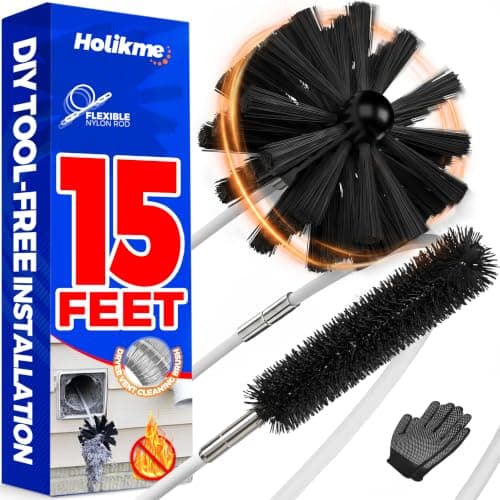
Holikme 15 ft Dryer Vent Cleaner Kit (4 in Vent Brush, Nylon Rods, Lint Brush, Drill Connector)See it on Amazon ↗

Quick Verdict

Holikme 15 ft Dryer Vent Cleaner Kit: the short kit sized for a 4 in duct, for dryers on an outside wall.

Key Specs

Reach

15 ft, per the listing title

Brush (stated)

Heavy-duty vent brush for 4 in pipes

Included (stated)

Flexible nylon rods, a lint brush, a drill connector and protective gloves

Drive (stated)

Screw handle and a connector for standard household drills

Rod count

Not stated on the listing bullets

Pros

  • Fewer rods to join for a short run, so less chance of one coming apart
  • The listing names the 4 in duct size the brush is made for
  • Includes a lint brush for the filter slot

Cons

  • 15 ft is too short for most runs that leave from an interior laundry room
  • No vacuum hose
  • Rod count and rod material are not stated on the listing

Suited to

Dryers on an outside wall with a vent run under 15 ft

Our take

Many dryers sit against an outside wall with a vent run of a few feet, and for those homes a 60 ft kit is just more rods to store. This kit is the same Holikme design cut to 15 ft, with a brush the listing sizes for 4 in pipe, the standard dryer duct diameter. That stated size matters: a brush much bigger than the duct jams, and one much smaller leaves a ring of lint on the walls. Measure from the back of the dryer to the outside hood before choosing it, and remember the transition duct behind the dryer counts. If the run is 15 ft or less, cleaning from the outside hood inward with the dryer pulled out and disconnected is a short job that needs no ladder.

Check today's price on Amazon →

Affiliate link — commission at no extra cost to you

#5
Best Lint-Trap Vacuum Add-On

Check price

on Amazon ↗

Listing verified 5 Nov 2026

PetOde Dryer Vent Cleaner Vacuum Attachment, 5 Pack (31.5 in Hose, Stretch Connector, Four Brushes)See it on Amazon ↗

Quick Verdict

PetOde Vacuum Attachment 5 Pack: a slim hose and brushes for the lint-trap slot, to pair with a rod kit.

Key Specs

Hose (stated)

31.5 in, 0.4 in inner and 0.73 in outer diameter, anti-collapse design

Connector (stated)

Elastic stretch connector for most vacuum cleaners

Brushes (stated)

Two flexible lint brushes in different lengths and two crevice brushes

Other uses (stated)

Refrigerator coils, window tracks and condensers

Vent rods

None; this is not a duct-cleaning kit

Pros

  • A narrow hose that fits down the filter slot of most dryers
  • Stretch connector is meant to fit most vacuums, where many adapters fit one size
  • The brushes double for refrigerator coils

Cons

  • Does not clean the vent duct at all; pair it with a rod kit
  • A 0.4 in bore clogs on large wads of lint
  • Newer listing with fewer ratings than the Holikme kits

Suited to

Owners who already have a rod kit, or whose vent is cleaned by a pro, and want to clear the lint-trap slot between visits

Our take

This is the add-on, not the kit. It answers the second half of dryer lint: the fluff that slips past the screen into the filter slot and builds up in the cabinet. A slim hose with an elastic connector goes on most household vacuums, and two flexible brushes loosen what the hose cannot pull. The narrow bore, 0.4 in inside per the listing, is what lets it reach down the slot, and it is also why big clumps stall in it, so loosen them with a brush first. It does nothing for the duct to the outside, which is where the airflow problem behind long dry times usually sits. If the dryer is already overheating, clean the duct first with a rod kit and use this as the monthly follow-up.

Check today's price on Amazon →

Affiliate link — commission at no extra cost to you

Buyer's Guide

What to know before you buy.

Why a Clogged Vent Makes a Dryer Shut Off

A dryer heats air and pushes it through the drum and out the vent. When lint narrows the vent, the hot air cannot leave fast enough, the drum stays humid, and the cycle runs long. Heat then builds in the cabinet until a cycling thermostat or high-limit switch cuts the heater, and on many models a thermal fuse blows to stop the dryer altogether. That is why a dryer that stops after a few minutes, or one that runs but no longer heats after a fuse blows, so often has a vent problem behind it. Replacing the fuse without clearing the vent usually means a second fuse soon after. The US Fire Administration names failure to clean as the leading factor in home clothes dryer fires, so a vent full of lint is a safety issue before it is an efficiency one.

Match the Rod Length to Your Vent

Rod length is the one spec that decides the purchase. Measure the full run: from the dryer outlet, through the transition duct, along the wall or ceiling, to the hood outside, and count each bend. Then buy a kit at least a few feet longer than that number. The picks here run 15 ft, 30 ft, 35 ft and 60 ft. A short run to an outside wall needs only the 15 ft kit. Most side-wall runs from an interior laundry room fall inside 30 ft. Basement runs that climb to a rim joist, and any vent ending on the roof, often need 60 ft. If you cannot find the outside end, or the run seems longer than your dryer's manual allows, that is worth knowing before you clean, because a vent longer than the maker's limit will keep running long even when clean.

How to Clean a Dryer Vent With a Rod Kit

Unplug the dryer; on a gas dryer, close the gas valve and move the dryer without kinking its gas line. Disconnect the transition duct from the dryer and the wall. Clean the transition duct separately, or replace it if it is foil or plastic. Attach the brush and a few rods, feed it into the wall duct, and spin it slowly with a drill in forward, pushing and pulling in short strokes and adding rods as you go. Tape threaded joints as the Holikme listing advises. Work from both ends if you can reach the outside hood, and have a vacuum running at the open end to catch lint. Finish by clearing the hood flap, which often sticks with lint, then reconnect with foil tape or clamps, not screws, which catch lint. Run the dryer on air-only and check that the flap opens strongly outside.

Rods, Brushes and What the Listings Leave Out

Most kits are flexible nylon rods with a synthetic brush on the end, and the differences come down to length and joints. Threaded joints are cheap and reliable when turned the right way but can unscrew in reverse, which is why one listing tells you to tape them and another tells you to turn clockwise only. Sealegend's snap-lock rods are sold on holding in either direction. Brush size matters too: the standard dryer duct is 4 in, and the Holikme 15 ft listing states that size; others do not, so check the head against your duct. None of these listings states the rod material grade or the torque the joints take, so treat any drill as a slow helper, not a power tool. A brush that will not pass a point is telling you something about the duct, not asking for more speed.

Who Should Not Rely on a Kit

A kit cleans a sound duct; it does not repair a bad one. If the brush tears through foil, or the duct is crushed behind the dryer or inside a wall, the duct needs replacing with semi-rigid or rigid metal, which the CPSC recommends over plastic and foil, and the dryer vent hose review covers the connector. Roof terminations you cannot reach safely, vents with a bird nest or a damaged hood, and runs inside finished walls that you cannot open are jobs for a dryer vent cleaning service. A heat pump or condenser dryer has no outside vent, so it needs its filters and condenser cleaned per its manual, not a rod kit. And if a clean vent still leaves the dryer cold, the fault is a heating element, gas valve or fuse, which the not-heating and thermal fuse guides walk through.

Frequently Asked Questions

Do dryer vent cleaning kits work?

YesOn a sound metal duct of a length the rods can reach: a spinning brush loosens packed lint that a vacuum alone cannot pull out.

They work less well on foil or plastic duct, which the brush can tear, and on runs longer than the kit. Measure the vent first and buy a kit a few feet longer, then clean from both ends where you can.

How often should you clean your dryer vent?

Once a year is the interval most dryer-vent guidance uses, and sooner if you see the signs: loads taking more than one cycle, the dryer top feeling hot, a weak flap outside, or lint around the hood.

Clean the lint filter before or after every load, which is the US Fire Administration's standing advice. Homes with long runs, pets or large families usually need it more often.

Can you clean a dryer vent yourself?

YesIf the run is reachable and the duct is in good condition: a rod kit, a vacuum and about an hour will do most side-wall vents.

Unplug the dryer first and take care with a gas dryer's supply line. Leave roof vents you cannot reach safely, ducts hidden in finished walls and any vent with damage or a nest to a professional dryer vent service.

How do you use a dryer vent cleaning kit?

Attach the brush to a few rods, feed it into the disconnected duct, and turn it slowly with a drill in forward while pushing and pulling, adding rods as it goes.

Tape threaded joints so they cannot unscrew. Keep a vacuum at the open end, finish by clearing the outside hood flap, then reconnect and run the dryer to check airflow outside.

Can a clogged dryer vent cause the dryer to stop?

YesTrapped heat trips the dryer's high-limit protection, and on many models it blows the thermal fuse, which stops the dryer until the fuse is replaced.

That is why a dryer that shuts off after a few minutes should have its vent checked first. Replacing a fuse without clearing the vent usually leads to another blown fuse.

Is dryer vent cleaning the same as duct cleaning?

NoDryer vent cleaning clears the single 4 in duct that carries hot, damp air and lint from the dryer to the outside.

Air duct cleaning deals with the heating and cooling supply and return ducts, a separate system. A rod kit made for a dryer vent is sized for that one duct and is not a substitute for HVAC duct work.

Who do I call right now for water damage?

Call (888) 840-6512. The line is answered 24 hours a day, seven days a week, and connects you with an IICRC-certified water damage restoration company that serves your area. A recorded menu picks up first: choose water damage or mold, key in your 5-digit ZIP code, and hold through the short silence while the call is passed to the company.

Describe what you can see — where the water is coming from, how long it has been there, and whether it smells — the more specific you are, the faster the right company is on the line. If the source is a pipe or an appliance, shut the main water valve first. Have four things ready and the call goes quickly: the address, when the water started, what is wet now, and whether you have filed an insurance claim.

Still not sure which of these is your situation? (888) 840-6512 · toll-free · answered 24/7

Sources

  1. US Fire Administration
  2. US Consumer Product Safety Commission

Methodology: How we source and verify data · Report an error

How we chose these picks

  • Every pick is a current listing. Stock, star ratings and rating counts are read from Amazon by script and carry the date they were read.
  • Nothing under 4.0 stars makes the list, and the top pick needs a large rating count, so one good week of reviews cannot put it there.
  • Specs are quoted from the listing or the maker, with the test condition behind the number where there is one, and sized against the job rather than the room on the box.
  • Each comparison is reviewed by Marcus Reed, an IICRC-certified Water Restoration Technician, against the IICRC drying standards and public guidance listed under Sources.

Free 2-day shipping

Amazon Prime members pay no shipping on restoration equipment

Dehumidifiers, air movers, and moisture meters qualify for free Prime delivery — bulk items that otherwise cost $15–$40 to ship.

Try Prime free →

Affiliate link — HearthDry earns a bounty if you sign up; costs you nothing extra.

Also Worth Comparing