
Best for: Showers where the rest of the house has normal pressure but the current head feels weak
- Type:
- Fixed rain-style head
- Face (stated):
- 6 in round; 8 in also offered
Listing verified 5 Nov 2026

Compact Fixed Heads, a Handheld, and How to Tell When the Problem Is the Plumbing, Not the Head
5 picks compared · prices, ratings and stock checked November 5, 2026
Our Top Pick
For most weak showers, the SparkPod 6 in Rain Shower Head, switched to its included 2.5 GPM restrictor. For the most concentrated spray from a small metal head, the HammerHead Showers 2 in All-Metal 2.5 GPM Shower Head.
4.6 on Amazon · 54,142 ratings
Quick answer
If low pressure affects only the shower and the cause is not a valve, regulator or clogged pipe, buy a head rated at the full 2.5 GPM with small nozzles, such as the SparkPod 6 in Rain Shower Head, rated 4.6 stars across 54,142 Amazon ratings. It ships at 1.8 GPM, and the listing includes a 2.5 GPM restrictor to swap in for weak supplies. A head cannot raise your pressure; it only shapes the flow you already have into a faster spray. If every tap in the house is weak, find that cause first.
Every pick below is currently stocked — ratings and stock read from Amazon on 5 November 2026.
Best for: Showers where the rest of the house has normal pressure but the current head feels weak
Listing verified 5 Nov 2026
Best for: People who want the strongest-feeling spray from a weak supply and do not need wide coverage
Listing verified 5 Nov 2026
Best for: Low-pressure showers where you want several spray patterns rather than one hard jet
Listing verified 5 Nov 2026
Best for: Low-pressure showers used for rinsing children, pets or the tub as well as showering
Listing verified 5 Nov 2026
Best for: Replacing an old, scaled-up head on a standard arm in one short job
Listing verified 5 Nov 2026
How this page was made: we compare the current Amazon listings, the makers' published specs and what verified buyers report, then rank by fit for the job. Ratings, review counts and stock are read from Amazon and dated. We earn a commission on purchases through our links; it does not change the order. Reviewed by Marcus Reed, IICRC-certified Water Restoration Technician.
Full Reviews
Each pick in detail: what the listing states, what buyers report, and where it falls short.
Check price
on Amazon ↗
Listing verified 5 Nov 2026
See it on Amazon ↗Best Overall
Quick Verdict
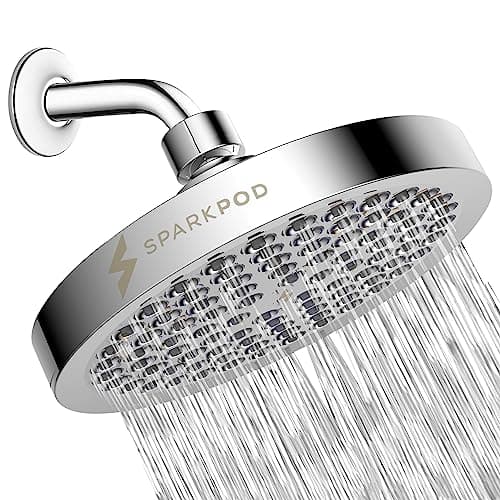
SparkPod 6 in Rain Shower Head: a wipe-clean 6 in head you can set to 2.5 GPM, the pick when only the shower feels weak.
Key Specs
Type
Fixed rain-style head
Face (stated)
6 in round; 8 in also offered
Flow (stated)
Ships at 1.8 GPM; 2.5 GPM restrictor included
Nozzles (stated)
90 flexible rubber jets, wipe-clean
Body (stated)
ABS with polished chrome finish
Connection (stated)
Standard 1/2 in shower arm, hand-tightened
Pros
Cons
Suited to
Showers where the rest of the house has normal pressure but the current head feels weak
Our take
SparkPod suits low pressure for a plain reason: you choose the flow. It arrives with a 1.8 GPM restrictor fitted and a 2.5 GPM one in the box, and 2.5 GPM is the most a US shower head may be rated for. Swap to the larger one if the spray feels thin. The 90 rubber nozzles matter in hard-water areas, since scale in the jets is one of the most common reasons a shower weakens over time, and these wipe clear. Pick the 6 in face over the 8 in when pressure is weak, because a bigger face spreads the same water over more area. The listing also mentions running with only the screened washer; that runs the head past its rating, so keep a restrictor in.
Affiliate link — commission at no extra cost to you
Compare elsewhere
These open a search for this model. We quote prices only where we can verify them — Amazon, Sylvane and eBay.
Check price
on Amazon ↗
Listing verified 5 Nov 2026
See it on Amazon ↗Best Concentrated Spray
Quick Verdict
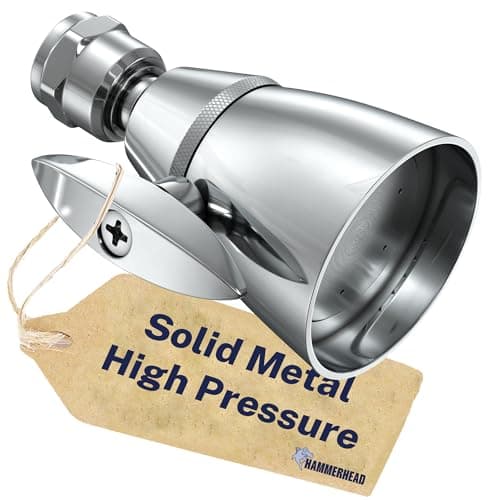
HammerHead Showers 2 in All-Metal Shower Head: a small 2.5 GPM metal head that turns weak pressure into a hard, narrow spray.
Key Specs
Type
Fixed compact head
Face (stated)
2 in
Flow (stated)
2.5 GPM
Body (stated)
Solid metal with metal nozzles
Spray (stated)
Knob adjusts from a narrow high-pressure spray to a rain spray
Pivot (stated)
Brass ball joint, adjustable up to 23 degrees
Pros
Cons
Suited to
People who want the strongest-feeling spray from a weak supply and do not need wide coverage
Our take
HammerHead's head works on the principle every pressure-boosting head uses, taken to its limit. At a given flow rate, a smaller face with fewer openings makes the water leave faster, so it feels stronger on the skin. This one is 2 in across and rated at 2.5 GPM, per the listing, which is as much flow as a US head may use. The knob moves the pattern from a tight jet to a softer rain, a useful range when pressure changes through the day. It is solid metal with a brass pivot, which avoids the cracked plastic ball joint that ends many cheap heads. Coverage is narrow, and in hard water the metal nozzles need an occasional soak in vinegar.
Affiliate link — commission at no extra cost to you
Compare elsewhere
Check price
on Amazon ↗
Listing verified 5 Nov 2026
See it on Amazon ↗Best Multi-Mode Fixed Head
Quick Verdict
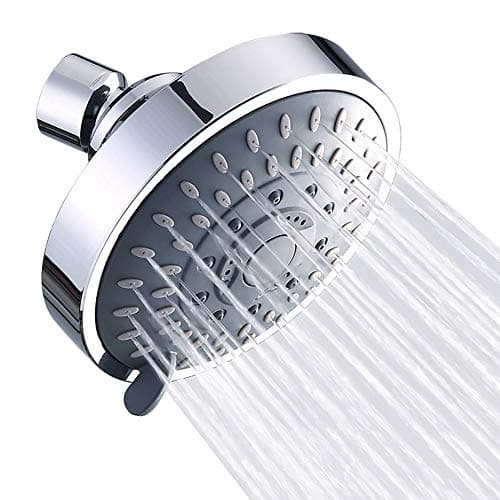
AISOSO 4.1 in High Pressure Shower Head: five spray modes in a mid-size head, with the flow rate not stated on the listing.
Key Specs
Type
Fixed head
Face (stated)
4.1 in
Modes (stated)
Power mist, power rain, pulsating, rain massage, rain mist
Nozzles (stated)
Self-cleaning
Body (stated)
ABS with chrome finish
Pivot (stated)
Metal ball joint, 360 degree rotation
Pros
Cons
Suited to
Low-pressure showers where you want several spray patterns rather than one hard jet
Our take
AISOSO's head sits between the two picks above in size, with a 4.1 in face and five modes switched by a lever, from a fine mist to a pulsating massage. On a weak supply, modes are more than a gimmick: the narrower patterns concentrate the flow, so you can switch to a harder spray when pressure dips. The listing describes the nozzles as self-cleaning and the body as ABS with a metal ball joint that turns 360 degrees. The one gap is the flow rate. The listing does not state a GPM figure, so check the marking on the head or the restrictor inside the inlet once it arrives. A head rated below 2.5 GPM will deliver less water whatever the mode.
Affiliate link — commission at no extra cost to you
Compare elsewhere
Check price
on Amazon ↗
Listing verified 5 Nov 2026
See it on Amazon ↗Best Handheld
Quick Verdict
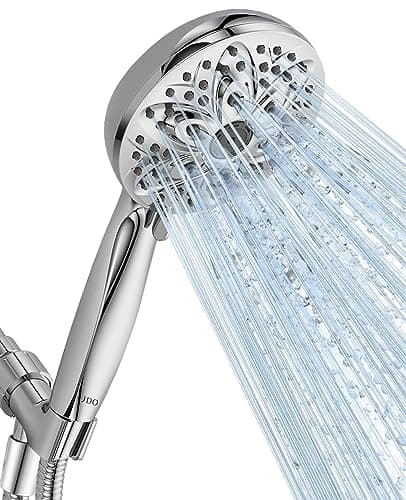
JDO 6-Setting Handheld Shower Head: an air-induction handheld with a pause mode and a 59 in hose, with no flow rate stated.
Key Specs
Type
Handheld with adjustable holder
Face (stated)
4.7 in
Settings (stated)
Six, including rain, massage, mist and a pause mode
Design (stated)
Air-induction to strengthen the stream at low pressure
Nozzles (stated)
54 anti-clog silicone nozzles
Hose (stated)
59 in stainless steel
Pros
Cons
Suited to
Low-pressure showers used for rinsing children, pets or the tub as well as showering
Our take
A handheld helps a weak shower in a way a fixed head cannot: you bring the spray close, so less force is lost over the distance from arm to body. JDO's head is 4.7 in across with six settings, and the listing says it draws air into the water to strengthen the stream at low pressure. Air induction makes the drops feel larger and fuller, though some people find the spray slightly cooler. The 54 silicone nozzles resist scale, and a pause setting holds the water while you shampoo. As with AISOSO, the listing gives no GPM figure, so check the rating stamped on the head. The 59 in hose suits most stalls and tubs.
Affiliate link — commission at no extra cost to you
Compare elsewhere
Check price
on Amazon ↗
Listing verified 5 Nov 2026
See it on Amazon ↗Best With an Install Wrench
Quick Verdict
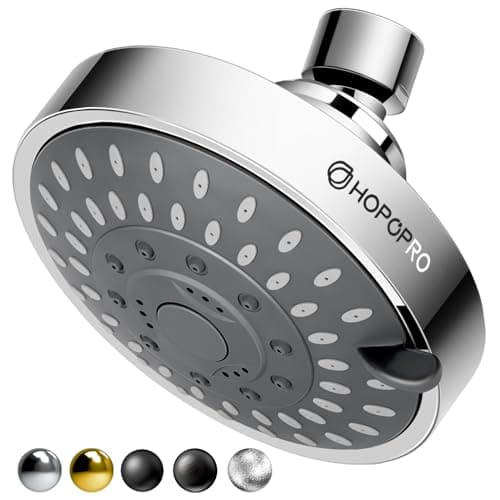
HOPOPRO 4 in 5-Mode Fixed Shower Head: a compact five-mode head with a brass joint and the wrench and tape to fit it, no flow rate stated.
Key Specs
Type
Fixed head
Face (stated)
4.1 in panel
Modes (stated)
Five
Nozzles (stated)
66, easy to clean
Body (stated)
ABS plastic
Pivot (stated)
Brass ball joint, 360 degree adjustment
Pros
Cons
Suited to
Replacing an old, scaled-up head on a standard arm in one short job
Our take
HOPOPRO's head is a close match to AISOSO's in size and modes, with a 4.1 in panel, 66 nozzles and five settings. What sets it apart is the kit: the box includes plumber's tape and a small wrench, which helps when an old shower arm is stiff or scaled and needs a firm seat to stop dripping at the joint. The ball joint is brass. The listing spends more words on media mentions than on specifications and gives no GPM rating, so treat it as a solid replacement head rather than a proven pressure fix. If the old head you are taking off is caked with scale, that alone may explain the weak spray.
Affiliate link — commission at no extra cost to you
Compare elsewhere
What to know before you buy.
A shower head cannot fix low pressure that starts upstream of it. Open the kitchen tap and an outdoor spigot. If they are weak too, the problem is in the house plumbing. Common causes are a failing pressure-reducing valve near the main, a main or branch shutoff valve left partly closed after a repair, and old galvanized pipes narrowed inside by scale and rust. A screw-on pressure gauge on an outdoor spigot gives you a number; many plumbers aim for roughly 40 to 60 psi. A sudden drop across the house can also mean a leak, so with every tap off, check whether the water meter is still moving. If only the shower is weak, look at the head, its restrictor screen, and the shower valve cartridge before buying anything.
US federal efficiency rules from the Department of Energy cap new shower heads at 2.5 gallons per minute, measured at 80 psi. EPA's WaterSense label goes further and covers heads that use no more than 2.0 GPM, and California and some other states set their own lower limit. Every head on this page sits inside those rules, so none can deliver more water than a legal head. What a low-pressure head can do is use all of its permitted flow well. At 30 or 40 psi, a 2.5 GPM head passes less than 2.5 GPM, so a head that ships at 1.8 GPM loses even more. That is why the SparkPod restrictor swap matters, and why a stated GPM figure on the listing is worth looking for.
There is no pump inside a pressure-boosting shower head. These heads push the same water through smaller or fewer openings, so it leaves at a higher speed and feels stronger. A small face, such as HammerHead's 2 in, concentrates the flow into a hard spray. A wide rain face does the opposite and spreads it out, which is why large 10 and 12 in rain heads often disappoint on a weak supply and why none made this list. Air-induction heads, such as the JDO, mix air into the stream so each drop feels fuller. Spray modes help too: on a day when pressure dips, switching to a narrower pattern restores some force. Nozzle material matters over time, because rubber or silicone jets can be rubbed free of scale.
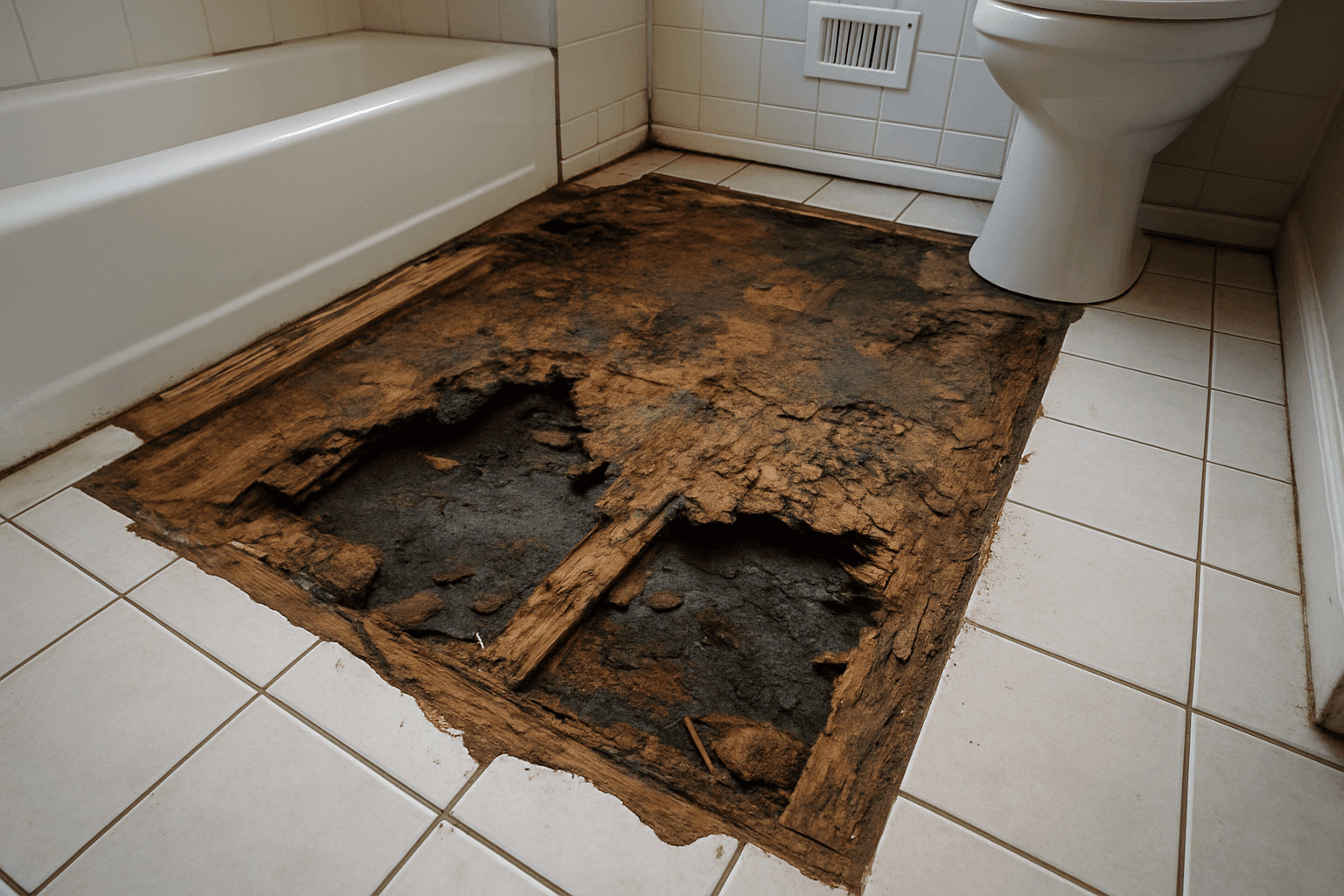
Skip a new head if the whole house is weak, since no head on this page can fix a failing pressure regulator, a half-open valve, or scale-choked pipes. Those need a valve replaced, a valve opened, or pipe work from a plumber. A shower that lost pressure after work on the plumbing may have debris in the valve cartridge, and that needs the cartridge cleaned or replaced. If hot water fades while cold stays strong, the issue may be the water heater or a mixing valve, not the head. Homes on a well may need the pressure switch or pressure tank checked. A head that keeps dripping after you shut it off points to a worn valve cartridge, not a faulty head.
Turn the old head counterclockwise to remove it, using a cloth around the nut if you need pliers so the finish is not marked. Clean the old tape and scale off the arm threads with a brush. Wrap new plumber's tape clockwise two or three times around the threads, so tightening the head does not unwind it. Check that the rubber washer is seated in the new head, then thread it on by hand and snug it gently. Overtightening can crack a plastic connector. Run the water and watch the joint for a minute. A drip at the arm usually means the washer is missing or the tape is thin. Water that runs down the wall behind tile can reach the framing, so fix any drip at the joint right away.
NoA shower head cannot raise the pressure in your pipes.
It can make the flow you already have feel stronger by forcing it through smaller nozzles, which speeds up the water. That helps when only the shower feels weak, but it will not fix low pressure at every tap in the house.
YesA clogged or restricted head is one of the most common causes of a weak shower.
Hard-water scale blocks the nozzles and the small screen inside the inlet, and many heads ship with a low-flow restrictor. Soak the head in white vinegar and clean the screen; if the spray recovers, the head was the problem.
Not necessarily, because the flow is set by the GPM rating, not by how hard the spray feels. A head rated at 2.5 GPM uses more water and more hot water than a 1.8 GPM head. A pressure-boosting head with the same rating only speeds the water up, so it uses the same amount.
YesIn the sense that new shower heads sold in the US may not be rated above 2.5 GPM at 80 psi under federal efficiency rules set by the Department of Energy.
California and some other states set a lower limit. Removing a head's flow restrictor pushes it past its rating, which is why this page advises leaving the restrictor in.
Usually something at the shower itself. Check for a scaled head or inlet screen, a low-flow restrictor, a partly closed shutoff under the valve, or a clogged shower valve cartridge.
If the shower lost pressure right after plumbing work, debris may have lodged in the cartridge, which needs cleaning or replacing rather than a new head.
A compact head rated at 2.5 GPM with small, easy-to-clean nozzles. On this page that is the SparkPod 6 in Rain Shower Head with its included 2.5 GPM restrictor fitted, or the HammerHead Showers 2 in All-Metal head for a harder, narrower spray. Avoid large rain heads, which spread a weak supply too thin.
Call (888) 840-6512. The line is answered 24 hours a day, seven days a week, and connects you with an IICRC-certified water damage restoration company that serves your area. A recorded menu picks up first: choose water damage or mold, key in your 5-digit ZIP code, and hold through the short silence while the call is passed to the company.
Describe what you can see — where the water is coming from, how long it has been there, and whether it smells — the more specific you are, the faster the right company is on the line. If the source is a pipe or an appliance, shut the main water valve first. Have four things ready and the call goes quickly: the address, when the water started, what is wet now, and whether you have filed an insurance claim.
Still not sure which of these is your situation? (888) 840-6512 · toll-free · answered 24/7
Methodology: How we source and verify data · Report an error
Free 2-day shipping
Amazon Prime members pay no shipping on restoration equipment
Dehumidifiers, air movers, and moisture meters qualify for free Prime delivery — bulk items that otherwise cost $15–$40 to ship.
Affiliate link — HearthDry earns a bounty if you sign up; costs you nothing extra.
A water pressure gauge shows the pressure your pipes, hoses and fill valves sit under all day, and if it passes the 80 psi line many plumbing codes draw. These picks are hose-thread test gauges compared on range, max needle, case and stated accuracy, with the test method and the reading that means it is time for a regulator.
Read the comparisonA water pressure regulator comes in two very different kinds: a whole-house pressure reducing valve (PRV) that a plumber fits on the main line, and a small hose-thread regulator for an RV, a camper or a garden hose. These picks say plainly which kind each one is, compared on connection, stated adjustment range and what each listing leaves out, with the gauge test to run first and the expansion tank a PRV can make necessary.
Read the comparisonHard water leaves scale inside water heaters, valves and appliances, and a whole-house softener is the fix that actually removes the minerals behind it. These picks compare salt-based softeners on grain capacity, certification and controls, plus one salt-free conditioner whose own listing says it does not soften, with the sizing arithmetic and the drain and brine connections that need careful installation.
Read the comparisonA whole house water filter takes sand, rust and chlorine out at the main line, before the water reaches your fixtures and water heater. These systems are compared on stages, stated flow, bypass valves and the housing details that keep a filter on the main line from turning into a leak.
Read the comparison