
Best for: Anyone checking whether a home oven runs hot or cold before calling for a repair
- Type:
- Mechanical dial, leave-in oven thermometer
- Range (stated):
- 60 to 580°F / 20 to 300°C
Listing verified 5 Nov 2026

Dial and Probe Models Compared, and How to Tell an Oven That Needs Calibrating From One That Needs a Repair
5 picks compared · prices, ratings and stock checked November 5, 2026
Our Top Pick
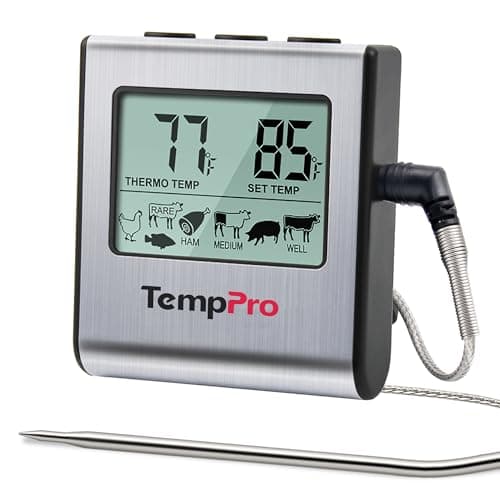
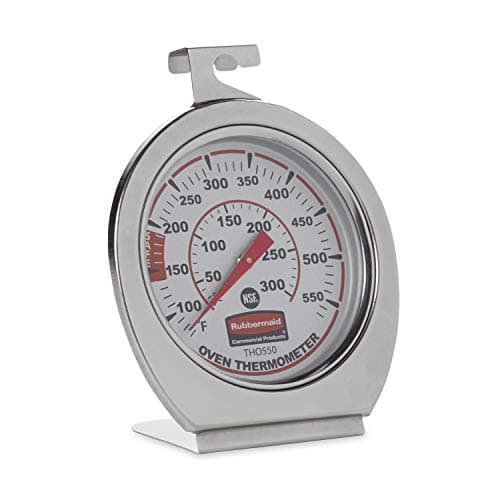
For checking whether an oven runs hot or cold, the Rubbermaid Commercial Products Stainless Steel Oven Monitoring Thermometer: a battery-free dial reading 60 to 580°F that hangs or stands on the rack. To read the oven without opening the door, the TempPro TempTrack digital probe thermometer with its 40 in cable.
4.5 on Amazon · 46,395 ratings
Quick answer
The best oven thermometer for testing an oven that seems to run hot or cold is a leave-in stainless steel dial such as the Rubbermaid Commercial Products Stainless Steel Oven Monitoring Thermometer, rated 4.5 stars across 46,395 Amazon ratings, which reads 60 to 580°F with no battery. Set it on the center rack, preheat to 350°F, wait about 20 minutes after the preheat signal, then take four or five readings a few minutes apart and average them. Swings above and below the set point are normal; a steady average offset can usually be dialed out, while an oven that never gets near the set point needs a repair.
Every pick below is currently stocked — ratings and stock read from Amazon on 5 November 2026.
Best for: Anyone checking whether a home oven runs hot or cold before calling for a repair
Listing verified 5 Nov 2026
Best for: Readers who want a bigger face to read through the oven door glass
Listing verified 5 Nov 2026
Best for: A thermometer to leave in the oven full time after the diagnosis
Listing verified 5 Nov 2026
Best for: Ovens with thin rack wires where other hooks slide or tip
Listing verified 5 Nov 2026
Best for: Logging a full heating cycle without opening the oven door
Listing verified 5 Nov 2026
How this page was made: we compare the current Amazon listings, the makers' published specs and what verified buyers report, then rank by fit for the job. Ratings, review counts and stock are read from Amazon and dated. We earn a commission on purchases through our links; it does not change the order. Reviewed by Marcus Reed, IICRC-certified Water Restoration Technician.
Full Reviews
Each pick in detail: what the listing states, what buyers report, and where it falls short.
Check price
on Amazon ↗
Listing verified 5 Nov 2026
See it on Amazon ↗Best Overall
Quick Verdict
Rubbermaid Commercial Products Stainless Steel Oven Monitoring Thermometer: a battery-free 60 to 580°F dial that answers whether the oven runs hot or cold.
Key Specs
Type
Mechanical dial, leave-in oven thermometer
Range (stated)
60 to 580°F / 20 to 300°C
Construction (stated)
Stainless steel with a shatter-proof lens
Power
None; battery free per the listing
Mounting (stated)
Hangs from a rack or stands on it
Certification (stated)
NSF certified
Pros
Cons
Suited to
Anyone checking whether a home oven runs hot or cold before calling for a repair
Our take
A dial thermometer that lives on the rack is the simplest way to answer the question a repair guide asks first: what temperature is the oven actually holding? The Rubbermaid reads to 580°F with no battery, so it can stay in through a full bake with no electronics to cook. What it cannot tell you is its own error, because the listing states no tolerance. Before you trust a single number, check it in boiling water (212°F at sea level, lower at altitude) if the dial reaches that low, and compare it with a second thermometer if the result decides whether you pay for a part. Keep it out of a self-clean cycle; that heat is well beyond its stated range.
Affiliate link — commission at no extra cost to you
Compare elsewhere
These open a search for this model. We quote prices only where we can verify them — Amazon, Sylvane and eBay.
Check price
on Amazon ↗
Listing verified 5 Nov 2026
See it on Amazon ↗Best Large Dial
Quick Verdict
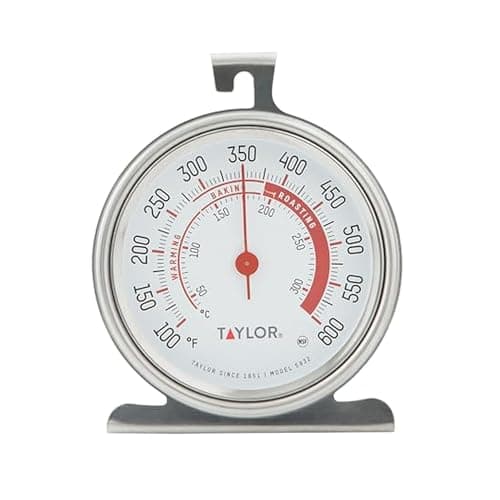
Taylor Analog Oven Thermometer, 3 in dial: the larger face to read through the door glass, up to 600°F.
Key Specs
Type
Analog dial, leave-in oven thermometer
Dial (stated)
3 in, color-marked cooking zones
Range (stated)
100 to 600°F / 50 to 300°C
Construction (stated)
Stainless steel
Mounting (stated)
Hangs from a rack or stands upright
Certification (stated)
NSF listed
Pros
Cons
Suited to
Readers who want a bigger face to read through the oven door glass
Our take
The Taylor's main advantage for diagnosis is its 3 in dial, which matters when you are trying to read the oven through the window without opening the door and dumping heat. That keeps the test honest, because every door opening drops the air temperature and starts the element or burner cycling again. The range runs to 600°F, which covers every bake setting on a home oven. Ignore the colored cooking zones when you are testing; write down the actual number each time. Taylor does not state a tolerance on this listing, so if one reading decides between a calibration offset and a new sensor, confirm it with a second thermometer or a boiling-water check where the scale allows.
Affiliate link — commission at no extra cost to you
Compare elsewhere
Check price
on Amazon ↗
Listing verified 5 Nov 2026
See it on Amazon ↗Best Compact Dial
Quick Verdict
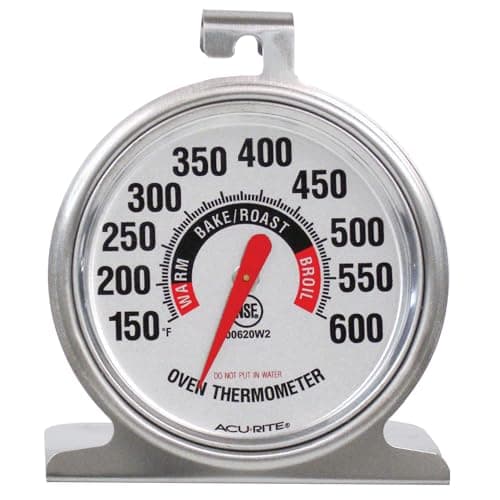
AcuRite 00620A2: a leave-in 150 to 600°F dial for watching an oven after it has been fixed.
Key Specs
Type
Dial, leave-in oven and grill thermometer
Model
AcuRite 00620A2
Range (stated)
150 to 600°F
Construction (stated)
Stainless steel with a protective glass lens
Mounting (stated)
Integrated hanger, or stands upright on its base
Stated accuracy
Not stated on the listing
Pros
Cons
Suited to
A thermometer to leave in the oven full time after the diagnosis
Our take
The AcuRite 00620A2 is a plain, leave-in dial with a 150 to 600°F scale, which suits the second job an oven thermometer does: staying in the oven after a repair or recalibration so you notice if the reading drifts again. A sensor or thermostat that is starting to fail often shows up as a slowly growing gap rather than a sudden one, and a thermometer that is always there catches that early. Because the scale begins at 150°F, it cannot be checked in boiling water; if you need to confirm its accuracy, compare it with a second thermometer at a 350°F setting. The listing states no tolerance figure.
Affiliate link — commission at no extra cost to you
Compare elsewhere
Check price
on Amazon ↗
Listing verified 5 Nov 2026
See it on Amazon ↗Most Stable on the Rack
Quick Verdict
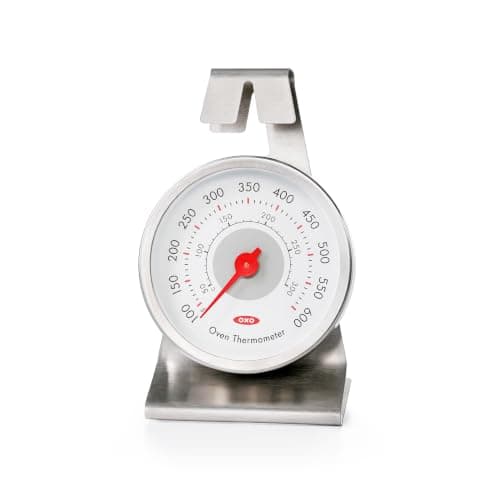
OXO Good Grips Oven Thermometer: the steady two-point hook for ovens where other dials slide or tip.
Key Specs
Type
Dial, leave-in oven thermometer
Mounting (stated)
Two-point hook for thin or thick rack wires; wide angled base for standing
Scale (stated)
Large numbers in °F and °C
Placement advice (stated)
Place it near where the food cooks, since temperature can differ across the oven
Range
Not stated in the listing bullets
Stated accuracy
Not stated as a tolerance on the listing
Pros
Cons
Suited to
Ovens with thin rack wires where other hooks slide or tip
Our take
A thermometer that tips over or slides along the rack between readings spoils a test, because each reading comes from a slightly different spot. The OXO's two-point hook and wide angled base are aimed at exactly that problem, and the listing makes a useful point of its own: temperatures differ across the inside of an oven, so place the thermometer where the food sits. For a diagnosis, use the center of the middle rack, then repeat near a corner if baked goods brown unevenly. Check the box or the product page for the range before buying, since it is not in the listing bullets read for this page.
Affiliate link — commission at no extra cost to you
Compare elsewhere
Check price
on Amazon ↗
Listing verified 5 Nov 2026
See it on Amazon ↗Best Digital (Door-Closed Readings)
Quick Verdict
TempPro TempTrack probe: watch the oven cycle from outside the door, with a stated 1.8°F accuracy.
Key Specs
Type
Digital base with a wired stainless steel probe
Range (stated)
32 to 572°F / 0 to 300°C
Probe and wire heat limit (stated)
716°F
Accuracy (stated)
1.8°F / 1°C, 1 degree resolution
Cable (stated)
40 in stainless steel mesh, base stays outside the oven
Probe (stated)
6.5 in food-grade stepdown tip
Pros
Cons
Suited to
Logging a full heating cycle without opening the oven door
Our take
The point of a probe for diagnosis is that the display sits outside the oven, so you can watch the temperature rise, overshoot and fall as the element or burner cycles, which a dial behind a door cannot show you easily. The listing states 1.8°F accuracy and a 572°F reading limit, with a cable and probe rated to 716°F. To read air rather than food, position the probe tip in the middle of the oven, clear of the rack and walls; touching metal will read the rack, not the air. Run the cable along the hinge side where the seal is softest and check the door still closes. Use it alongside a dial if you also want something that stays in the oven.
Affiliate link — commission at no extra cost to you
Compare elsewhere
What to know before you buy.
Put the thermometer in the middle of the center rack, close the door and set the oven to 350°F. When the preheat signal sounds, wait another 15 to 20 minutes, because many ovens signal before the walls and racks have caught up. Then take four or five readings about five minutes apart, reading through the window where you can, and write each one down. Average them. One reading on its own tells you little, since the oven is always somewhere in its heating cycle. If the average sits close to 350°F, the oven is fine and the recipe or the pan is the issue. If it sits a steady distance above or below, you have a calibration question. If it never climbs near 350°F, you have a repair question, and the next sections explain the difference.
A home oven does not hold one temperature. The control turns the bake element or gas burner on until the sensor reads above the set point, shuts it off, and turns it back on once the air cools below the set point. Most ovens therefore swing above and below the number on the dial for the whole bake, and the swing can look alarming on a single glance. Opening the door to check makes it worse, because the air temperature falls and the oven starts a new heating burst. That is why the test above uses several readings and an average, and why a probe with an outside display is useful: you can watch the rise and fall without disturbing it. Judge the oven by its average, not by its peaks.
A steady offset is a calibration job. If the average runs a consistent amount above or below the set point at 350°F and again at 425°F, most owner's manuals describe an offset adjustment through the control panel or a knob screw, within a limited range the manual states. A repair is the answer when the oven cannot reach temperature, when the gap grows over weeks, or when the offset changes a lot between settings. On an electric oven, a bake element that is blistered, split or does not glow points to the element; an error code or wildly wrong readings point to the temperature sensor, which a technician checks with a meter against the maker's resistance chart. On a gas oven, an igniter that glows but never lights the burner is the classic weak-igniter failure. No thermometer or offset will fix any of those.
If the oven does not heat at all, trips a breaker, shows an error code, smells of gas, or will not light, skip the thermometer and go to the repair. A thermometer measures; it does not change anything, and buying one first only delays a part replacement or a service call. The same applies when the bake element has a visible break or bubble, or a gas oven needs repeated tries before the burner catches. If you smell gas, leave the home and call the gas utility from outside rather than testing anything. A thermometer is worth buying when the oven heats but your food comes out under or over done, when you want to confirm a repair worked, or when you want a check you can leave in the oven for good.
A stainless steel dial is the standard tool: no battery, safe to leave in, and enough to answer whether the oven runs hot or cold. Look for a range that reaches at least 500°F, a hook or base that holds it still, and a face large enough to read through the door glass. A digital probe adds an outside display and, on the TempPro, a stated accuracy figure, at the cost of a cable through the door seal and a battery. Placement matters as much as the model. For a diagnosis, use the center of the middle rack, away from walls and the element. If the issue is uneven browning, repeat the test with the thermometer in a back corner. Take every dial out before a self-clean cycle; the heat is far beyond their stated ranges.
Compare it against a second thermometer or a known reference before trusting it. If the dial reads as low as 212°F, hold it in a pot of boiling water and check that it reads close to 212°F at sea level, or a little less at altitude.
For dials that start at 150°F or higher, place two thermometers side by side on the center rack at 350°F and compare the average after 20 minutes. None of the dial listings here state a tolerance figure.
Put it in the middle of the center rack for a diagnosis, hanging from the rack or standing on it. That is where most recipes assume the food sits, and it is away from the element and the walls.
The OXO listing notes that temperature differs across the inside of an oven, so if your problem is uneven browning, repeat the test with the thermometer in a back corner and compare.
YesA leave-in dial can stay in during normal baking and roasting.
The AcuRite listing calls its model safe to leave in while cooking, and the Rubbermaid and Taylor are built to hang or stand on a rack. Take every dial out before a self-clean cycle, which runs far hotter than their stated maximums of 580 to 600°F, and before broiling right under the element.
YesEvery home oven swings above and below the set temperature while it is on.
The control switches the element or burner on and off around the set point, so a single reading can look far off even when the oven is fine. Take four or five readings a few minutes apart after the oven has fully preheated and average them; judge the oven by that average.
Most ovens let you set an offset, and your owner's manual gives the steps and the limit. On many digital controls it is a menu or a held key combination; on older dial ovens it is a screw behind the temperature knob.
Measure the average offset first with a thermometer, change the setting by that amount, then repeat the test to confirm. An offset only corrects a steady error; it cannot fix a failing sensor, element or igniter.
An oven that stalls well below the set point usually has a failed or weak part rather than a calibration problem. On an electric oven, the bake element may be broken, leaving only the broil element to heat; on a gas oven, a weak igniter may fail to keep the burner lit.
A faulty temperature sensor or control can also cause it. A thermometer confirms the stall, then the part needs testing and replacing.
Call (888) 840-6512. The line is answered 24 hours a day, seven days a week, and connects you with an IICRC-certified water damage restoration company that serves your area. A recorded menu picks up first: choose water damage or mold, key in your 5-digit ZIP code, and hold through the short silence while the call is passed to the company.
Describe what you can see — where the water is coming from, how long it has been there, and whether it smells — the more specific you are, the faster the right company is on the line. If the source is a pipe or an appliance, shut the main water valve first. Have four things ready and the call goes quickly: the address, when the water started, what is wet now, and whether you have filed an insurance claim.
Still not sure which of these is your situation? (888) 840-6512 · toll-free · answered 24/7
Methodology: How we source and verify data · Report an error
Free 2-day shipping
Amazon Prime members pay no shipping on restoration equipment
Dehumidifiers, air movers, and moisture meters qualify for free Prime delivery — bulk items that otherwise cost $15–$40 to ship.
Affiliate link — HearthDry earns a bounty if you sign up; costs you nothing extra.
A natural gas detector comes in two forms: an alarm that stays plugged in and sounds when gas builds up in the room, and a handheld sniffer you hold to a fitting to find where a small leak is. These picks cover both, compared from their listings and buyer ratings, with the placement and safety points from general gas safety guidance.
Read the comparisonA home air quality monitor reads humidity, temperature and, depending on the model, CO2, fine particles, VOCs or radon, but none of them can tell you that mold is growing. These picks are compared on what each listing says its sensors measure, whether you need an app to see the numbers, and the humidity range EPA advises for keeping mold away.
Read the comparison