

Quick answer
Cupping means the edges of each board are higher than the center, caused by moisture entering from below — it is often reversible with specialised drying mats over one to two weeks. Buckling means boards have lifted away from the subfloor entirely and usually requires replacement. Do not sand cupped floors until moisture readings are stable, or the boards will dry flat and then crown. Call (888) 840-6512 to reach a certified water damage restoration company in your area; the line is answered 24/7.
Written & reviewed by Marcus ReedIICRC WRT
Reviewed July 2, 2026· Next review Jan 2027
What Cupping Actually Tells You
A cupped board has edges higher than its center, and it happens for one reason: the underside of the wood is wetter than the top. The bottom face absorbs moisture, swells, and pushes the edges up.
Which means cupping is a diagnostic, not just cosmetic damage. It tells you moisture is coming from below — the subfloor, a crawl space, a slab, or a leak that ran under the floor rather than across it.
Three related terms worth keeping straight:
| Term | Shape | Cause |
|---|---|---|
| Cupping | Edges high, center low | Underside wetter than the top surface |
| Crowning | Centre high, edges low | Top wetter than the bottom — or a cupped floor sanded before it finished drying |
| Buckling | Boards lifted off the subfloor entirely | Severe expansion with nowhere to go — usually prolonged saturation |
Crowning caused by premature sanding is the single most expensive avoidable mistake in this whole subject, and the next section is entirely about avoiding it.
The Part Everyone Gets Wrong: Do Not Sand Yet
A cupped floor often flattens on its own. As the underside dries and the moisture content equalises through the board, the wood returns toward its original shape. Sanding a floor while it is still cupped removes the raised edges — and then, when the bottom finally dries and the board flattens, you are left with a crowned floor that is thinner at the edges and frequently unsalvageable.
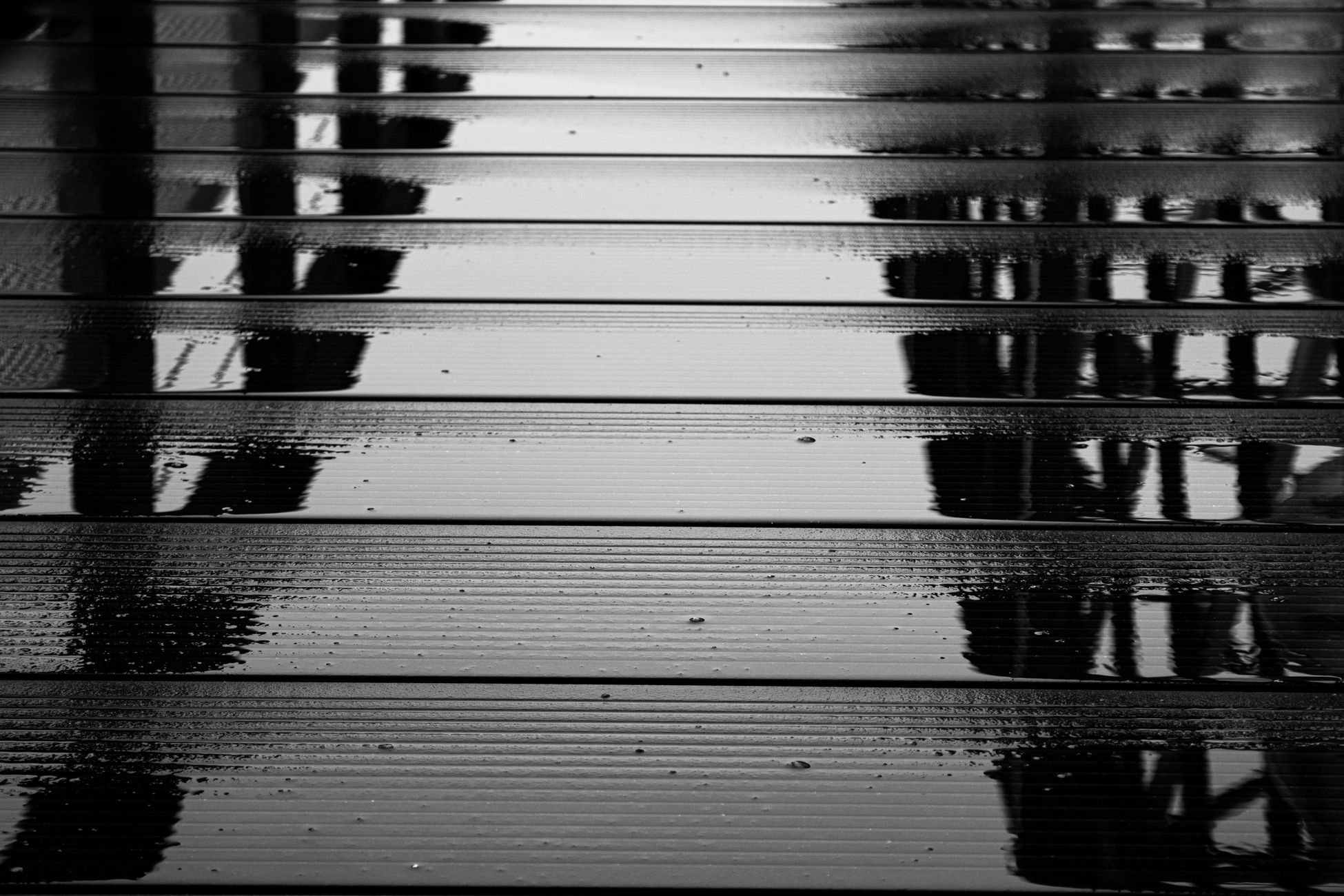
So the rule from the National Wood Flooring Association is unambiguous: never repair a cupped floor until every source of excess moisture has been found and eliminated, verified with a moisture meter reading the subfloor underneath — not by how the surface looks.
How long is the wait? There is no industry answer in weeks, and any article giving you a flat "wait 30 days" is making it up. The standard is a *condition*, not a clock:
- Normal in-service moisture content for wood flooring is about 6–9% in most US regions, and can spike above 25% after a water event
- Sand only when the flooring is within roughly 1% moisture variation of the subfloor, and both are stable
- Keep the space at 30–50% relative humidity while it stabilises
In practice that is several weeks to several months. A floor that has not returned to shape after a full heating season is probably permanently deformed. One documented NWFA case ran about a year and four months — two complete seasonal cycles — before sanding. Transition seasons, roughly October or May, are the usual recommendation for the eventual sanding.
The hard part of this repair is patience, and the industry's own case studies exist because people ran out of it.
What It Costs
| Work | Typical cost |
|---|---|
| Sand and refinish | $3 – $8 per sq ft (most pay $4.50 – $6.50) |
| — sanding component | $0.50 – $3 per sq ft |
| — staining | $1 – $3 per sq ft |
| — recoating only | $1 – $2 per sq ft |
| Replace hardwood, installed | $6 – $25 per sq ft ($6 – $12 standard) |
| — remove old flooring | $1 – $5 per sq ft |
| Subfloor repair | $3 – $10 per sq ft |
| Water damage / rot remediation to subfloor | adds $1,000 – $3,000 |
| Damaged joists | $40 – $60 per sq ft |
For 1,000 square feet, refinishing runs roughly $3,000–$8,000 against $6,000–$25,000 to replace — which is why the wait is worth it. Sanding prematurely is how a refinishing job becomes a replacement job.
Talk to a water damage pro now
Answered 24/7 · Toll-free · answered 24/7 · no obligation
(888) 840-6512- Describe the damage & give your ZIP
- You're routed to the on-call local crew
- They quote — you decide, no obligation
When Replacement Is Genuinely the Answer
- Buckled boards that lifted from the subfloor
- Boards already sanded thin, or engineered flooring with a wear layer too thin to sand — engineered wood typically tolerates one or two sandings at most
- Growth underneath the flooring, or Category 3 water exposure
- A floor still cupped after a full heating season
- A subfloor that has to come up anyway
Drying It Properly in the First Place
Hardwood is Class 4 drying — water bound in a dense, low-permeance material, released slowly. Standard air movers pointed at the surface will not reach it, and they dry the top faster than the bottom, which makes cupping worse.
Proper hardwood drying uses specialty floor drying mats that pull moisture up through the boards, or injection drying through the tongue-and-groove, usually with desiccant dehumidification. Even done well it takes 10–14 days, and a crew that treats a wet hardwood floor as an ordinary drying job is quietly deciding you will be replacing it. See our structural drying guide for how the process should be documented.
Insurance
Sudden and accidental water — a burst pipe, an appliance failure — normally covers hardwood damage. Gradual leaks and humidity do not.
Two claim-specific issues arise with wood floors. Matching: if your floor is discontinued, whether the insurer pays to replace beyond the damaged area is often disputed, and some states have rules requiring reasonable uniformity. And timing: the long wait before sanding sits awkwardly with claim deadlines, so tell the adjuster early that the floor is being monitored to a moisture standard, and get the monitoring documented rather than letting the file close.
Bottom Line
Cupping means water underneath, and the temptation to sand it flat is the mistake that turns a $5,000 refinish into a $15,000 replacement. Stop the moisture, dry it properly with mats or injection rather than fans, monitor with a meter until the flooring is within about 1% of the subfloor, and expect to wait months rather than weeks.
Reading to confirm what you already suspect?
Confirm it in two minutes instead — the pro on this line answers questions about YOUR situation all day: what it is, what it should cost, whether you even need service. If you want, they'll set the appointment on the same call.
Toll-free · no obligation · asking costs nothing
Frequently Asked Questions
What should homeowners know about wood floor cupping and buckling after water damage?
Hardwood response depends on water category, duration, and wood type. Consult an IICRC-certified restoration professional for site-specific assessment.
Does insurance cover this type of water damage?
Coverage depends on whether the event was sudden and accidental vs gradual. Document everything and review your policy exclusions.
When should I call a professional?
Call immediately if water affects multiple rooms, involves Category 2 or 3 water, or drying cannot begin within 24 hours.
How does IICRC S500 apply?
IICRC S500 defines industry-standard inspection, extraction, drying, and documentation requirements that insurers expect.
Where can I find local restoration pros?
Use HearthDry's location finder to connect with IICRC-certified restoration companies in your area.
Who do I call right now for water damage?
Call (888) 840-6512. The line is answered 24 hours a day, seven days a week, and connects you with an IICRC-certified water damage restoration company that serves your area. Describe what you can see — where the water is coming from, how long it has been there, and whether it smells — the more specific you are, the faster the right company is on the line.
If the source is a pipe or an appliance, shut the main water valve first. Have four things ready and the call goes quickly: the address, when the water started, what is wet now, and whether you have filed an insurance claim.
Still not sure which of these is your situation? (888) 840-6512 · toll-free · answered 24/7
Sources
- IICRC S500 — Water Damage Restoration(retrieved 2026-07-02)
- EPA — Mold and Water Cleanup Guidance(retrieved 2026-07-02)
Methodology: How we source and verify data · Report an error
Disclaimer: HearthDry is an independent educational resource. This article is for informational purposes only and does not constitute professional, legal, or insurance advice. Consult licensed professionals before making decisions about your property or insurance claims.
Professional Equipment
Measure Before You Decide: Save the Floor or Replace It
A pin-type moisture meter is the only reliable way to know if your hardwood is under the 9% MC threshold needed before sanding and refinishing. Skip the guesswork.
Affiliate link — HearthDry earns a commission from Sylvane via CJ at no extra cost to you
Watch
Source: Cali Floors — YouTube
Free 2-day shipping
Amazon Prime members pay no shipping on restoration equipment
Dehumidifiers, air movers, and moisture meters qualify for free Prime delivery — bulk items that otherwise cost $15–$40 to ship.
Affiliate link — HearthDry earns a bounty if you sign up; costs you nothing extra.
Equipment
What each machine actually does
Removes the moisture the structure is still giving off — the machine that decides how long drying takes
See the picks →Moves air across wet surfaces so the dehumidifier has something to take out of the air
See the picks →Finds water behind walls and under floors, and tells you when a material is actually dry
See the picks →Alerts you the moment a leak starts — the cheapest thing on this list and the only preventive one
See the picks →Those pages carry affiliate links. As an Amazon Associate, HearthDry earns from qualifying purchases; it costs you nothing extra.
Our Amazon storefront →Advertisement
