Best Moisture Meter for Wood in 2026 — Pin vs Pinless, Species Settings, and Reading a Subfloor After a Leak

Best Moisture Meter for Wood in 2026

Pin vs Pinless, Species Settings, and Reading a Subfloor After a Leak

4 picks compared · prices, ratings and stock checked October 12, 2026

Our Top Pick

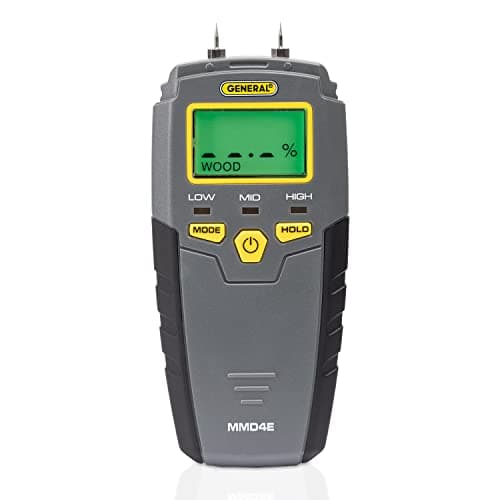
For wood, the General Tools MMD4E Pin Moisture Meter: it reads moisture content from 5% to 50% on wood and ships with spare 8 mm pins. For finished floors you cannot put holes in, add the General Tools MMD7NP Pinless Moisture Meter.

4.5 on Amazon · 15,233 ratings

Quick answer

If you want one meter for wood, buy a pin-type meter, because its pins read the wood's actual moisture content at a depth you control, and for most people that is the General Tools MMD4E Pin Moisture Meter, rated 4.5 stars across 15,233 Amazon ratings. Its listing gives a 5% to 50% wood range, spare 8 mm pins and a cap that checks calibration. Add a pinless meter such as the General Tools MMD7NP Pinless Moisture Meter to scan finished floors without holes. After a leak, aim for your own dry reference reading; wood that stays above about 20% can support mold.

Our Picks at a Glance

Every pick below is currently stocked — ratings and stock read from Amazon on 12 October 2026.

How this page was made: we compare the current Amazon listings, the makers' published specs and what verified buyers report, then rank by fit for the job. Ratings, review counts and stock are read from Amazon and dated. We earn a commission on purchases through our links; it does not change the order. Reviewed by Marcus Reed, IICRC-certified Water Restoration Technician.

Full Reviews

Each pick in detail: what the listing states, what buyers report, and where it falls short.

#1
Best Overall for Wood

Check price

on Amazon ↗

Listing verified 13 Oct 2026

General Tools MMD4E Pin Moisture Meter (Wood 5–50%, Building Materials 1.5–33%, Spare 8 mm Pins)See it on Amazon ↗

Quick Verdict

General Tools MMD4E Pin Moisture Meter: a 5% to 50% wood range, spare pins and a calibration cap, the simple way to put a number on wet wood.

Key Specs

Type

Pin (two stainless steel pins)

Wood range (stated)

5% to 50%

Building materials range (stated)

1.5% to 33%, for drywall and concrete

Pins

8 mm stainless steel; a spare set is included

Calibration check

Protective cap doubles as a calibration checker

Display

Backlit LCD with 0.3 in digits, low/medium/high tones and icons, hold button

Pros

  • Reports moisture content on wood as a percentage, the same unit drying targets and firewood advice use
  • A 5% to 50% wood range covers everything from dry trim to a soaked joist
  • Spare pins come in the box, which matters because pins bend in dense or knotty wood
  • The cap checks calibration, so a suspect reading can be ruled in or out in seconds

Cons

  • No species or wood-group setting is stated, so readings on dense hardwoods are approximate
  • Every reading leaves two small holes, which rules it out on a finished floor you care about
  • Pins read only between their tips, so finding the edge of a wet area takes many readings

Suited to

Putting a moisture content number on subfloor, framing, lumber or firewood

Our take

A pin meter is the right first tool for wood because it reports moisture content as a share of the wood's dry weight, which is the number drying targets and firewood advice are written in. This one reads 5% to 50% on wood, wide enough to cover kiln-dried trim and a soaked joist alike, and its tones and icons sort each reading into low, medium or high without a chart. Use the cap's calibration check at the start of each session and whenever a reading looks wrong. The listing names no species setting, so treat a reading on oak or maple as close rather than exact, and compare like with like: subfloor to subfloor, stud to stud, from the same pin depth.

Check today's price on Amazon →

Affiliate link — commission at no extra cost to you

Compare elsewhere

These open a search for this model. We quote prices only where we can verify them — Amazon, Sylvane and eBay.

#2
Best Pinless for Finished Floors

Check price

on Amazon ↗

Listing verified 13 Oct 2026

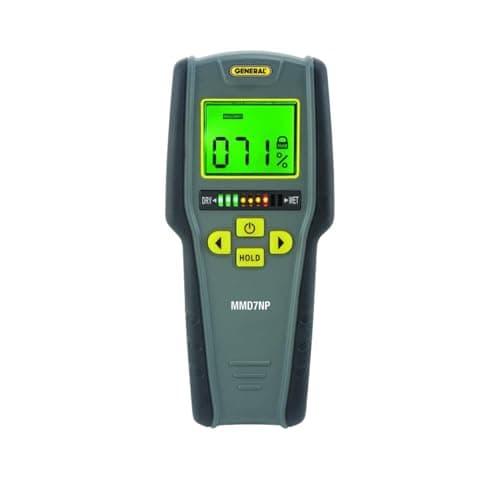
General Tools MMD7NP Pinless Moisture Meter (Reads to 3/4 in Deep, Softwood and Hardwood Scales)See it on Amazon ↗

Quick Verdict

General Tools MMD7NP Pinless Moisture Meter: hole-free scanning to 3/4 in deep with softwood and hardwood scales, best for finished floors.

Key Specs

Type

Pinless (sensor pad), auto-calibrating per the listing

Reading depth (stated)

Up to 3/4 in (19 mm)

Softwood range (stated)

0% to 53%

Hardwood range (stated)

0% to 35%

Drywall and masonry

Relative readings only, per the listing

Display

2 in backlit LCD, 3-color LED bar graph, hold button

Pros

  • No pins, so it reads finished hardwood, cabinets and trim without marking them
  • Separate softwood and hardwood scales, the only wood setting stated among these picks
  • A pad that slides across a floor traces the outline of a wet patch far faster than pins
  • The listing is clear that drywall and masonry readings are relative, so you know how to read them

Cons

  • On 3/4 in solid hardwood its reading depth is filled by the flooring itself, so it cannot judge the subfloor from above
  • Needs flat, full contact, so rough split firewood and round logs read poorly
  • Nails, pipes and metal plates under the pad can push a reading up

Suited to

Scanning finished wood floors, cabinets and trim for wet areas without leaving holes

Our take

Speed and clean surfaces are the reasons to own a pinless meter. Slide it across a hardwood floor and you can trace the edge of a wet patch in a few minutes, marking it with tape as you go. Its listing gives a reading depth of 3/4 in (19 mm), with separate scales for softwood (0% to 53%) and hardwood (0% to 35%). That depth has a catch on floors: over 3/4 in solid hardwood, nearly everything it reads is the flooring, not the subfloor under it. To judge the subfloor, read it from the basement or crawl space, or through an opening such as a lifted floor register. Keep the pad flat and away from nails and ductwork, then confirm any high spot with a pin meter.

Check today's price on Amazon →

Affiliate link — commission at no extra cost to you

#3
Best 2-in-1 Pin and Pinless

Check price

on Amazon ↗

Listing verified 13 Oct 2026

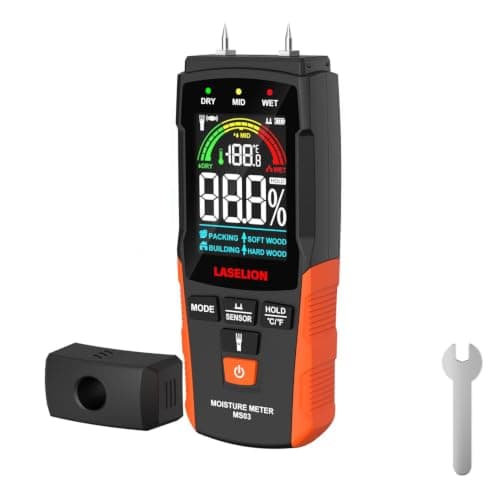
LASELION MS03 2-in-1 Pin & Pinless Moisture Meter (Wood 0–75%, Flashlight, Ambient Temperature)See it on Amazon ↗

Quick Verdict

LASELION MS03 2-in-1 Pin & Pinless Moisture Meter: scan and confirm with one tool, with a flashlight for crawl spaces, though its accuracy claim is loosely stated.

Key Specs

Type

Pin and pinless in one meter

Wood range (stated)

0% to 75%

Building materials range (stated)

0% to 25%

Accuracy (stated)

±4, written on the listing as %RH

Calibration

Manual calibration for pinless mode

Extras

Built-in flashlight, ambient temperature display, hold function

Pros

  • Both modes in one tool: sweep without holes, then pin the spot that reads high
  • A built-in flashlight helps when reading joists and sill plates in a dark crawl space
  • Shows ambient temperature, a useful note when cold wood may be reading low

Cons

  • The accuracy figure is written as %RH, a humidity unit, so treat the stated precision loosely
  • No pinless reading depth and no species setting are stated
  • Auto power off after 2 minutes can interrupt a slow grid of readings

Suited to

One meter that both scans for wet areas and confirms them with pins

Our take

A 2-in-1 makes sense when one meter has to cover both halves of a water-damage check: sweep a floor or wall without marking it, then push pins in where the pad reads high. This listing covers both modes, shows ambient temperature and adds a flashlight, which matters more than it sounds when you are on your back under a floor. Read its numbers with some care. The listing gives a 0% to 75% wood range and an accuracy of ±4 written as %RH, a humidity unit rather than moisture content, and it states no pinless depth. Use it to compare readings on the same material, set the pinless calibration on a board you know is dry, and lean on pin mode for any figure you will act on.

Check today's price on Amazon →

Affiliate link — commission at no extra cost to you

#4
Best Pinless With an Alarm

Check price

on Amazon ↗

Listing verified 13 Oct 2026

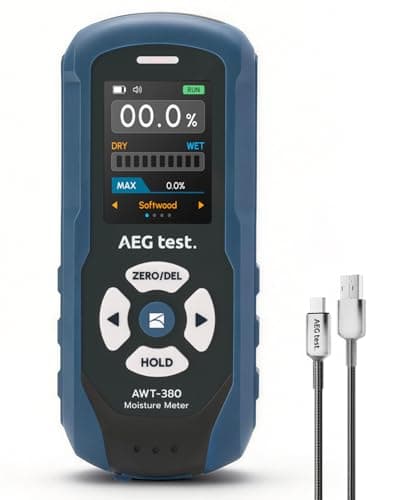
AEGTEST AWT-380 Rechargeable Pinless Moisture Meter (Reads to 0.79 in, Adjustable Alarm, Data Storage)See it on Amazon ↗

Quick Verdict

AEGTEST AWT-380 Rechargeable Pinless Moisture Meter: a settable alarm and stored readings for tracking a drying room, with relative readings only.

Key Specs

Type

Pinless

Reading depth (stated)

Up to 0.79 in (20 mm)

Speed (stated)

Reading within 1 second, two scans per second

Alarm

Adjustable threshold, visual and audible; sound can be turned off

Memory

Max hold and data storage

Power

Built-in rechargeable battery, USB-C

Pros

  • An alarm you set yourself beeps wherever a reading is above your chosen threshold
  • Stored readings make day-to-day comparisons at the same marks easier
  • USB-C charging, so there is no 9V battery to replace
  • Names firewood checks and wall and floor inspection among its uses

Cons

  • States no wood moisture range and no species or density setting, so treat readings as relative
  • Pinless only: no pins to confirm a moisture content figure
  • A newer listing with a shorter buyer record than the other picks

Suited to

Checking a drying room day after day against a threshold you set

Our take

The adjustable alarm is what this meter adds for anyone drying out a room. Set the threshold just above your dry reference reading, sweep the floor or wall, and it beeps wherever moisture is still above that line, so you are not squinting at a screen while kneeling in a closet. Max hold and stored readings help when you compare the same taped marks each morning. The listing gives a reading depth of up to 0.79 in (20 mm) and a USB-C rechargeable battery. What it leaves out is a wood moisture range or any species or density setting, so its numbers are best used to compare one spot with another. For a moisture content figure you will hold a repair to, use a pin meter.

Check today's price on Amazon →

Affiliate link — commission at no extra cost to you

Buyer's Guide

What to know before you buy.

Pin or Pinless: What Each Type Actually Reads

A pin meter passes a small current between two steel pins and converts the wood's electrical resistance into moisture content. It reads only the wood between the pin tips, at the depth you push them, and it leaves two small holes. A pinless meter presses a flat sensor pad against the surface and reads a block of material beneath it to a fixed depth: 3/4 in on the General Tools MMD7NP and 0.79 in on the AEGTEST AWT-380, per their listings. It leaves no marks and can sweep a floor in a minute, but it needs full, flat contact, and it reads everything inside that block, including finish, glue and metal. For wood, the practical split is simple. Use pinless to find where a wet area starts and stops, and pins to put a number on the worst spot and on anything you plan to burn, sand or cover.

Species Settings, and Why Two Meters Disagree

Different species conduct current differently at the same moisture content, and pinless meters respond to density as much as to water. That is why better meters ask what you are measuring. Among these picks, only the General Tools MMD7NP lists separate softwood and hardwood scales; the MMD4E, LASELION MS03 and AEGTEST AWT-380 listings name no species setting. Without one, a reading on oak, maple or a tropical hardwood is an estimate that can be off by a few points. Temperature moves pin readings too: cold wood in a winter crawl space reads lower than it really is on most resistance meters. For water damage this matters less than it seems, because you compare wet wood with dry wood of the same kind, on the same meter and setting, so most of the error cancels. For a flooring install with a written moisture limit, use the meter maker's species chart.

Reading a Subfloor and Framing After a Leak

Start with a dry reference: read the same material in a room the water never reached, such as subfloor in a closet across the house, and write the number down. Then work outward from the wet spot in a rough grid about a foot apart until readings fall back to that reference, marking each spot with tape so tomorrow's reading lands in the same place. From a basement or crawl space, push pins into the underside of the subfloor and the side of each joist below the wet area. As general guidance, wood that stays above about 20% moisture content can support mold, and dry framing in a heated house usually reads well under 15%, but your own reference beats any chart. Plywood and OSB contain glue, so treat their numbers as relative. Drying is done when the wet marks match the reference for several days running.

Firewood: Split a Piece and Read the Fresh Face

EPA's Burn Wise program advises burning wood with a moisture content below 20% and testing it with a wood moisture meter first. The outside of a log dries long before the middle, so a reading on bark or a weathered end says little. Pull a piece from the middle of the stack, split it, and read the freshly split face straight away, near the center of the piece rather than the ends. A pin meter suits this job: split faces are rough, and a pinless pad needs flat, full contact to read properly. Check three or four pieces from different parts of the stack, since the top and the windward side dry first. If most read above 20%, give the stack more time, stored off the ground with the top covered and the sides open, as Burn Wise suggests. Dense oak and light pine can read differently at the same real moisture on a meter without a species setting.

What a Wood Moisture Meter Cannot Tell You

A moisture meter measures water, not mold, rot or strength. Wood can dry out with mold still on its surface, and a joist that reads normal can still be soft from old decay, so probe anything suspicious with a screwdriver. Readings on drywall and concrete are relative on most of these meters, as the MMD7NP listing says outright, so a 12 on drywall is not a moisture content and cannot be compared with another brand's 12. Once wood passes its fiber saturation point, roughly 25% to 30%, the cell walls are full and pin readings stop being precise; a high number then means very wet, nothing finer. Surface water, condensation and a freshly mopped floor all give false highs, so wipe and wait before reading. A meter also stops at tile, vinyl or a vapor barrier. A thermal camera can show where to look first.

Who Should Not Rely on a Meter Alone

If the water was sewage or outdoor floodwater, the wet subfloor and anything porous it touched are a sanitation problem as well as a drying one, and a dry reading does not make them safe. The same applies to a floor that feels soft or sags, a whole floor of wet subfloor, or mold covering more than about 10 square feet, the size above which EPA no longer treats cleanup as a job most homeowners can handle themselves. A restoration company working to the IICRC S500 standard for water damage records readings on a moisture map and brings them down with industrial dehumidifiers and air movers, which also builds the record an insurance claim needs. Renters should report the leak to the landlord in writing before testing or opening anything. A meter earns its place on small, clean-water leaks you can dry yourself, on checking a finished repair, and on firewood and woodworking. It measures; it does not dry anything.

Frequently Asked Questions

What is a good moisture reading for wood?

It dependsOn the job: indoor wood in a heated house usually settles in the single digits to low teens, and firewood should be under 20% before burning, per EPA's Burn Wise program.

After a leak, the best target is a dry reference reading from the same kind of wood in an unaffected room, taken with the same meter and setting. Wood that stays above about 20% for days can support mold, so a reading there means keep drying.

Are pinless moisture meters accurate on wood?

They are accurate enough to compare one spot with another, and less exact as a single absolute number. A pinless meter reads a block of wood to a set depth, so the result depends on density, surface contact and anything inside that block, such as nails or glue lines.

Choose the right wood scale, keep the pad flat, and confirm a high reading with pins before you decide to dry, sand or install.

Do I need to set the wood species on a moisture meter?

For an exact moisture content, yes; for finding wet areas, usually not. Species changes how wood conducts current and how dense it is, so a meter set for the wrong group can be a few points off.

When you compare wet subfloor with dry subfloor of the same material, that error appears in both readings and mostly cancels out. Species settings matter most for flooring installs and woodworking, where a written limit is the target.

What moisture content should firewood be?

Below 20%, according to EPA's Burn Wise program, which also advises checking with a wood moisture meter before you burn. Wetter wood spends its heat boiling off water, so it smokes more and burns cooler.

Split a piece and read the fresh inside face, because the outside dries first and will flatter the stack. A pin meter handles the rough split surface better than a pinless pad.

How dry should a subfloor be before installing flooring?

Dry enough to meet the limit in the flooring maker's installation instructions, and steady rather than still falling. Wood flooring instructions commonly set both a maximum subfloor reading and an allowed difference between subfloor and flooring, so read both with the same meter and setting.

After a leak, wait until the wet area matches a dry reference from elsewhere in the house for several days. Laying flooring over a subfloor that is still drying invites cupping.

Can a moisture meter detect mold in wood?

NoA moisture meter detects water, not mold, though it shows you where mold has what it needs to grow.

Wood reading well above your dry reference, or above about 20%, holds enough moisture to support growth if it stays that way. Look and sniff at those spots, and remember that wood can dry out with old growth still on it. Clean visible mold only after the leak is fixed and the wood is dry.

Who do I call right now for water damage?

Call (888) 840-6512. The line is answered 24 hours a day, seven days a week, and connects you with an IICRC-certified water damage restoration company that serves your area. A recorded menu picks up first: choose water damage or mold, key in your 5-digit ZIP code, and hold through the short silence while the call is passed to the company.

Describe what you can see — where the water is coming from, how long it has been there, and whether it smells — the more specific you are, the faster the right company is on the line. If the source is a pipe or an appliance, shut the main water valve first. Have four things ready and the call goes quickly: the address, when the water started, what is wet now, and whether you have filed an insurance claim.

Still not sure which of these is your situation? (888) 840-6512 · toll-free · answered 24/7

Sources

  1. EPA — A Brief Guide to Mold, Moisture, and Your Home
  2. IICRC — ANSI/IICRC S500 Standard for Professional Water Damage Restoration

Methodology: How we source and verify data · Report an error

How we chose these picks

  • Every pick is a current listing. Stock, star ratings and rating counts are read from Amazon by script and carry the date they were read.
  • Nothing under 4.0 stars makes the list, and the top pick needs a large rating count, so one good week of reviews cannot put it there.
  • Specs are quoted from the listing or the maker, with the test condition behind the number where there is one, and sized against the job rather than the room on the box.
  • We do not run lab or field tests. Where a spec matters, we say what it is measured under and what it cannot tell you.

Free 2-day shipping

Amazon Prime members pay no shipping on restoration equipment

Dehumidifiers, air movers, and moisture meters qualify for free Prime delivery — bulk items that otherwise cost $15–$40 to ship.

Try Prime free →

Affiliate link — HearthDry earns a bounty if you sign up; costs you nothing extra.

Also Worth Comparing

Best Moisture Meters for Homeowners in 2026 — Water Damage Detection

A moisture meter tells you what your eyes can't see — wet drywall, soggy subfloor, and moisture in framing. These are the four best moisture meters for homeowners dealing with water damage.

Read the comparison

Best Thermal Cameras for Water Leak Detection in 2026 — Find Hidden Moisture

Water damage behind walls is invisible until it's mold. A thermal camera reveals temperature differentials caused by moisture — identifying wet areas in walls, ceilings, and floors before they become a mold problem.

Read the comparison

Best Mold Remover for Wood in 2026 — Bleach-Free Treatments, Stain Removers, and How to Tell Mold From Rot

Mold on wood needs two different products: one that treats the growth and one that lifts the dark stain it leaves, and on finished wood the first one should not be bleach. These picks are matched to sealed furniture and floors, raw framing and plywood, and outdoor decks, with the screwdriver test that tells you when the wood is rotten and no spray will help.

Read the comparison

Best Hygrometers for Home in 2026 — Indoor Humidity Monitors That Tell You When a Room Is Too Damp

A hygrometer is the small, inexpensive instrument that tells you whether a room needs a dehumidifier, a humidifier or nothing at all. These picks are judged on the accuracy each listing states, how easily you can read them, and whether they can warn you about a damp basement before you smell it.

Read the comparison

Best Air Movers (Airmovers) for Water Damage Drying in 2026

Air movers dry wet carpet, walls and floors by keeping a fast stream of air on the wet surface. These are three air movers for residential water damage, plus a high-velocity floor fan to use beside them.

Read the comparison