FLIR ONE Review 2026 — The Pro, the Edge Pro and the C5 Compared From Their Listings, Which One Fits Your Phone, and What a Thermal Camera Can and Cannot Tell You About a Leak

FLIR ONE Review 2026

The Pro, the Edge Pro and the C5 Compared From Their Listings, Which One Fits Your Phone, and What a Thermal Camera Can and Cannot Tell You About a Leak

5 picks compared · prices, ratings and stock checked October 13, 2026

Our Top Pick

For an iPhone 14 or older, the FLIR ONE Pro for iOS with the Lightning connector; for an iPhone 15 or newer, the same camera in its USB-C version. If you want one camera that pairs with any phone and can be held around a corner while you watch the screen, the FLIR ONE Edge Pro. Confirm every cold patch with a pinless moisture meter before you cut.

4.5 on Amazon · 2,340 ratings

Quick answer

A FLIR ONE shows temperature difference, not water, and the one to buy depends on your phone's port: for an iPhone 14 or older, the FLIR ONE Pro for iOS with the Lightning connector, rated 4.5 stars across 2,340 Amazon ratings, which has a 160 x 120 native thermal sensor upscaled to 480 x 360 with MSX edge detail, per the listing. An iPhone 15 or newer takes the USB-C version of the same camera, and the FLIR ONE Edge Pro connects to any iOS or Android phone over Bluetooth. A wet wall reads cooler because evaporation cools it, so confirm each cold patch with a moisture meter before anything is opened.

Our Picks at a Glance

Every pick below is currently stocked — ratings and stock read from Amazon on 13 October 2026.

Best FLIR ONE for iPhone 14 and Older
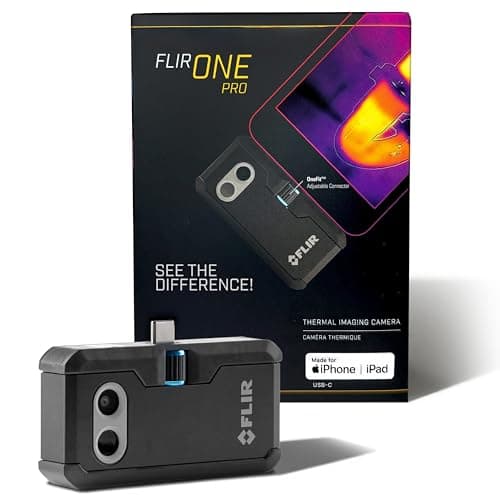
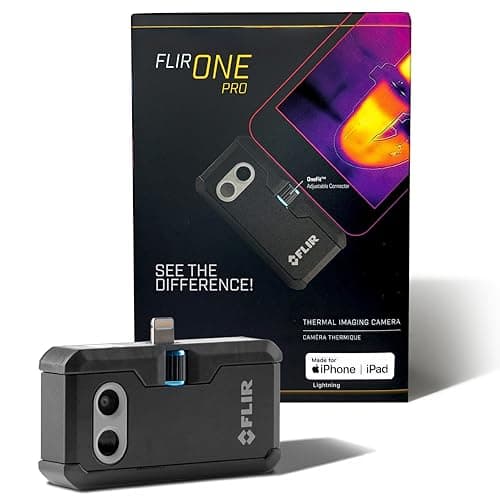
FLIR ONE Pro for iOS, Lightning Connector (iPhone 14 and Older; 160 x 120 Native, 480 x 360 Upscaled, MSX)
4.5 from 2,340 Amazon ratings · checked 13 Oct

Best for: iPhone 14 or older owners who want the sharpest FLIR ONE image for tracing a wet patch across a wall or ceiling

Phone fit (stated):
Plugs into the Lightning port; iPhone 14 and older
Thermal sensor (stated):
160 x 120 native, upscaled to 480 x 360 by Vivid IR

Listing verified 13 Oct 2026

Best for Any Phone, Wireless
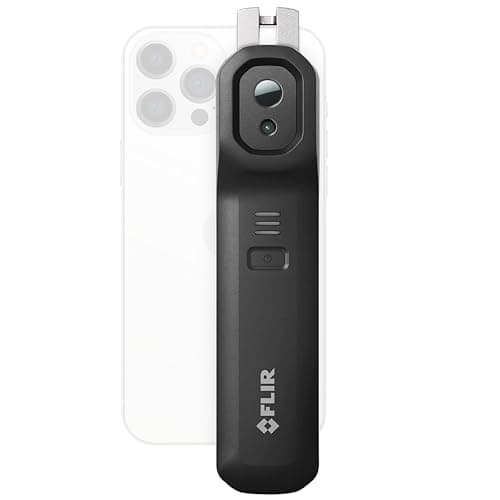
FLIR ONE Edge Pro Wireless Thermal Camera (Bluetooth to iOS or Android; 160 x 120 Native, 480 x 360 Upscaled)
4.1 from 348 Amazon ratings · checked 13 OctAmazon's Choice

Best for: A household with mixed phones, or anyone who needs to aim the camera where a phone cannot go

Connection (stated):
Bluetooth, with any iOS or Android device
Thermal sensor (stated):
160 x 120 native, upscaled to 480 x 360 by Vivid IR, with MSX

Listing verified 13 Oct 2026

If Not FLIR: Higher Native Resolution
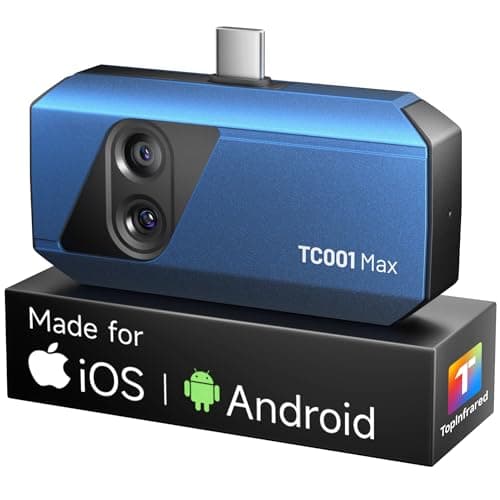
TOPDON TC001 Max Dual-Lens Thermal Camera for Phones (USB-C and Lightning Adapters; 256 x 192 Native, ≤40 mK)
4.5 from 132 Amazon ratings · checked 13 OctAmazon's Choice

Best for: Anyone choosing on sensor numbers rather than the FLIR name, or who owns both an older and a newer iPhone

Thermal sensor (stated):
256 x 192 native, enhanced to 512 x 384 by TISR
Sensitivity (stated):
≤40 mK NETD, 25 Hz refresh

Listing verified 13 Oct 2026

How this page was made: we compare the current Amazon listings, the makers' published specs and what verified buyers report, then rank by fit for the job. Ratings, review counts and stock are read from Amazon and dated. We earn a commission on purchases through our links; it does not change the order. Reviewed by Marcus Reed, IICRC-certified Water Restoration Technician.

Full Reviews

Each pick in detail: what the listing states, what buyers report, and where it falls short.

#1
Best FLIR ONE for iPhone 14 and Older

Check price

on Amazon ↗

Listing verified 13 Oct 2026

FLIR ONE Pro for iOS, Lightning Connector (iPhone 14 and Older; 160 x 120 Native, 480 x 360 Upscaled, MSX)See it on Amazon ↗

Quick Verdict

FLIR ONE Pro for iOS, Lightning: the sharpest FLIR ONE image on an older iPhone, as long as your phone still has the port.

Key Specs

Phone fit (stated)

Plugs into the Lightning port; iPhone 14 and older

Thermal sensor (stated)

160 x 120 native, upscaled to 480 x 360 by Vivid IR

MSX (stated)

Merges the thermal and visible images to add edge detail in real time

Accuracy (stated)

±3°C or ±5%, with the unit at 15–35°C and the scene at 5–120°C

Measurement range

Not stated on the listing

Drop rating (stated)

1.5 m

Pros

  • The strongest buyer record of any FLIR ONE listing read for this page
  • 160 x 120 native pixels, four times the 80 x 60 sensor in the Gen 3 FLIR ONE
  • MSX edge detail puts a cold patch on an outline of the real baseboard, stud or pipe run
  • Stated accuracy covers the 5–120°C scene range a house falls inside

Cons

  • Lightning only, so it does nothing on an iPhone 15 or newer without the separate USB-C version
  • The listing showed limited stock when it was read
  • Battery life and measurement range are not stated on the listing

Suited to

iPhone 14 or older owners who want the sharpest FLIR ONE image for tracing a wet patch across a wall or ceiling

Our take

The FLIR ONE Pro's number that matters is 160 x 120. That is the native thermal sensor, 19,200 points of temperature; the 480 x 360 in the title is the same data upscaled by software, which smooths the picture but adds no new measurements. MSX then traces edges from the phone's visible camera onto the thermal image, so a cool patch sits on the outline of the vanity or the ceiling vent instead of floating in a color blob, and that outline is what lets you mark the wall. The stated accuracy of ±3°C or ±5% is fine for leak work, because you are comparing one patch of wall with the patch beside it, not measuring. The catch is the port. This is the Lightning version, and stock was limited when the listing was read.

Check today's price on Amazon →

Affiliate link — commission at no extra cost to you

Compare elsewhere

These open a search for this model. We quote prices only where we can verify them — Amazon, Sylvane and eBay.

#2
Best FLIR ONE for iPhone 15 and Newer

Check price

on Amazon ↗

Listing verified 13 Oct 2026

FLIR ONE Pro for iOS, USB-C Connector (iPhone 15 and Newer; 160 x 120 Native, 480 x 360 Upscaled, MSX)See it on Amazon ↗

Quick Verdict

FLIR ONE Pro for iOS, USB-C: the same Pro sensor on an iPhone 15 or newer, with the shorter buyer record a newer listing carries.

Key Specs

Phone fit (stated)

Plugs into the USB-C port; iPhone 15 and newer

Thermal sensor (stated)

160 x 120 native, upscaled to 480 x 360 by Vivid IR

MSX (stated)

Thermal and visible images merged for edge detail

Accuracy (stated)

±3°C or ±5%, unit at 15–35°C, scene at 5–120°C

Drop rating (stated)

1.5 m

Android version

The FLIR ONE Pro for Android USB-C is a separate listing

Pros

  • The same 160 x 120 sensor and MSX as the Lightning Pro, on a current iPhone with no adapter
  • In stock when read, unlike the Lightning version
  • Comes with the FLIR ONE app's inspection guides, per the listing

Cons

  • A much shorter buyer record than the Lightning listing, since it is newer
  • Not the version for Android phones, which have their own USB-C listing
  • No battery figure or measurement range on the listing

Suited to

Anyone with an iPhone 15 or newer who wants the Pro's sensor rather than the Gen 3's 80 x 60

Our take

FLIR sells what is in effect one Pro camera under three listings sorted by port: Lightning for iOS, USB-C for iOS, and USB-C for Android. The body and the sensor are the same, and the wrong-port purchase is the mistake buyers describe most, because the box does not make the difference obvious. If your iPhone is a 15 or newer, this is the listing. Beyond the port, the choice between the Pro and the plain FLIR ONE is resolution: the Gen 3 FLIR ONE for USB-C iPhones lists an 80 x 60 native sensor upscaled to 240 x 180, a quarter of the Pro's pixels, which turns a damp patch into a soft blob rather than a shape you can follow along a pipe run. For leak-finding, pay for the Pro.

Check today's price on Amazon →

Affiliate link — commission at no extra cost to you

#3
Best for Any Phone, Wireless

Check price

on Amazon ↗

Listing verified 13 Oct 2026

FLIR ONE Edge Pro Wireless Thermal Camera (Bluetooth to iOS or Android; 160 x 120 Native, 480 x 360 Upscaled)See it on Amazon ↗

Quick Verdict

FLIR ONE Edge Pro: the Pro's sensor without the port problem, in exchange for pairing and a battery of its own.

Key Specs

Connection (stated)

Bluetooth, with any iOS or Android device

Thermal sensor (stated)

160 x 120 native, upscaled to 480 x 360 by Vivid IR, with MSX

Wireless use (stated)

Connects to a phone or tablet wirelessly to see in tight spaces or around corners

Accuracy (stated)

±3°C or ±5%, unit at 15–35°C, scene at 5–120°C

Cloud (stated)

FLIR Ignite upload and sharing

Battery life

Not stated on the listing

Pros

  • No port question at all, so it survives your next phone
  • The camera can go under a sink, into a crawl-space hatch or behind a toilet while the phone stays in your hand
  • Same 160 x 120 sensor and MSX as the Pro, per the listing

Cons

  • A pairing step and a separate battery to keep charged, where the plug-in Pro just works
  • The plain FLIR Edge is a different camera with an 80 x 60 sensor under a near-identical name
  • Battery life and any water or dust rating are not stated on the listing

Suited to

A household with mixed phones, or anyone who needs to aim the camera where a phone cannot go

Our take

The Edge Pro answers the complaint that runs through every plug-in FLIR ONE review: the camera is stuck to the phone, so the phone has to go wherever the camera goes. With a Bluetooth link, the camera clips off and can be pointed at the underside of a subfloor from a crawl-space hatch, up behind a tub apron or into the back of a vanity while you watch the picture in the other hand. The sensor is the Pro's 160 x 120 with the same upscale and MSX, per the listing. What you take on is a pairing step and a second battery to charge, and the listing gives no battery life, so plan to charge it before each session. Be sure the listing says Edge Pro; the plain Edge has the 80 x 60 sensor.

Check today's price on Amazon →

Affiliate link — commission at no extra cost to you

#4
Best FLIR Handheld

Check price

on Amazon ↗

Listing verified 13 Oct 2026

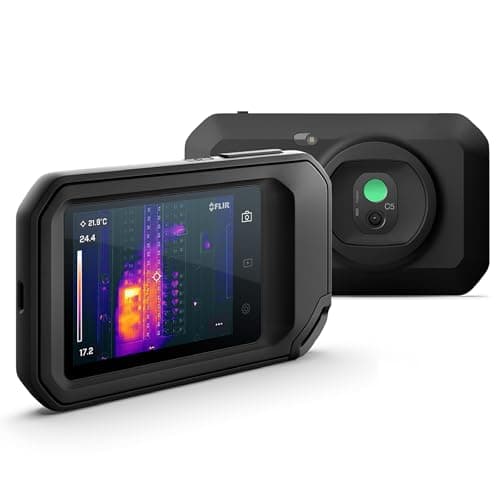
FLIR C5 Compact Thermal Camera (Handheld, 160 x 120 True Thermal, -20 to 400°C, Wi-Fi, 2-10 Warranty)See it on Amazon ↗

Quick Verdict

FLIR C5: the Pro's sensor in a standalone body with a stated range and a 10-year detector warranty, if the listing is in stock when you look.

Key Specs

Type

Pocket handheld with its own screen; no phone needed

Thermal sensor (stated)

160 x 120 true thermal, 19,200 pixels, with MSX

Measurement range (stated)

-20 to 400°C (-4 to 752°F)

Cloud (stated)

FLIR Ignite upload for reports and sharing

Warranty (stated)

2 years parts and labor, 10 years on the detector

Screen size

Not stated on the listing

Pros

  • Works with no phone, app update or port, so anyone in the house can pick it up and scan
  • States a measurement range, which the FLIR ONE listings do not
  • A 2-year camera and 10-year detector warranty, per the listing

Cons

  • Showed a future availability date when read, so check stock
  • The same 160 x 120 sensor as the FLIR ONE Pro, so the extra cost buys the body and warranty, not more pixels
  • Screen size is not stated on the listing

Suited to

A homeowner or landlord who wants a standalone camera that outlasts phone changes and carries a long detector warranty

Our take

A handheld earns its place when the phone is the weak link: a shared household, a landlord handing the camera to a tenant or a handyman, or anyone tired of adapters. The C5 has the same 160 x 120 sensor as the FLIR ONE Pro, which means the thermal picture is the same; what changes is a screen of its own, a stated -20 to 400°C range, Ignite cloud upload for a report you can send to an insurer or a contractor, and the 2-10 warranty with ten years on the detector. FLIR's other handhelds in the candidate set sort by sensor: the C3-X lists 128 x 96 and -20 to 300°C, the TG165-X is a spot thermometer with a 4,800-pixel image and a laser, the E5 Pro matches the C5's 160 x 120, and the C8 lists 320 x 240. All carry the same 2-10 warranty.

Check today's price on Amazon →

Affiliate link — commission at no extra cost to you

#5
If Not FLIR: Higher Native Resolution

Check price

on Amazon ↗

Listing verified 13 Oct 2026

TOPDON TC001 Max Dual-Lens Thermal Camera for Phones (USB-C and Lightning Adapters; 256 x 192 Native, ≤40 mK)See it on Amazon ↗

Quick Verdict

TOPDON TC001 Max: more native pixels and a stated 40 mK sensitivity for less, with a shorter record and a different app.

Key Specs

Thermal sensor (stated)

256 x 192 native, enhanced to 512 x 384 by TISR

Sensitivity (stated)

≤40 mK NETD, 25 Hz refresh

Measurement range (stated)

-20 to 550°C (-4 to 1,022°F), ±2°C or ±2%

Phone fit (stated)

USB-C and Lightning adapters for iPhone, Android and Windows; no battery, plug-and-play

Lenses (stated)

Thermal plus a visible-light camera for sharper outlines

Size (stated)

7.1 x 4.2 cm, 33 g

Pros

  • 256 x 192 native pixels, more than two and a half times the FLIR ONE Pro's 160 x 120
  • States a 40 mK sensitivity figure, which no FLIR ONE listing gives
  • Lightning and USB-C adapters in one box, so it moves from an older iPhone to a newer one
  • Draws power from the phone, so there is no camera battery to forget

Cons

  • A shorter buyer record than the FLIR ONE Pro listings
  • The visible-light overlay is TOPDON's own, not FLIR's MSX, and the app has more settings to learn
  • Drawing power from the phone shortens the phone's battery during a long scan

Suited to

Anyone choosing on sensor numbers rather than the FLIR name, or who owns both an older and a newer iPhone

Our take

On paper the TC001 Max wins the two numbers that matter for leak work. Its native sensor is 256 x 192, which is 49,152 temperature points against the FLIR ONE Pro's 19,200, and it states a sensitivity of 40 mK, meaning a difference of about 0.04°C can register. A damp patch on drywall is often only a degree or two cooler than the dry wall beside it, so sensitivity does more for you than a wide range. The listing also puts both a Lightning and a USB-C adapter in the box, which sidesteps the port confusion that splits the FLIR ONE Pro across three listings. The trade is a smaller buyer record, a different app, and the fact that FLIR's MSX edge overlay is a known quantity while TOPDON's dual-lens overlay is its own approach. The 25 Hz refresh keeps the picture smooth as you sweep.

Check today's price on Amazon →

Affiliate link — commission at no extra cost to you

Buyer's Guide

What to know before you buy.

What a Thermal Camera Shows, and Why It Is Not a Moisture Meter

A thermal camera sees surface temperature and nothing else. Wet drywall, plaster or subfloor usually reads a little cooler than the dry material around it because water evaporating from the surface carries heat away, so a leak shows up as a cool shape: a triangle spreading down from a window, a line following a pipe run, a pool on a ceiling under a bathroom. The camera does not see water, and it does not see through anything. Cold air leaking around a window, an uninsulated stud bay, a duct in the wall or the shadow of a cabinet can all read cooler too. That is why every cool patch gets checked with a pinless moisture meter before a wall is opened. EPA's mold guide lists the back side of drywall and the inside of walls around pipes among the places mold hides, which is exactly where a camera plus a meter earn their keep.

Native Resolution vs Upscaled: 80 x 60, 160 x 120, 256 x 192

Every listing here prints two resolutions, and only the smaller one is real. The FLIR ONE Pro's sensor is 160 x 120, which is 19,200 temperature readings; Vivid IR upscales that to 480 x 360 on screen, and TOPDON's TISR does the same from 256 x 192 to 512 x 384. Upscaling smooths the picture and makes it easier to look at, but it invents no new readings. The Gen 3 FLIR ONE and the plain FLIR Edge list 80 x 60, which is 4,800 readings, and at that count a damp patch across a room is a soft blob. The second number to look for is sensitivity, written as NETD in mK: TOPDON states 40 mK, the FLIR ONE listings state none. Lower is better, and for a wall that is only a degree cooler where it is wet, sensitivity matters more than a wide temperature range you will never use.

Which FLIR ONE Fits Your Phone: Lightning, USB-C or Wireless

FLIR sorts its phone cameras by connector, and the listings are easy to mix up. The FLIR ONE Pro comes as a Lightning version for iPhone 14 and older, a USB-C version for iPhone 15 and newer, and a USB-C version for Android, each a separate listing with the same 160 x 120 sensor. The Gen 3 FLIR ONE, also sold by port, has the 80 x 60 sensor. The Edge Pro drops the connector and pairs over Bluetooth with any iOS or Android device, per its listing, so it is the one that survives a phone upgrade. Before you buy, look at the bottom of your phone, then check the listing's compatibility bullet rather than the title. The plug-in cameras put the phone wherever the camera needs to be; the Edge Pro lets you reach into a hatch or under a sink with the camera alone.

Phone Attachment or FLIR Handheld

FLIR's compact handhelds in the candidate set are the C3-X, C5, C8, E5 Pro and the TG165-X and TG268 spot cameras. Per their listings, the C3-X has a 128 x 96 sensor and reads -20 to 300°C, the C5 and E5 Pro have 160 x 120 and read -20 to 400°C, the C8 has 320 x 240, and the TG165-X is a spot thermometer with a 4,800-pixel image, a laser pointer and a -25 to 300°C range. All of them carry FLIR's 2-10 warranty, two years on the camera and ten on the detector, and the C-series and E5 Pro upload to Ignite cloud for reports. A handheld makes sense when the phone is the problem: shared use, a tenant or contractor who needs to borrow it, or a report you want to send to an insurer. For a homeowner who scans a few times a year, the FLIR ONE Pro delivers the same 160 x 120 picture as the C5 on the phone already in your pocket.

How to Scan a Room for a Leak With a Phone Thermal Camera

Make a temperature difference first, because the camera can only show one. Run hot water for ten minutes to warm a supply line, run the heat or the air conditioning so the wall surfaces and the wet spots drift apart, or scan right after rain for a roof or window leak. Hold the phone square to the wall from a few feet back and sweep slowly across the ceiling below a bathroom, the base of exterior walls, around windows and along the wall behind a toilet, tub or dishwasher. Use a high-contrast palette, lock the temperature span once a suspect patch appears so the colors stop shifting, and take an MSX photo so the edges of the trim show in the image. Then put a pinless moisture meter on the center of the cool patch and on dry wall a foot away. Mark the wet edge with tape; that outline is what a contractor or an adjuster needs.

Who Should Not Buy a FLIR ONE, and When to Call a Pro

Skip the camera if the leak is already visible and you only need to know how far it spread; a moisture meter alone answers that. Skip it for a suspected slab leak, because the camera reads the floor's surface and a line a few inches down in concrete may show nothing; a plumber with leak-detection equipment is the right call. Skip it if the job is an insurance claim on a large loss, where an adjuster expects a professional moisture map; our guide on moisture mapping explains what that includes. EPA advises drying water-damaged areas within 24 to 48 hours to prevent mold and calling a professional when mold covers more than about 10 square feet. If the camera and meter show a wet area you cannot dry in that window, the referral line on this site reaches restoration companies that do the drying and the mapping. It is not a plumbing service.

Frequently Asked Questions

Is the FLIR ONE Pro worth it?

For finding where a leak has spread, yes, provided you buy the version that fits your phone's port. Its 160 x 120 native sensor is four times the Gen 3 FLIR ONE's 80 x 60, which is the difference between a shape you can trace along a wall and a blur.

The listing states accuracy of ±3°C or ±5%, which is enough because leak work compares one patch of wall with the next. Pair it with a moisture meter; the camera alone cannot confirm water.

Does the FLIR ONE Pro work with iPhone 15?

Only the USB-C version does. FLIR lists the Pro three ways, Lightning for iPhone 14 and older, USB-C for iPhone 15 and newer, and USB-C for Android, each as a separate listing, and the Lightning camera does not fit a USB-C phone.

If you may change phones soon, the FLIR ONE Edge Pro pairs over Bluetooth with any iOS or Android device, per its listing, so the port stops mattering.

What is the difference between the FLIR ONE Pro and the FLIR ONE Edge Pro?

The connection. Both list a 160 x 120 native sensor upscaled to 480 x 360 with MSX and the same stated accuracy; the Pro plugs into the phone's port, while the Edge Pro pairs over Bluetooth and can be held away from the phone to see into tight spaces and around corners, per its listing.

The Edge Pro carries its own battery and needs pairing. Do not confuse it with the plain FLIR Edge, which lists an 80 x 60 sensor.

Can a FLIR camera see water leaks behind walls?

It can show where a wall is cooler, which is often where it is wet, because evaporation cools a damp surface. It cannot see through the wall or see water itself, and the picture only appears when there is a temperature difference, so run hot water or the heating first.

Cold air leaks, missing insulation and ducts read cool too. Confirm every cool patch with a pinless moisture meter before cutting drywall.

What does MSX mean on a FLIR camera?

MSX is FLIR's method of taking the edges from the phone's visible-light camera and drawing them onto the thermal image in real time, per the listings.

The thermal picture on its own is a field of color with no outlines; with MSX you can see the baseboard, the outlet, the tile edge and the vent inside the thermal view. For leak work that matters, because it is how you know which stud bay or which run of ceiling the cool patch belongs to.

Is 160 x 120 resolution enough for finding leaks?

YesFor walls, ceilings and floors scanned from a few feet away, which is what a homeowner does. At 160 x 120 a damp patch keeps its shape, so you can follow it toward its source.

The 80 x 60 sensors in the Gen 3 FLIR ONE and the plain Edge are the ones that struggle. If you want more, the TOPDON TC001 Max lists a 256 x 192 native sensor and a 40 mK sensitivity, and sensitivity helps more than pixels when the wet spot is barely cooler than the dry wall.

Who do I call right now for water damage?

Call (888) 840-6512. The line is answered 24 hours a day, seven days a week, and connects you with an IICRC-certified water damage restoration company that serves your area. A recorded menu picks up first: choose water damage or mold, key in your 5-digit ZIP code, and hold through the short silence while the call is passed to the company.

Describe what you can see — where the water is coming from, how long it has been there, and whether it smells — the more specific you are, the faster the right company is on the line. If the source is a pipe or an appliance, shut the main water valve first. Have four things ready and the call goes quickly: the address, when the water started, what is wet now, and whether you have filed an insurance claim.

Still not sure which of these is your situation? (888) 840-6512 · toll-free · answered 24/7

Sources

  1. EPA — A Brief Guide to Mold, Moisture, and Your Home
  2. EPA — Mold Cleanup in Your Home

Methodology: How we source and verify data · Report an error

How we chose these picks

  • Every pick is a current listing. Stock, star ratings and rating counts are read from Amazon by script and carry the date they were read.
  • Nothing under 4.0 stars makes the list, and the top pick needs a large rating count, so one good week of reviews cannot put it there.
  • Specs are quoted from the listing or the maker, with the test condition behind the number where there is one, and sized against the job rather than the room on the box.
  • Each comparison is reviewed by Marcus Reed, an IICRC-certified Water Restoration Technician, against the IICRC drying standards and public guidance listed under Sources.

Free 2-day shipping

Amazon Prime members pay no shipping on restoration equipment

Dehumidifiers, air movers, and moisture meters qualify for free Prime delivery — bulk items that otherwise cost $15–$40 to ship.

Try Prime free →

Affiliate link — HearthDry earns a bounty if you sign up; costs you nothing extra.

Also Worth Comparing

Best Thermal Cameras for Water Leak Detection in 2026 — Find Hidden Moisture

Water damage behind walls is invisible until it's mold. A thermal camera reveals temperature differentials caused by moisture — identifying wet areas in walls, ceilings, and floors before they become a mold problem.

Read the comparison

Best Moisture Meters for Homeowners in 2026 — Water Damage Detection

A moisture meter tells you what your eyes can't see — wet drywall, soggy subfloor, and moisture in framing. These are the four best moisture meters for homeowners dealing with water damage.

Read the comparison

Best Inspection Camera in 2026 — Borescopes for Seeing Inside a Wall Through a Small Hole, Before You Cut

A borescope lets you look inside a wall cavity or behind a cabinet through a 3/8 in hole, so you can see a drip, a stain or mold before you cut drywall. These five cameras are compared from their listings on probe size, side view, cable, light and recording, with the drilling arithmetic and safety points the product pages leave out.

Read the comparison

Best Water Leak Detectors in 2026 — Wi-Fi and Smart Sensors That Alert Your Phone

Most homeowners do not discover a leak until it has soaked into subfloor and drywall. A Wi-Fi water leak detector sends the alert to your phone while the water is still on the floor, whether or not anyone is home to hear a siren.

Read the comparison

Best Hygrometers for Home in 2026 — Indoor Humidity Monitors That Tell You When a Room Is Too Damp

A hygrometer is the small, inexpensive instrument that tells you whether a room needs a dehumidifier, a humidifier or nothing at all. These picks are judged on the accuracy each listing states, how easily you can read them, and whether they can warn you about a damp basement before you smell it.

Read the comparison