
Quick answer
Moisture mapping records meter readings across a floor plan so wet areas are documented as numbers, not guesses. Thermal imaging supports it by showing cooler evaporating surfaces, which reveals how far water travelled behind walls — but a thermal camera detects temperature, not moisture, so every suspect area still needs meter confirmation. Together they define the true drying scope and the insurance file. Call (888) 840-6512 to reach a certified water damage restoration company in your area; the line is answered 24/7.
Written & reviewed by Marcus ReedIICRC WRT
Reviewed July 2, 2026· Next review Jan 2027
The Thing Nobody Tells You About Thermal Cameras
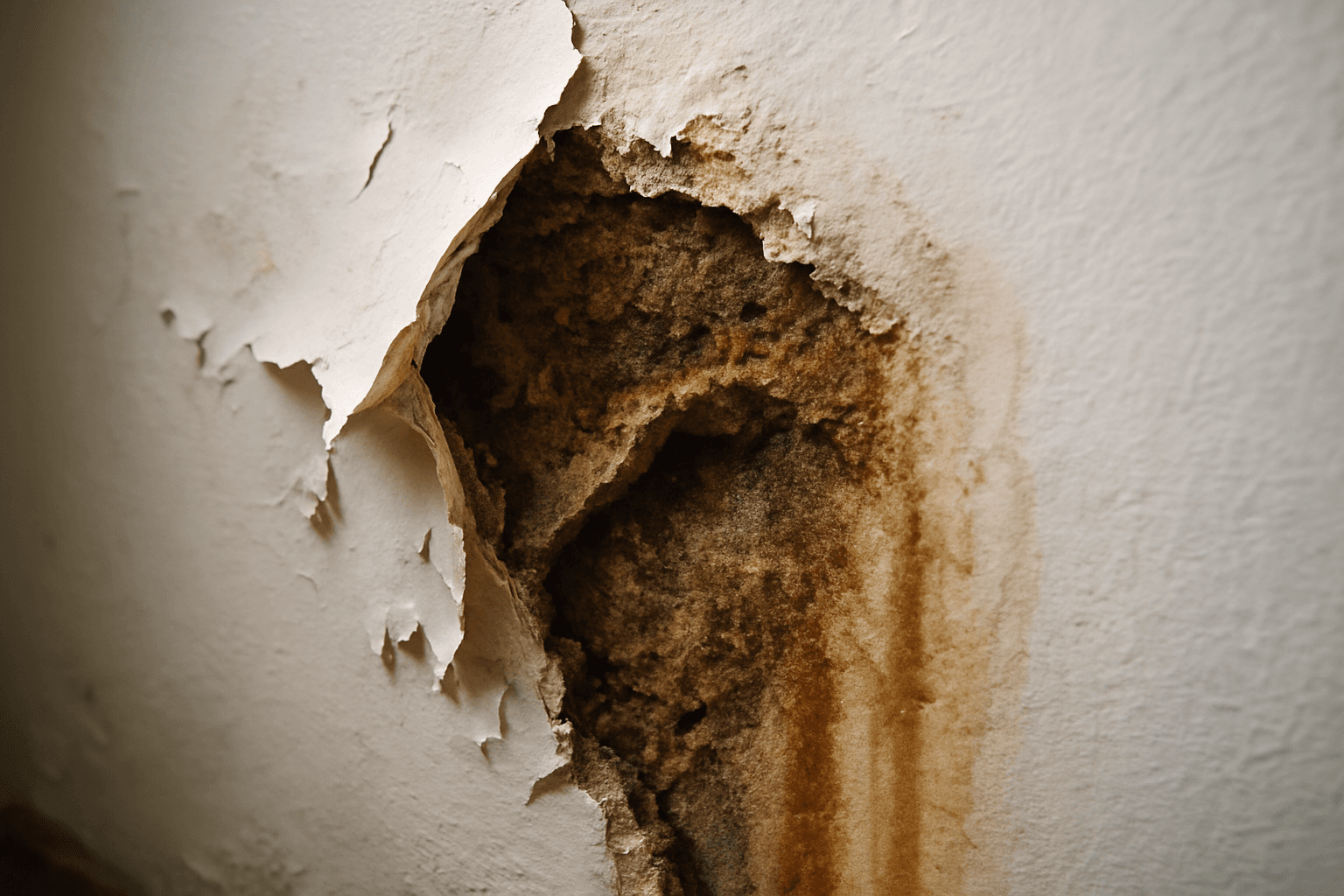
A thermal camera cannot see moisture. It sees temperature. Wet materials show up because evaporation cools them, so they read colder than the dry material around them — but a cold draft, a missing patch of insulation, a chilled water pipe and a shaded exterior wall all produce the same signature.
This matters because thermal imaging is now the industry's favorite sales prop. An impressive photo of a blue plume across your ceiling is a lead, not a finding. Any competent technician confirms every thermal anomaly with a moisture meter before writing it into a scope, and you are entitled to ask them to do it in front of you.
The Two Meters That Do the Confirming
| Pinless (non-invasive) | Pin (invasive) | |
|---|---|---|
| How it works | Radio frequency field reads roughly ¾–1½ inches into the material | Two probes measure electrical resistance between them |
| Leaves marks | No | Yes — two small holes |
| Gives true %MC | No — a relative scale | Yes, in wood and drywall |
| Best used for | Fast scanning of large areas | Confirming a specific spot, checking depth |
The correct workflow uses all three tools in sequence: thermal camera to find suspects, pinless meter to scan them, pin meter to confirm and quantify. Anyone skipping straight from camera to demolition is guessing with expensive tools.
The Dry Standard — The Concept That Makes Readings Mean Anything
A moisture reading on its own is close to meaningless. Wood in a Phoenix home in June and wood in a Seattle home in January sit at very different normal moisture contents.
So technicians establish a dry standard: a reading taken from the same material in an unaffected part of the same building. That becomes the target. Drying is complete when affected materials return to the dry standard, not when they hit some universal number.
If a crew tells you your wall is "at 18%" without telling you what the unaffected wall reads, the number is not yet information. Our structural drying guide covers how these targets are set and verified.
Talk to a water damage pro now
Answered 24/7 · Toll-free · answered 24/7 · no obligation
(888) 840-6512- Describe the damage & give your ZIP
- You're routed to the on-call local crew
- They quote — you decide, no obligation
What a Moisture Map Is
A moisture map is a drawing of the affected area with readings recorded at marked, numbered locations — the same locations, re-read every day. It is the document that proves three things:
- 1The full extent of the loss, including water that travelled inside wall cavities and under flooring where nothing is visible
- 2That drying progressed, day by day
- 3That drying finished, against the dry standard
That third point is why this matters at claim time. Insurance adjusters accept documented readings; they do not accept "it looked dry". A restoration company that maps properly is also building your claim file, and one that does not is leaving you to argue the scope with a photograph.
Where Water Hides — and Where to Aim the Camera
Water travels sideways and downward through paths you cannot see. Ask specifically about:
- Wall cavities below the entry point, especially at the bottom plate
- Under the flooring — a dry-looking laminate surface commonly sits on a soaked subfloor
- The ceiling below, if water came from an upper floor
- Insulation, which holds water and dries very slowly
- Behind cabinets and vanities, where kickboards trap moisture
- The adjacent room — water crosses the bottom plate and appears somewhere nobody suspected
The hidden water damage guide covers the signs a homeowner can spot without instruments.
What to Ask For
- 1Show me the moisture map — before demolition, and before you sign anything.
- 2What is the dry standard for this material?
- 3Did you confirm the thermal image with a meter?
- 4Can I have the daily readings in the final report? — you want them for the claim.
Bottom Line
Thermal imaging finds suspects fast and is genuinely valuable; it does not detect water and it proves nothing on its own. Insist that anomalies are meter-confirmed, that readings are compared against a dry standard, and that you receive the daily log. A crew that documents properly costs the same as one that does not, and the paperwork is what wins the claim.
Reading to confirm what you already suspect?
Confirm it in two minutes instead — the pro on this line answers questions about YOUR situation all day: what it is, what it should cost, whether you even need service. If you want, they'll set the appointment on the same call.
Toll-free · no obligation · asking costs nothing
Frequently Asked Questions
What should homeowners know about moisture mapping and thermal imaging for water damage?
Surface dry does not mean structurally dry — moisture mapping finds hidden damage. Consult an IICRC-certified restoration professional for site-specific assessment.
Does insurance cover this type of water damage?
Coverage depends on whether the event was sudden and accidental vs gradual. Document everything and review your policy exclusions.
When should I call a professional?
Call immediately if water affects multiple rooms, involves Category 2 or 3 water, or drying cannot begin within 24 hours.
How does IICRC S500 apply?
IICRC S500 defines industry-standard inspection, extraction, drying, and documentation requirements that insurers expect.
Where can I find local restoration pros?
Use HearthDry's location finder to connect with IICRC-certified restoration companies in your area.
Who do I call right now for water damage?
Call (888) 840-6512. The line is answered 24 hours a day, seven days a week, and connects you with an IICRC-certified water damage restoration company that serves your area. Describe what you can see — where the water is coming from, how long it has been there, and whether it smells — the more specific you are, the faster the right company is on the line.
If the source is a pipe or an appliance, shut the main water valve first. Have four things ready and the call goes quickly: the address, when the water started, what is wet now, and whether you have filed an insurance claim.
Still not sure which of these is your situation? (888) 840-6512 · toll-free · answered 24/7
Sources
- IICRC S500 — Water Damage Restoration(retrieved 2026-07-02)
- EPA — Mold and Water Cleanup Guidance(retrieved 2026-07-02)
Methodology: How we source and verify data · Report an error
Disclaimer: HearthDry is an independent educational resource. This article is for informational purposes only and does not constitute professional, legal, or insurance advice. Consult licensed professionals before making decisions about your property or insurance claims.
Professional Equipment
The Tools That Make Moisture Mapping Accurate
FLIR and Seek Compact thermal cameras in the $200–$500 range give homeowners and contractors the ability to map wet zones in minutes. Pair with a Protimeter or General Tools pin meter for confirmed readings.
Affiliate link — HearthDry earns a commission from Sylvane via CJ at no extra cost to you
Free 2-day shipping
Amazon Prime members pay no shipping on restoration equipment
Dehumidifiers, air movers, and moisture meters qualify for free Prime delivery — bulk items that otherwise cost $15–$40 to ship.
Affiliate link — HearthDry earns a bounty if you sign up; costs you nothing extra.
Equipment
What each machine actually does
Removes the moisture the structure is still giving off — the machine that decides how long drying takes
See the picks →Moves air across wet surfaces so the dehumidifier has something to take out of the air
See the picks →Finds water behind walls and under floors, and tells you when a material is actually dry
See the picks →Alerts you the moment a leak starts — the cheapest thing on this list and the only preventive one
See the picks →Those pages carry affiliate links. As an Amazon Associate, HearthDry earns from qualifying purchases; it costs you nothing extra.
Our Amazon storefront →Advertisement
