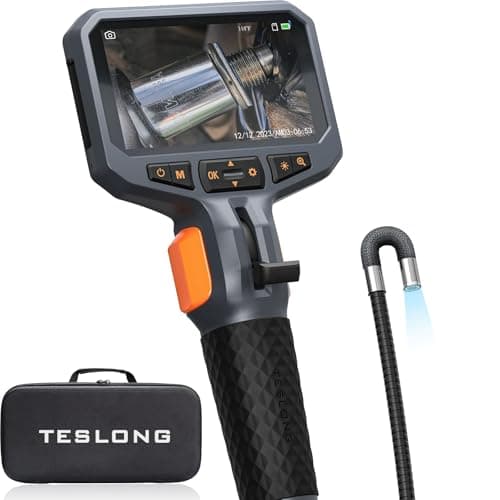
Best for: Looking up and down a wall cavity or behind a cabinet through one small hole
- Probe diameter (stated):
- 8 mm; fits a 3/8 in hole
- Lenses:
- Front and side cameras, switchable, each with its own LEDs
Listing verified 13 Oct 2026

Borescopes for Seeing Inside a Wall Through a Small Hole, Before You Cut
5 picks compared · prices, ratings and stock checked October 12, 2026
Our Top Pick
For looking inside walls, the Teslong NTS300 5 in Dual-Lens Borescope: an 8 mm probe with front and side cameras and its own 5 in screen. To record photos and video on your phone instead, the Kinpthy W400 Dual-Lens Phone Endoscope.
4.6 on Amazon · 3,650 ratings
Quick answer
To look inside a wall before you cut it open, buy a borescope with a probe of 8 mm or less, a side-view lens and its own screen, and for most homeowners that is the Teslong NTS300 5 in Dual-Lens Borescope. Its 8 mm probe passes through a 3/8 in hole, and a button switches from the front camera to a side camera that looks up and down the cavity. The 16.5 ft semi-rigid cable holds a bend, and the 5 in screen needs no phone. A camera shows stains, drips and mold on the back of drywall, but it cannot measure moisture, so confirm with a moisture meter.
Every pick below is currently stocked — ratings and stock read from Amazon on 12 October 2026.
Best for: Looking up and down a wall cavity or behind a cabinet through one small hole
Listing verified 13 Oct 2026
Best for: Steering the view around a wall or ceiling cavity and recording what you find
Listing verified 13 Oct 2026
Best for: Recording what is inside a wall on your phone, to send to a plumber, landlord or insurer
Listing verified 13 Oct 2026
Best for: Peeking into finished walls, cabinets or trim where you want the smallest possible hole
Listing verified 13 Oct 2026
Best for: A quick live look behind a cabinet or inside a wall when no one else needs to see the footage
Listing verified 13 Oct 2026
How this page was made: we compare the current Amazon listings, the makers' published specs and what verified buyers report, then rank by fit for the job. Ratings, review counts and stock are read from Amazon and dated. We earn a commission on purchases through our links; it does not change the order. Reviewed by Marcus Reed, IICRC-certified Water Restoration Technician.
Full Reviews
Each pick in detail: what the listing states, what buyers report, and where it falls short.
Check price
on Amazon ↗
Listing verified 13 Oct 2026
See it on Amazon ↗Best Overall for Wall Cavities
Quick Verdict
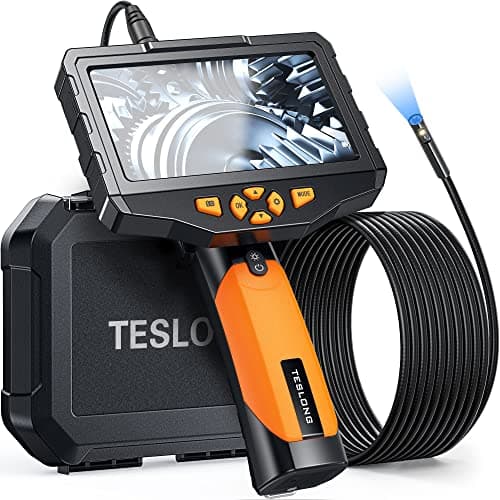
Teslong NTS300 5 in Dual-Lens Borescope: front and side cameras on an 8 mm probe with its own screen, the most practical setup for wall cavities.
Key Specs
Probe diameter (stated)
8 mm; fits a 3/8 in hole
Lenses
Front and side cameras, switchable, each with its own LEDs
Lights (stated)
7 LEDs (6 front, 1 side) with brightness control
Cable (stated)
16.5 ft semi-rigid gooseneck
Screen
5 in IPS, self-contained; no phone, Wi-Fi or app needed
Battery (stated)
5000 mAh, about 4.5 hours of use, about 5 hours to charge
Pros
Cons
Suited to
Looking up and down a wall cavity or behind a cabinet through one small hole
Our take
Inside a wall, the side camera is what earns this one first place. A front lens pushed through drywall mostly stares at the back of the far wall, about 3.5 in away in a 2x4 wall. The side lens turns the view up toward a pipe or down to the bottom plate, where leaking water collects, without bending the cable. The listing gives each lens its own LEDs and puts both on an 8 mm probe that passes through a 3/8 in hole. The 16.5 ft cable is longer than any wall needs, but it also reaches along a crawl space or into a drain. Recording is the open question: the bullets do not describe it, though the details table names AVI and JPEG files, so check before relying on it.
Affiliate link — commission at no extra cost to you
Compare elsewhere
These open a search for this model. We quote prices only where we can verify them — Amazon, Sylvane and eBay.
Check price
on Amazon ↗
Listing verified 13 Oct 2026
See it on Amazon ↗Best Articulating Borescope
Quick Verdict
Teslong TD450S Two-Way Articulating Borescope: a steerable 210° tip and recording to a card, for following a leak around a cavity.
Key Specs
Articulation (stated)
Two-way, 210°, steered by a joystick usable with either hand
Screen (stated)
4.5 in IPS; no app required
Cable (stated)
5 ft semi-rigid gooseneck
Lights (stated)
8 LEDs with adjustable brightness
Recording (stated)
Photo button captures images or video; 32GB card named in the listing title
Waterproofing
IP67, per the listing title
Pros
Cons
Suited to
Steering the view around a wall or ceiling cavity and recording what you find
Our take
Articulation means the tip of the probe bends on command, here through 210 degrees in two directions, steered by a joystick you can work with either thumb. In a wall that turns one hole into a view up to the top of the stud bay and down to the bottom plate; in a ceiling it lets you look along a joist toward a drip. The 5 ft gooseneck is short for drains but right for walls, cabinets and ceilings. A photo button on the back captures images or video, and the listing title names a 32GB card, so you can show a plumber or insurer exactly what you saw. The one gap for wall work is the probe diameter, which the bullets leave out. Measure the tip before choosing a drill bit.
Affiliate link — commission at no extra cost to you
Compare elsewhere
Check price
on Amazon ↗
Listing verified 13 Oct 2026
See it on Amazon ↗Best Phone-Based Camera
Quick Verdict
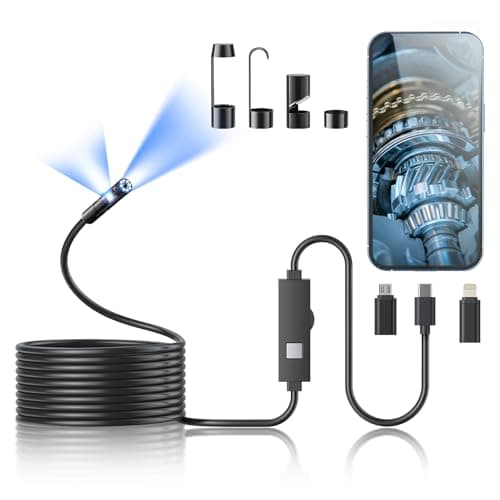
Kinpthy W400 Dual-Lens Phone Endoscope: a 7.9 mm dual-lens probe that records to your phone, with an Android image caveat on its own listing.
Key Specs
Probe diameter (stated)
7.9 mm; use a 3/8 in hole
Lenses
Dual lenses, per the listing title
Resolution (stated)
1920 x 1440 photos and video
Phone (stated)
Plugs into iOS 9.0+ and Android 7+ devices through an app; Lightning, Type-C and Android connectors included
Cable (stated)
16.4 ft semi-rigid
Waterproofing (stated)
IP67; underwater to 3.28 ft for 1 hour
Pros
Cons
Suited to
Recording what is inside a wall on your phone, to send to a plumber, landlord or insurer
Our take
A phone camera trades a built-in screen for the larger one already in your pocket, and recording is where that pays off. The listing states 1920 x 1440 photos and video, saved to the phone where they are easy to send. The probe is 7.9 mm, which is almost exactly the width of a 5/16 in bit, so drill 3/8 in instead. Dual lenses supply the side view that matters inside a cavity, and the 16.4 ft semi-rigid cable comes with Lightning, Type-C and Android connectors. Read the listing's own caution before buying: iOS devices generally show clearer images, and some Android phones may show slight blur. A phone clamp or a second person makes it far easier to steer the cable and watch the screen at the same time.
Affiliate link — commission at no extra cost to you
Compare elsewhere
Check price
on Amazon ↗
Listing verified 13 Oct 2026
See it on Amazon ↗Best for the Smallest Hole
Quick Verdict
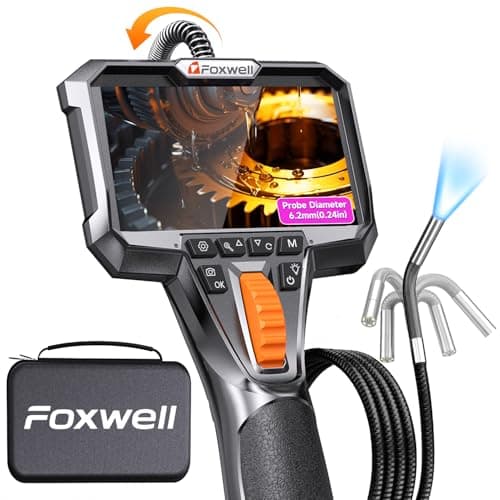
FOXWELL Y400 Two-Way Articulating Borescope: a 6.2 mm steerable probe with zoom and storage, for the smallest hole in a finished wall.
Key Specs
Probe diameter (stated)
6.2 mm (0.24 in); a 5/16 in hole leaves clearance
Articulation (stated)
Two-way, 220°, thumb-wheel control
Zoom (stated)
2X and 4X
Lights (stated)
6 LEDs, 3 brightness levels
Storage (stated)
32GB onboard, photos and video
Battery (stated)
5 to 7 hours of continuous use
Pros
Cons
Suited to
Peeking into finished walls, cabinets or trim where you want the smallest possible hole
Our take
This is the pick when the size of the hole matters most, such as a finished wall you would rather not patch much. Its probe is 6.2 mm (0.24 in), so a 5/16 in bit leaves clearance; a 1/4 in bit, at 6.35 mm, is too tight to feed it comfortably. The tip steers through 220 degrees with a thumb-wheel, and the listing adds 2X and 4X zoom, six LEDs with three brightness levels, 32GB of onboard storage and a stated 5 to 7 hours of battery. It is marketed mainly for engines, valves and HVAC, and the details give a 5.3 ft cable, which is plenty for a wall, a vanity or a ceiling bay. For a long run down a drain or across a crawl space, pick one of the 16 ft cameras above.
Affiliate link — commission at no extra cost to you
Compare elsewhere
Check price
on Amazon ↗
Listing verified 13 Oct 2026
See it on Amazon ↗Simplest Live-View Camera (No Recording)
Quick Verdict
Daxiongmao C30 Inspection Camera: an 8 mm probe and a 4.3 in screen for a quick live look, with no way to record what you see.
Key Specs
Probe diameter (stated)
8 mm; use a 3/8 in hole
Screen (stated)
4.3 in color LCD; no phone, Wi-Fi or software
Best viewing distance (stated)
1.5 in to 5 in
Lights (stated)
8 adjustable LEDs
Cable (stated)
16.5 ft semi-rigid
Waterproofing (stated)
IP67
Pros
Cons
Suited to
A quick live look behind a cabinet or inside a wall when no one else needs to see the footage
Our take
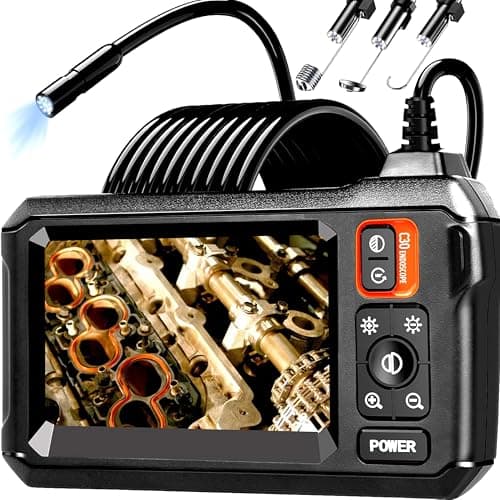
This is the plainest way to take a look: switch it on and the 4.3 in screen shows the view, with no phone, app or pairing. The listing names the exact job, drilling a hole in a wall to see inside, and gives a best viewing distance of 1.5 to 5 in, which fits a 2x4 wall cavity at about 3.5 in deep. The 8 mm probe needs a 3/8 in hole, and the 16.5 ft semi-rigid cable is rated IP67. The trade-off is printed on the listing itself: it cannot take pictures or video. That is fine for a quick check behind a kitchen base cabinet, but if a plumber, landlord or insurer may need to see what you found, choose one of the recording cameras above.
Affiliate link — commission at no extra cost to you
Compare elsewhere
What to know before you buy.
Match the drill bit to the probe, with a little room to spare. Drill bits come in fractions of an inch and probes in millimeters, so convert first: a 1/4 in bit is 6.35 mm, a 5/16 in bit is 7.9 mm, and a 3/8 in bit is 9.5 mm. That makes a 3/8 in hole right for the 8 mm Teslong NTS300 and Daxiongmao C30, and for the 7.9 mm Kinpthy W400, whose probe is the same width as a 5/16 in bit. The 6.2 mm FOXWELL Y400 slides through 5/16 in. A clip-on side mirror widens the tip, so if you plan to use one, the hole must fit the mirror too; a dual-lens probe gets the side view without it. Standard drywall is 1/2 in thick, and a 3/8 in hole fills with one pass of spackle. Behind a baseboard, it disappears once the trim goes back on.
Drill where the water would be. For a leak at floor level, pull the baseboard and drill just above the bottom plate, where water collects; for a stain, drill at its edge, not its center; for a ceiling, drill beside the stain closest to the fixture above. Find the studs first, and keep away from the line above and below outlets and switches, because cables run there. Supply and drain pipes usually run straight up or down from the fixture they serve. Turn off the breaker for any circuit in that wall before drilling, and use a stop collar or a flag of tape on the bit so it goes through the drywall and no farther. Wear eye protection when drilling overhead. An IP67 rating means the probe is sealed against water and dust; it is not electrical insulation, so never push a camera into an electrical box.
A 2x4 wall cavity is about 3.5 in deep and, with studs 16 in apart, about 14.5 in wide. That is close range, which suits the 1.5 to 5 in viewing distance stated on the Daxiongmao listing; looking up or down the bay, the image fades as distance grows. Interior walls are usually hollow, so the view is clear. Exterior walls are usually packed with insulation, and the camera may see little more than the face of a batt. Signs of water are mostly visual: dark staining or tide lines on the back of the drywall, darkened studs or bottom plate, droplets on a fitting, sagging or discolored insulation, rust on nails, and spots of mold. What no camera shows is whether the material is still wet, how far the moisture reaches beyond the view, or whether a stain is old or active.
Three designs cover most cameras. A built-in screen, as on the Teslong NTS300 and Daxiongmao C30, works the moment you turn it on and keeps your phone out of dust and water. A phone camera, such as the Kinpthy W400, uses your larger screen and saves photos and video where they are easy to share, but compatibility varies, and its own listing warns about blur on some Android phones. An articulating tip, as on the Teslong TD450S and FOXWELL Y400, bends on command so one hole shows a whole stud bay; those cables tend to be short, 5 to 5.3 ft on these two. For the view inside a cavity, a side lens or a steerable tip matters more than resolution figures. If anyone else may need to see what you found, make sure the camera records: the Daxiongmao listing says it cannot.
A borescope is the last of three checks, not the first. A thermal camera scans a whole wall in seconds and shows cooler patches where water is evaporating, which tells you where to look. A moisture meter then confirms that a patch is actually wet and maps how far it spreads. Only then does it make sense to drill one small hole at the wettest spot and look for the source. That order keeps the number of holes to one or two. For a supply leak, check the water meter first: turn off every fixture and appliance, note the reading, and look again an hour later. EPA's WaterSense program notes that a family of four using more than 12,000 gallons a month may have a serious leak. A moving meter with everything off means water is escaping somewhere, which is a job for a plumber.
A camera finds problems; it fixes none of them. If you can hear water running in a wall or the stain is growing, shut off the water main and call a plumber before drilling anything. If you suspect hidden mold, EPA cautions that investigating it requires care when it means disturbing possible growth, and suggests considering an experienced professional; EPA's guidance for doing a mold cleanup yourself stops at about 10 square feet. Water from a sewer backup is a sanitation cleanup first. If you plan an insurance claim, photograph the stain and ask your insurer before opening the wall. Renters should report the problem to the landlord in writing rather than drilling. Buy a borescope if you want to check a suspect spot before calling someone, or to show a plumber exactly where the drip is.
YesThrough a small hole, but not through the drywall itself.
You drill a hole slightly wider than the probe, usually 3/8 in for an 8 mm camera, and feed the probe into the cavity. Interior walls are usually hollow and give a clear view; exterior walls are often full of insulation, which blocks much of it. A side-view lens or steerable tip lets you look up and down the stud bay.
A hole slightly wider than the probe, which for most 8 mm cameras means a 3/8 in bit. Convert before you drill: 5/16 in is 7.9 mm, so it suits a 6.2 mm probe like the FOXWELL Y400 but is too tight for a 7.9 mm or 8 mm probe.
If you plan to use a clip-on side mirror, size the hole for the mirror, which is wider than the probe.
It can show you the leak once you know roughly where it is, but it cannot find it on its own. A camera sees drips, stains, wet insulation and mold inside a cavity, and it cannot measure moisture.
Find the spot first with a thermal camera or a moisture meter, then drill one hole at the wettest reading. If water is actively running, shut off the main and call a plumber.
For home use there is none worth worrying about: both are small cameras on the end of a cable. Endoscope is the medical word, borescope the industrial one, and sellers use both names, often for the same product.
What matters is probe diameter, cable length and stiffness, a side lens or steerable tip, light, and whether the camera has its own screen, plugs into a phone and records.
Not for most walls, but it makes the job easier. A steerable tip, like the 210° tip on the Teslong TD450S, turns one hole into a view of the whole stud bay.
A dual-lens camera such as the Teslong NTS300 gets a similar side view without articulation, using a second lens on the side of the probe. Articulating models tend to have short cables, so they suit walls and ceilings more than drains.
It can show visible growth on the back of drywall, on studs or around pipes, but it cannot confirm mold inside materials or identify what kind it is.
EPA notes that hidden mold may grow on the back side of drywall and around pipes inside walls, and that investigating it calls for caution because disturbing it can release spores. If you see growth, stop drilling and consider an experienced professional.
Call (888) 840-6512. The line is answered 24 hours a day, seven days a week, and connects you with an IICRC-certified water damage restoration company that serves your area. A recorded menu picks up first: choose water damage or mold, key in your 5-digit ZIP code, and hold through the short silence while the call is passed to the company.
Describe what you can see — where the water is coming from, how long it has been there, and whether it smells — the more specific you are, the faster the right company is on the line. If the source is a pipe or an appliance, shut the main water valve first. Have four things ready and the call goes quickly: the address, when the water started, what is wet now, and whether you have filed an insurance claim.
Still not sure which of these is your situation? (888) 840-6512 · toll-free · answered 24/7
Methodology: How we source and verify data · Report an error
Free 2-day shipping
Amazon Prime members pay no shipping on restoration equipment
Dehumidifiers, air movers, and moisture meters qualify for free Prime delivery — bulk items that otherwise cost $15–$40 to ship.
Affiliate link — HearthDry earns a bounty if you sign up; costs you nothing extra.

Water damage behind walls is invisible until it's mold. A thermal camera reveals temperature differentials caused by moisture — identifying wet areas in walls, ceilings, and floors before they become a mold problem.
Read the comparisonA moisture meter tells you what your eyes can't see — wet drywall, soggy subfloor, and moisture in framing. These are the four best moisture meters for homeowners dealing with water damage.
Read the comparisonMost homeowners do not discover a leak until it has soaked into subfloor and drywall. A Wi-Fi water leak detector sends the alert to your phone while the water is still on the floor, whether or not anyone is home to hear a siren.
Read the comparisonA home mold test kit answers one question — is there mold here — and in almost every house the answer is yes. The kits differ in how well they answer the questions that matter, namely what kind, how much and whether it is growing, and this guide shows which kit answers which and when to skip the kit and fix the moisture instead.
Read the comparisonA FLIR ONE turns your phone into a thermal camera that shows temperature differences across a wall, a ceiling or a floor, which is how a hidden leak gets found without opening anything. This comparison of the FLIR ONE Pro in its Lightning and USB-C versions, the wireless Edge Pro, the C5 handheld and one TOPDON alternative is built from the Amazon listings, FLIR's published specs and buyer ratings, not from our own use.
Read the comparisonA sewer camera is a waterproof camera head on a stiff push cable that you feed into the drain line from a cleanout to see what is growing, sagging or breaking between the house and the street. These picks are compared from their listings on cable length, head size, screen, recording, self-leveling and locator features, with the backup-prevention angle that a borescope for walls does not cover.
Read the comparison