Quick answer
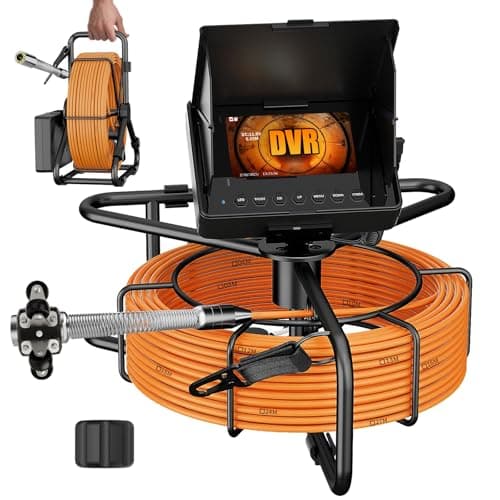
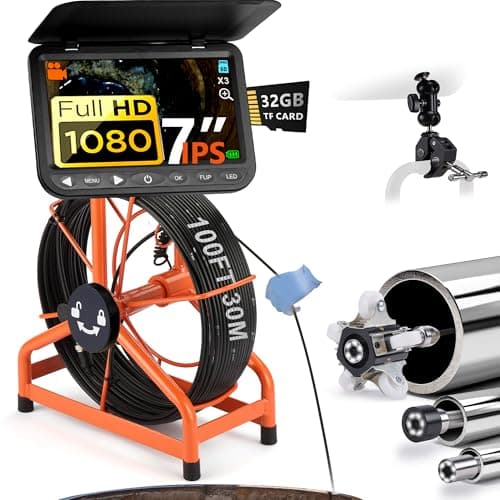
A sewer camera is a waterproof camera head on a stiff push cable that you feed in from a cleanout to see what is blocking or breaking your sewer line, and for most homes the ChoosePRO HD1080P 7 in Sewer Camera with a 100 ft cable marked in feet, rated 4.5 stars across 122 Amazon ratings, reaches the street connection. Measure from your cleanout to the curb first, because a line longer than 100 ft needs a longer reel. Self-leveling and a 512 Hz locator add cost and matter only if you will dig. The camera finds roots, bellies and breaks; a plumber fixes them.
Buyer's Guide
What to know before you buy.
What a Sewer Camera Finds Before the Basement Floods
Sewage backs up into a house when the line between the house and the street cannot carry what you send down it. The water finds the lowest opening, usually a basement floor drain or a basement shower, and that is where the damage starts. A camera shows the causes while they are still a plumber's job rather than a cleanup: tree roots growing through a joint, a belly where the pipe has sagged and holds standing water, an offset where two sections no longer line up, a crack or a crushed section, grease built up in a kitchen branch, and scale flaking off the inside of old cast iron. The camera finds them and the distance counter says where. It does not clear or repair anything. If a backup has already happened, EPA's mold cleanup guidance says that damage caused by sewage or other contaminated water is a job for a professional.
Cable Length: Measure From the Cleanout to the Street
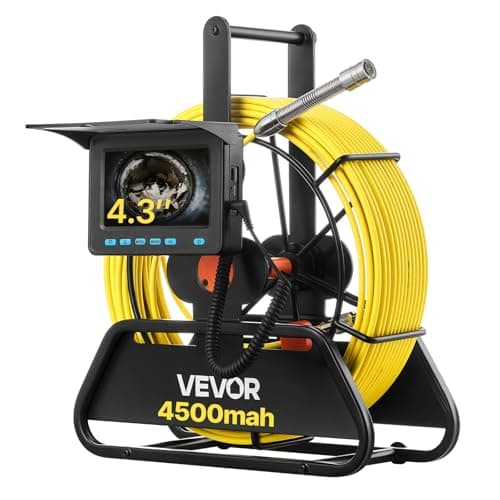
Every camera on this page has a cable of about 100 ft, and whether that reaches depends on your lot. Find the cleanout, a capped pipe near the foundation outside, in the basement floor or at the base of the main stack, and pace the distance from it to the curb or the property line where the city main runs. Add a margin, because the path bends and because every elbow absorbs push and shortens how far a cable will go. A house set well back on a deep lot, or one whose line runs to a main on the far side of the street, can need more than 100 ft, and then the choice is a longer reel or a plumber's camera. Cable stiffness is the other half of the spec. A thin rod such as VEVOR's 0.2 in bends through small branch drains but folds in a 4 in lateral, while the thicker rods on the self-leveling cameras push farther but will not make the tight turns of a 1.5 in drain.
Self-Leveling, Distance Counter and the 512 Hz Sonde: Which You Need
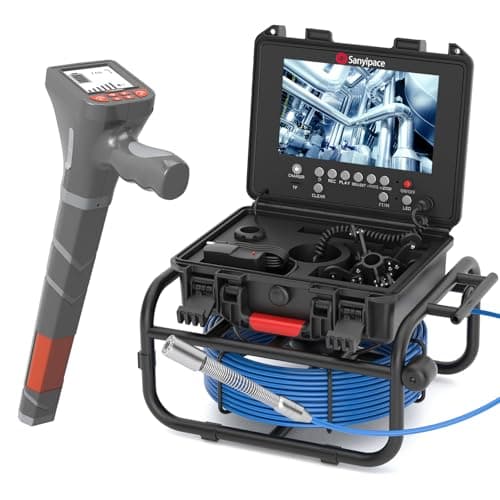
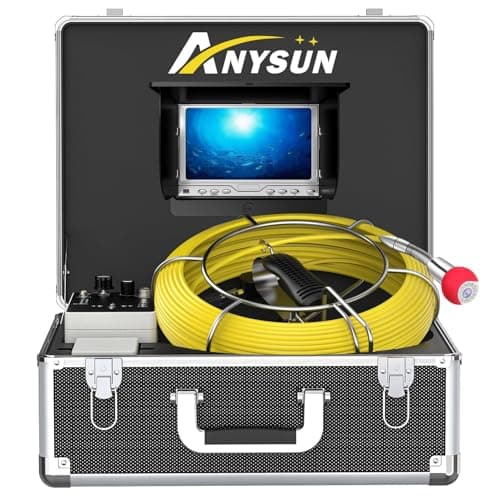
Self-leveling means the camera head rotates so the picture stays upright no matter how the cable twists. Without it, the image rolls through every bend, and water that should sit at the bottom of a belly shows up on the side of the frame; you can still spot the fault, but you will second-guess it. A distance counter, on screen or as marks on the cable, tells you how far in the fault sits, which is what turns a video into a flag in the yard. The 512 Hz sonde is a small transmitter in the camera head, and a matching receiver held at the surface finds it, so you can mark the spot and the rough depth before anyone digs. The Sanyipace lists all three; the ChoosePRO, VISIOPROBE, VEVOR and ANYSUN list a counter or marked cable only. If you only want to know what is wrong and whether to call, skip the sonde. If a dig or a pipe lining is likely, the locator saves exploratory holes.
Screen, Recording, Head Size and Video Quality
Screens on these cameras run from 4.3 in to 9 in, and the difference is whether you can read a hairline crack in the yard or have to replay the recording indoors. A sun visor helps outside. Recording matters more than it seems: a plumber will quote from a video, an insurer may ask for one, and the file is the record of the pipe's condition before and after a repair, so a DVR with a card in the box is worth having. Head size sets which pipes the camera enters: the 17 mm heads on some listings slip into small drains, the 23 mm heads here suit 2 to 4 in lines, and centering sleeves or wheeled covers hold the lens in the middle of a larger pipe so it looks down the bore instead of at one wall. Video is either 1080P or 1000TVL analog; the analog ANYSUN is softer, which shows when you are deciding whether a mark is a crack.
How to Run the Camera, and Why You Snake First
Open the cleanout, never a toilet or a trap, because the head can jam in a trap bend and the cleanout gives a straight shot into the line. Have someone run a faucet so a little water flows ahead of the camera; it floats loose debris away and makes a belly obvious as standing water. If the line is already backed up, the camera sees only brown water, so clear the blockage first with a snake or have a plumber clear it, then inspect to find out why it blocked. Push slowly, stop at each finding, say or note the counter reading, and record. Keep the head centered with a sleeve or wheels where the pipe allows. Rinse the head and the first few feet of cable with clean water when you are done and dry them before coiling; ANYSUN's listing adds the same advice. Wear gloves and wash up afterward; this is a sewer.
Who Should Not Buy One, and When to Call a Plumber
Rent a camera or pay for a plumber's inspection if you only need one look, if the house has no reachable cleanout, if the run to the street is longer than 100 ft, or if you need a locate and a depth before a dig and do not want to learn a sonde. Use a borescope instead, not a sewer camera, for looking inside a wall or a short sink drain; our inspection camera review covers those. Whatever the camera shows, the fix is a plumber's: a root cutter or hydro-jet for roots, a spot repair or liner for a crack, excavation for a belly or a collapse. If backups keep coming from the street side, a backwater valve is the device that stops them, and it is installed by a licensed plumber under a permit. Our referral line reaches restoration companies for the cleanup and drying after a backup, which EPA says should be done within 24 to 48 hours to prevent mold; it is not a plumbing service.
Free 2-day shipping
Amazon Prime members pay no shipping on restoration equipment
Dehumidifiers, air movers, and moisture meters qualify for free Prime delivery — bulk items that otherwise cost $15–$40 to ship.
Affiliate link — HearthDry earns a bounty if you sign up; costs you nothing extra.