
Written & reviewed by Marcus ReedIICRC WRT
Reviewed July 16, 2026· Next review Jan 2027
Quick answer
For a sewage backup, the first call is a water damage restoration company with Category 3 certification, not a plumber. A plumber clears the blockage, but the contaminated water, materials and disinfection are a remediation job requiring PPE, containment and HEPA filtration. Keep people and pets out of the area, stop using water in the house, and call your insurer to check for a sewer backup endorsement. Call (888) 840-6512 to reach a certified water damage restoration company in your area; the line is answered 24/7.
Sound like your situation? Confirm it in one call instead of ten more minutes of reading — (888) 840-6512 · toll-free · no obligation
Stop Using Water — Every Flush Makes It Worse
Before anything else: stop running water anywhere in the house. No sinks, no showers, no washing machine, no toilets. If the drain line is blocked, everything you send down comes back up through the lowest fixture.
Then keep people and pets out of the affected area. Sewage is Category 3 water — grossly contaminated, carrying bacteria, viruses and parasites. This is the one water damage scenario where the health risk genuinely outranks the property damage.
The Question That Decides Who Pays
Before you call a plumber, work out where the blockage is — because the answer determines whether you or the city pays for it.
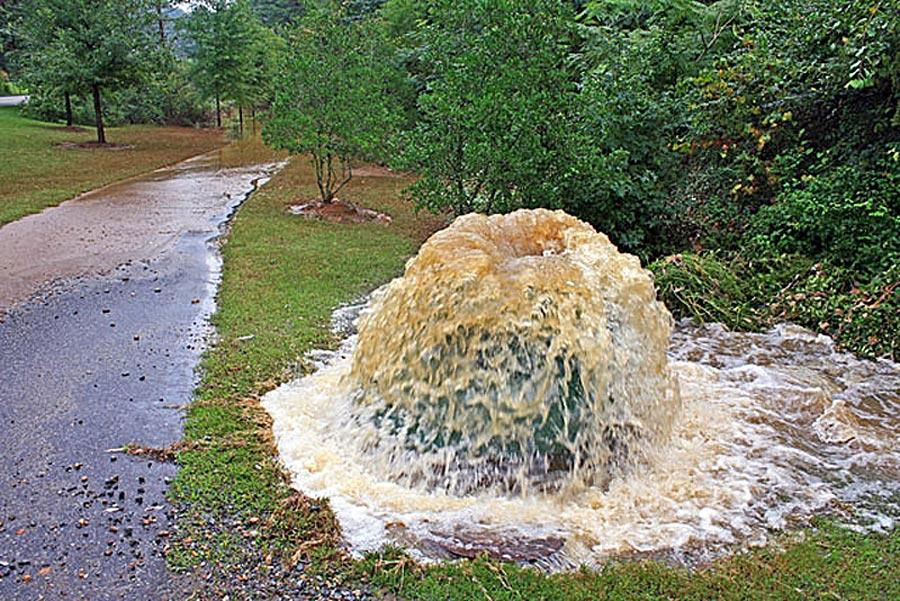
Call the municipal sewer department or water utility FIRST if:
- Multiple fixtures back up at once — toilet and shower and floor drain
- Neighbours are having the same problem
- The backup happened during or right after heavy rain
- You see sewage surfacing outdoors, at a manhole, or in the street
These are signs the blockage is in the public main, and the municipality is responsible for clearing it — usually at no obligation. Many cities dispatch 24/7 and will camera the line. Some also have a claims process for damage caused by a main-line failure. Making this call first can save thousands and takes ten minutes.
Call a plumber or drain specialist if:
- Only one fixture is affected
- Neighbours are fine
- You have a known history with roots, grease, or an old clay lateral
The lateral — the pipe running from your house to the main — is almost always the homeowner's responsibility, including the portion under the street in many jurisdictions.
Then Call Restoration — Not a Cleaning Service
Once the flow is stopped, the cleanup is a job for an IICRC-certified restoration company, not a carpet cleaner and not you.
| Task | Who |
|---|---|
| Clear the blockage | City (main) or plumber (lateral) |
| Extract contaminated water | Restoration company |
| Remove and dispose of porous materials | Restoration company |
| Disinfect and apply antimicrobial | Restoration company |
| Dry the structure and verify | Restoration company |
| Rebuild what was removed | Restoration or general contractor |
Category 3 protocol means porous materials that absorbed sewage are removed, not cleaned — carpet and pad, particle board, insulation, and usually drywall to a set height above the waterline. A crew that offers to shampoo the carpet and spray deodoriser is not following the standard, and you will be dealing with the smell and the contamination again in a month. The full sewage cleanup guide walks through the protocol.
Talk to a water damage pro now
Answered 24/7 · Free call · Your ZIP routes you to the nearest crew
(888) 840-6512Mold can establish within 24–48 hours of water exposure — drying started today stays a drying job.
- Describe the damage & give your ZIP
- You're routed to the on-call local crew
- They quote — you decide, no obligation
Insurance: The Endorsement Most People Do Not Have
Here is the unwelcome part. Standard homeowners policies exclude sewer and drain backup. Coverage comes from a separate endorsement — usually inexpensive, commonly capped somewhere between $5,000 and $25,000.
Call your carrier regardless. You may have it and not know, and some carriers add it by default in certain states. If you do not have it, add it at renewal; sewer backup is one of the most common claims homeowners discover they are not covered for.
If the backup came from a municipal main failure, the city's claims process is a separate avenue worth pursuing even where coverage exists.
What Not to Do
- Do not go in without protection. N95 or better, rubber gloves, waterproof boots, eye protection. Wash thoroughly afterward.
- Do not use a household or shop vacuum on sewage.
- Do not run the HVAC if it may pull contaminated air through the house.
- Do not throw anything out before photographing it. Document, then dispose.
- Do not let children or anyone immunocompromised near the area until it is professionally cleared.
Bottom Line
Stop using water, then call the city before the plumber if more than one fixture is backing up — the main may be theirs to fix. Restoration handles the cleanup, and it must follow Category 3 protocol with removal, not surface cleaning. Check whether you carry the sewer backup endorsement today, not at claim time.
Reading to confirm what you already suspect?
Confirm it in two minutes instead — the pro on this line answers questions about YOUR situation all day: what it is, what it should cost, whether you even need service. If you want, they'll set the appointment on the same call.
Toll-free · no obligation · asking costs nothing
Frequently Asked Questions
- 1Leave the affected area immediately -- do not wade through sewage water without full protective gear.
- 2Do not flush any toilets or run any water -- every drain in the house connects to the same line.
- 3Do not run HVAC -- it spreads contaminated air through ducts.
- 4Call an IICRC-certified Category 3 restoration company immediately.
- 5Call a licensed plumber to identify and clear the blockage source.
- 6Photograph everything from outside the affected area before remediation begins.
- 1Main sewer line blockage -- tree roots, grease buildup, or collapsed pipe in your private lateral
- 2Municipal sewer overflow -- heavy rain overwhelms the city system and backs up through floor drains
- 3Grease and debris blockage -- restaurant-style grease accumulation in drain lines
- 4Pipe collapse or offset in older clay or cast-iron lines. A plumber with a camera scope can identify the exact cause -- this is important for insurance purposes (municipal overflow may have a separate liability claim against the city).
- 1all porous materials in the contamination zone must be removed and disposed of as biohazardous waste,
- 2EPA-registered disinfectants require multiple applications and dwell times,
- 3HEPA air scrubbing must run continuously, and
- 4post-remediation clearance testing is required before re-occupancy.
Who do I call for a sewage backup?
Call an IICRC-certified water damage restoration company that handles Category 3 (biohazard) work -- not a plumber, not a general cleaning service. Sewage backup is classified as black water under IICRC S500 standards and contains pathogens including E. coli, hepatitis A, norovirus, and other harmful organisms.
It requires full PPE (respirators, Tyvek suits), EPA-registered hospital-grade disinfectants, HEPA air scrubbing, and regulated disposal of all affected porous materials. A plumber can clear the blockage -- but they cannot safely remediate the contamination.
Is sewage backup covered by homeowners insurance?
NoNot under a standard HO-3 policy. Sewage and drain backup is a specifically excluded peril under most standard policies. Coverage requires a Water Backup and Sump Overflow endorsement, which costs $50--200 per year and is added to your standard policy.
If you have this rider, sewage backup is covered up to your endorsement limit (typically $5,000--25,000). If you do not have the rider, you pay out of pocket. Check your policy declarations page right now -- and if you do not have the endorsement, add it at your next renewal.
What should I do immediately when sewage backs up?
Do these in order:
What causes sewage to back up into the basement?
The four most common causes:
How much does sewage backup cleanup cost?
Sewage backup cleanup costs $3,500--$50,000 depending on affected area. One bathroom backup averages $3,500--$8,000. Full basement sewage flooding averages $15,000--$50,000. Costs are higher than clean-water events because:
What causes a sewer to back up into the house?
Four usual suspects: a blockage in your lateral line (grease, wipes, or tree roots — the classic), a collapsed or bellied section of old pipe, a municipal main problem pushing flow back toward homes, and overwhelmed combined systems during heavy rain.
The clue is in where it appears: backups at the lowest drain in the house (a basement floor drain or shower) point at the lateral or the main, while a single slow fixture is usually just that fixture. Why it matters for the call order: your plumber handles your lateral, the city handles the main — and the city investigates for free, so if neighbors are also backing up, call the city first.
Who cleans up raw sewage?
Water damage restoration companies — the same industry that handles clean-water losses, working under a stricter protocol because raw sewage is Category 3 black water: full protective equipment, containment, removal of porous materials it touched, disinfection, and drying.
It is specifically not a job for a regular cleaning service, a carpet cleaner, or a DIY weekend — the contamination is biological, not cosmetic. The plumber or the city clears the blocked line; the cleanup crew handles everything the backup touched.
Who do I call right now for water damage?
Call (888) 840-6512. The line is answered 24 hours a day, seven days a week, and connects you with an IICRC-certified water damage restoration company that serves your area.
Describe what you can see — where the water is coming from, how long it has been there, and whether it smells — and the dispatcher routes you to a crew that handles that kind of loss. If the source is a pipe or an appliance, shut the main water valve first; the call itself takes under two minutes.
Sources
- IICRC S500 -- Category 3 Water Damage Classification(retrieved 2026-07-16)
- EPA -- Sewage and Water Main Breaks(retrieved 2026-07-16)
- CDC -- Floodwater After a Disaster or Emergency(retrieved 2026-07-16)
Methodology: How we source and verify data · Report an error
Disclaimer: HearthDry is an independent educational resource. This article is for informational purposes only and does not constitute professional, legal, or insurance advice. Consult licensed professionals before making decisions about your property or insurance claims.
Professional Equipment
Sewage Backup: Air Quality Matters as Much as Drying
Category 3 sewage events require HEPA air scrubbers to capture biohazard particulates during cleanup. IICRC AMRT technicians use commercial-grade HEPA units — the same models are available for homeowner purchase on Amazon.
Affiliate link — HearthDry earns a commission from Sylvane via CJ at no extra cost to you
Equipment
What each machine actually does
Removes the moisture the structure is still giving off — the machine that decides how long drying takes
See the picks →Moves air across wet surfaces so the dehumidifier has something to take out of the air
See the picks →Finds water behind walls and under floors, and tells you when a material is actually dry
See the picks →Alerts you the moment a leak starts — the cheapest thing on this list and the only preventive one
See the picks →Those pages carry affiliate links. As an Amazon Associate, HearthDry earns from qualifying purchases; it costs you nothing extra.
Advertisement
