
Quick answer
Water damaged drywall is repaired in two stages: first the wet material is dealt with — drywall that is stained but firm and dried within a day or two can usually stay; drywall that is soft, sagging, crumbling, wet for more than about 48 hours, or wetted by grey or black water is cut out, typically in a 'flood cut' 12–24 inches above the water line or a full-sheet replacement on ceilings — and the framing and insulation behind it are dried to normal moisture levels. Then the repair: new drywall patched or hung, taped and mudded in three coats, sanded, primed with a stain-blocking primer, textured to match and painted. Expect roughly $2–$4 per square foot for patching and finishing, $300–$900 for a typical wall section, $500–$1,500 for a ceiling section, and $1,500–$4,000 for a whole room including drying. On a covered water loss, insurers pay for removal, drying and the finished repair as part of the same claim. Call (888) 840-6512 to reach a certified water damage restoration company in your area; the line is answered 24/7.
Press 1 for water damage or 2 for mold, then your 5-digit ZIP. The line goes quiet for about half a minute while it connects — that is normal, stay on.
Written & reviewed by Marcus ReedIICRC WRT
Reviewed August 30, 2026· Next review Feb 2027
Two Jobs, in Order
Every drywall repair after water is really two jobs: getting the wall dry — which may mean removing part of it — and then making it look like nothing happened. Doing the second before the first is the mistake that turns a $600 repair into a mold remediation. The paint hides the stain; it does not dry the stud behind it.
Stage One: What Stays and What Goes
| Condition | Decision |
|---|---|
| Stained, firm, flat; dried within 24–48 hours; clean water | Keep. Seal the stain and paint. |
| Slightly soft at the bottom edge, otherwise firm | Flood cut the wet band; keep the rest |
| Sagging, bulging, crumbling, or paper delaminating | Remove the section |
| Wet for more than about 48 hours | Remove — the paper facing is mold food and growth is likely on the back |
| Wetted by grey water (appliance, sink) or black water (sewage, outside) | Remove — porous material cannot be sanitized |
| Ceiling drywall holding water (bulge) | Drain carefully, then remove the section; ceilings sag and fail |
The reasoning is in wet drywall: save or replace; the mold-specific version is in mold on drywall. What decides it in practice is a moisture meter — a reading well above a known-dry wall in the same house means the core is wet whatever the surface looks like.
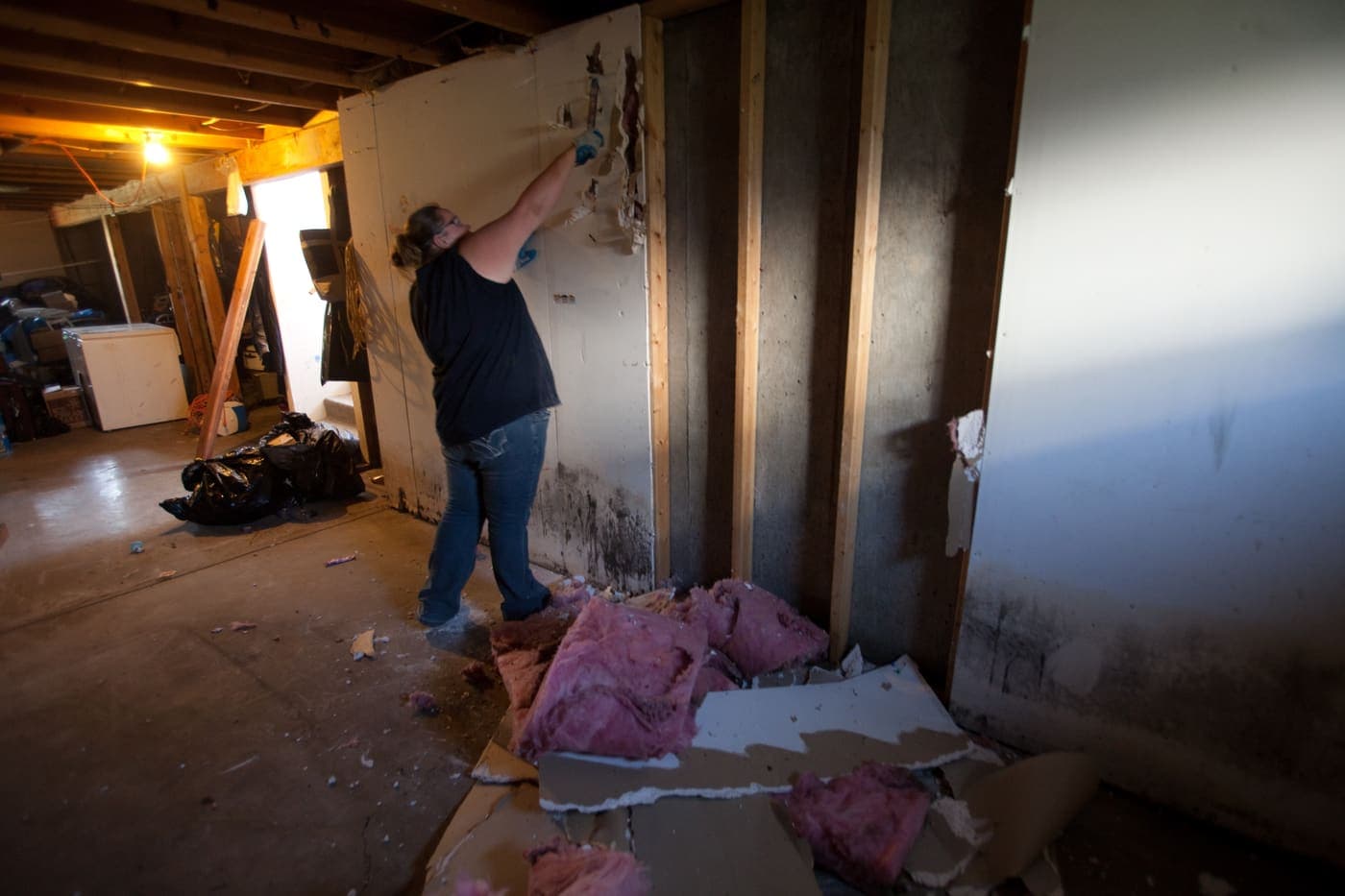
The flood cut. When water on the floor has reached the walls, the bottom of the drywall is wet even where the surface looks dry, because gypsum wicks. The standard fix is to cut a straight line 12 or 24 inches above the floor (whichever clears the wet band, on a line the new piece can seam to) and remove everything below it, along with the baseboard and any wet insulation. The cavity is then open to dry.
Drying the cavity. Air movers and a dehumidifier run until the studs and bottom plate read under about 16% moisture content — typically two to four days. Closing the wall over wet framing is how a repair becomes a remediation; how long drying takes sets expectations. Insulation that got wet is replaced; fiberglass holds water and does not dry in a wall.
Stage Two: The Repair
- 1Cut clean. Edges are squared to the center of studs or joists so the new piece has backing; where a cut falls between studs, a backing strip is screwed in.
- 2Hang the new piece. Same thickness as the original (½-inch walls, ⅝-inch on many ceilings and garages), screwed on 12–16 inch centers, with a ⅛-inch gap at seams. For a room that will get wet again — a bathroom, a laundry — moisture-resistant board is the upgrade.
- 3Tape and mud. Paper or mesh tape on the seams, three coats of joint compound feathered progressively wider, sanded between coats. This is where the difference between a patch you can see and one you can't is decided.
- 4Prime with a stain blocker. Water stains bleed through ordinary primer and paint; an oil-based or shellac-based stain-blocking primer over the stain and the new work stops it.
- 5Texture to match. Orange peel, knockdown, skip trowel or smooth — matched by spray or hand, then primed again.
- 6Paint. Corner to corner on the affected wall, because a touched-up patch shows under raking light; on a ceiling, usually the whole ceiling.
Timeline: the drying days, then two to three days for hang, tape and mud (each coat needs to dry), then a day for texture, prime and paint. A week from wet to painted is normal for a room.
Talk to a water damage pro now
Answered 24/7 · Toll-free · answered 24/7 · no obligation
(888) 840-6512- Describe the damage & give your ZIP
- You're routed to the on-call local crew
- They quote — you decide, no obligation
What It Costs
| Repair | Typical range |
|---|---|
| Seal and repaint a stained, dry area | $150 – $400 |
| Patch under 2 sq ft, finished and painted | $200 – $450 |
| Flood cut along one wall (remove, dry, replace 2-ft band, finish, paint) | $300 – $900 |
| Ceiling section, finished and texture-matched | $500 – $1,500 |
| Whole room — drying, insulation, drywall, finish, paint | $1,500 – $4,000 |
| Per square foot, patch through paint | $2 – $4 |
| Drying equipment, per day | $50 – $150 per air mover / dehumidifier |
Ceilings cost more per square foot than walls (overhead work, texture matching, larger paint area); texture matching is the line that varies most by region. Ceiling water damage repair cost goes deeper on that side, and the restoration cost guide puts drywall in the context of a whole loss.
Insurance
On a covered loss — sudden and accidental water — drywall removal, cavity drying, replacement and the finish through paint are all standard claim items, priced from the same Xactimate line items restoration contractors use. Adjusters generally allow paint to the nearest break (a whole wall or a whole ceiling), not just the patch. Photograph the damage before removal, keep the moisture readings, and keep the cut-out pieces until the adjuster has seen them or the photos are accepted — how to document a water damage claim. Drywall that grew mold because it sat wet is often paid under the policy's mold sublimit instead, which is smaller, and drywall damaged by a slow leak or condensation is generally excluded.
DIY or Contractor
A stained-but-dry area, or a small patch with the framing confirmed dry, is a homeowner weekend. A flood cut across a room, a ceiling, wet insulation, a cavity that is still wet, or texture you cannot match is a contractor — usually the restoration company that did the drying, or a drywall contractor after the restoration crew has cleared the framing as dry. On any repair that is going on a claim, the contractor's invoice and moisture log are what make the numbers stick. Get the framing dry first, whichever way you go; everything after that is finish carpentry.
Reading to confirm what you already suspect?
Confirm it in two minutes instead — the pro on this line answers questions about YOUR situation all day: what it is, what it should cost, whether you even need service. If you want, they'll set the appointment on the same call.
Toll-free · no obligation · asking costs nothing
Frequently Asked Questions
Does water damaged drywall need to be replaced?
Not always. Drywall that got wet briefly, was dried within a day or two, and is still firm and flat can be kept — the stain is cosmetic and is sealed with a stain-blocking primer.
Drywall that is soft, swollen, sagging, crumbling at the edges, has been wet more than about 48 hours, or was wetted by grey or black water comes out, because the gypsum core and paper facing have lost integrity and the paper is mold food. When in doubt, a moisture meter reading well above a known-dry wall decides it.
How much does it cost to repair water damaged drywall?
Roughly $2–$4 per square foot for patching, taping, finishing and painting; $300–$900 for a typical wall section (a flood cut along one wall); $500–$1,500 for a ceiling section, which costs more for the overhead work and texture matching; $1,500–$4,000 for a whole room when drying equipment, insulation and paint are included.
Removal and drying are separate line items from the finish repair.
What is a flood cut?
Removing the bottom section of wet drywall in a straight horizontal line — usually 12 or 24 inches above the water line, on the stud layout — so the wall cavity can be dried and the new piece fits a clean seam.
It is standard after any water on the floor reached the walls, because drywall wicks water up from its edge and the bottom foot is wet even when the surface above looks fine.
Can I repair water damaged drywall myself?
A small stained-but-firm area (seal, paint) or a patch under a few square feet after the framing is confirmed dry is a reasonable DIY job.
Cutting out large sections, anything on a ceiling, anything where the cavity is still wet, insulation replacement, or texture matching is where a professional earns the money — and any repair that goes on an insurance claim is easier with a contractor's invoice and moisture log.
Does insurance cover water damaged drywall?
If the water event is covered — a burst pipe, a failed supply line, an appliance leak, a storm-created roof opening — the drywall removal, drying and repair, including paint to match, are part of the claim; adjusters price it from the same Xactimate line items restoration contractors use.
Drywall damaged by a long-term leak, condensation or rising surface water is generally excluded, and drywall that grew mold because it sat wet may fall under the policy's mold sublimit.
Who do I call right now for water damage?
Call (888) 840-6512. The line is answered 24 hours a day, seven days a week, and connects you with an IICRC-certified water damage restoration company that serves your area. A recorded menu picks up first: choose water damage or mold, key in your 5-digit ZIP code, and hold through the short silence while the call is passed to the company.
Describe what you can see — where the water is coming from, how long it has been there, and whether it smells — the more specific you are, the faster the right company is on the line. If the source is a pipe or an appliance, shut the main water valve first. Have four things ready and the call goes quickly: the address, when the water started, what is wet now, and whether you have filed an insurance claim.
Still not sure which of these is your situation? (888) 840-6512 · toll-free · answered 24/7
Sources
- IICRC — Standards (ANSI/IICRC S520 Mold Remediation, S500 Water Damage Restoration)
- EPA — A Brief Guide to Mold, Moisture and Your Home
- FEMA — Dealing with Mold and Mildew in Your Flood Damaged Home
- EPA — Mold Cleanup in Your Home
Methodology: How we source and verify data · Report an error
Disclaimer: HearthDry is an independent educational resource. This article is for informational purposes only and does not constitute professional, legal, or insurance advice. Consult licensed professionals before making decisions about your property or insurance claims.
Watch
Source: Step-by-step homeowner repair walkthrough
Free 2-day shipping
Amazon Prime members pay no shipping on restoration equipment
Dehumidifiers, air movers, and moisture meters qualify for free Prime delivery — bulk items that otherwise cost $15–$40 to ship.
Affiliate link — HearthDry earns a bounty if you sign up; costs you nothing extra.
Equipment
What each machine actually does
Removes the moisture the structure is still giving off — the machine that decides how long drying takes
See the picks →Moves air across wet surfaces so the dehumidifier has something to take out of the air
See the picks →Finds water behind walls and under floors, and tells you when a material is actually dry
See the picks →Alerts you the moment a leak starts — the cheapest thing on this list and the only preventive one
See the picks →Those pages carry affiliate links. As an Amazon Associate, HearthDry earns from qualifying purchases; it costs you nothing extra.
Our Amazon storefront →Advertisement
