
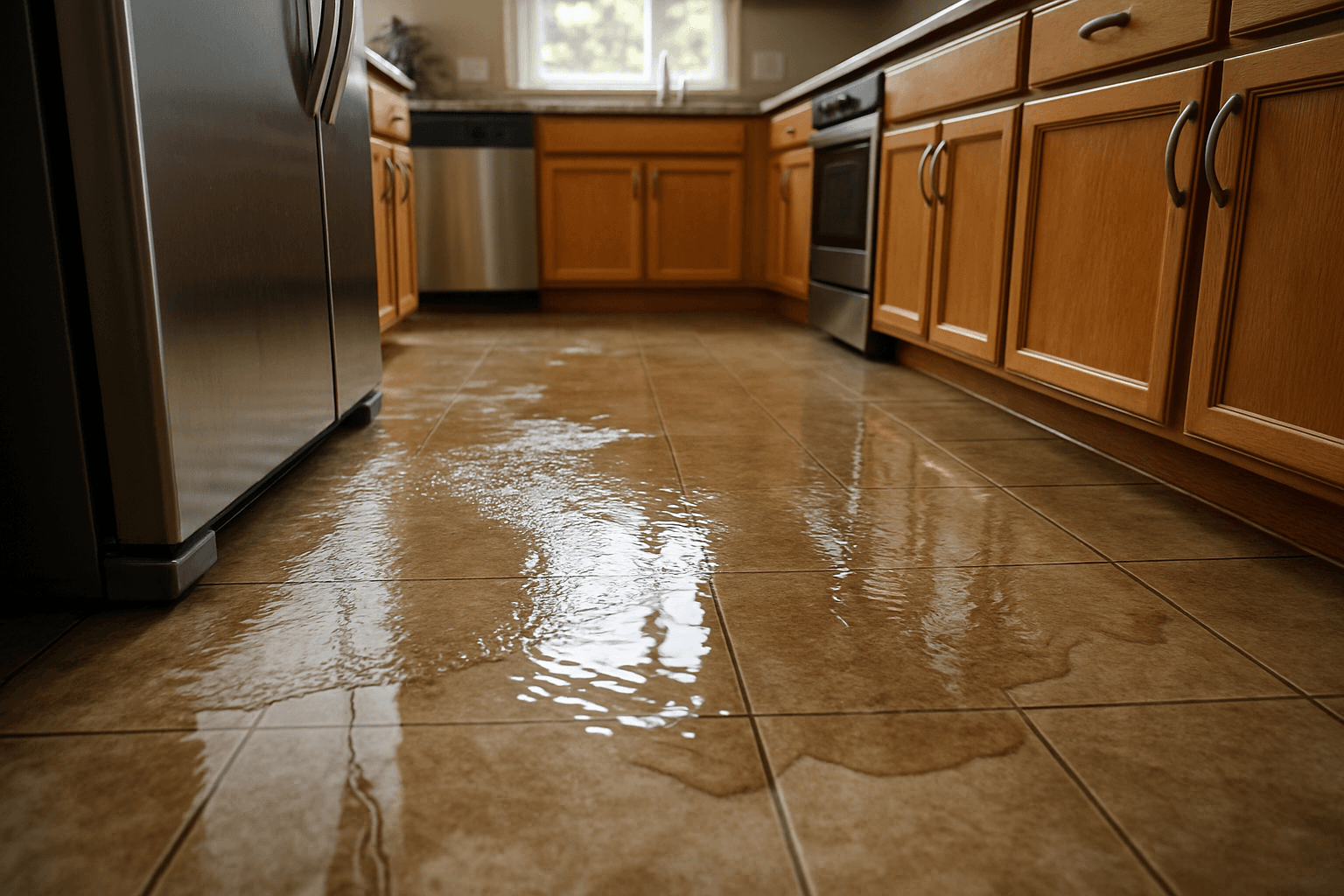
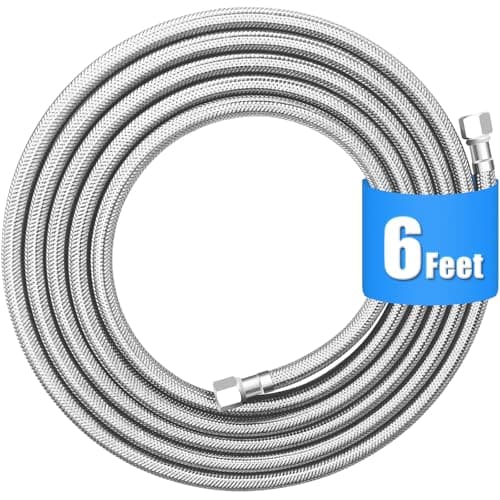
Best for: A fridge whose shutoff valve sits in the wall behind it or under the cabinet next to it
- Length:
- 6 ft; 4 ft and 10 ft versions are sold on the same listing
- Inner tube (stated):
- Food-grade PEX, BPA-free
Listing verified 12 Oct 2026

Braided Stainless vs PEX, 1/4 in Fittings, the Right Length, and the Valve That Should Feed It
4 picks compared · prices, ratings and stock checked October 12, 2026
Our Top Pick
For most kitchens, the HAOCHEN 6 ft Braided Stainless Refrigerator Water Line, with a PEX inner tube and brass 1/4 in compression nuts. If you want named UPC and NSF marks, the Eastman 48316 8 ft Flexible PEX Ice Maker Connector. Feed either one from a proper quarter-turn shutoff valve, not a saddle valve.
4.8 on Amazon · 1,190 ratings
Quick answer
The best refrigerator water line for most kitchens is a braided stainless line with a PEX inner tube and brass 1/4 in compression nuts at both ends: if the shutoff valve sits behind or beside the fridge, buy the HAOCHEN 6 ft Braided Stainless Refrigerator Water Line, rated 4.8 stars across 1,190 Amazon ratings. Leave enough slack to roll the fridge out from the wall, feed the line from a quarter-turn shutoff valve rather than a self-piercing saddle valve, and put a leak sensor on the floor behind the fridge.
Every pick below is currently stocked — ratings and stock read from Amazon on 12 October 2026.
Best for: A fridge whose shutoff valve sits in the wall behind it or under the cabinet next to it
Listing verified 12 Oct 2026
Best for: Buyers who want named plumbing certifications and have a clear route from valve to fridge
Listing verified 13 Oct 2026
Best for: A fridge with a recessed ice maker outlet box directly behind it
Listing verified 13 Oct 2026
Best for: A fridge fed from a valve under the sink across the kitchen or from a tee in the basement below
Listing verified 13 Oct 2026
How this page was made: we compare the current Amazon listings, the makers' published specs and what verified buyers report, then rank by fit for the job. Ratings, review counts and stock are read from Amazon and dated. We earn a commission on purchases through our links; it does not change the order. Reviewed by Marcus Reed, IICRC-certified Water Restoration Technician.
Full Reviews
Each pick in detail: what the listing states, what buyers report, and where it falls short.
Check price
on Amazon ↗
Listing verified 12 Oct 2026
See it on Amazon ↗Best Overall
Quick Verdict
HAOCHEN 6 ft Braided Stainless Refrigerator Water Line: braid over PEX with brass compression nuts, though the listing names no certification.
Key Specs
Length
6 ft; 4 ft and 10 ft versions are sold on the same listing
Inner tube (stated)
Food-grade PEX, BPA-free
Outer layer (stated)
Grade 304 stainless steel braid
Fittings (stated)
Brass 1/4 in compression on both ends, with built-in sealing rings
Connects to (stated)
A 1/4 in outlet angle stop valve, ice maker outlet box, RO system or drinking water faucet
Pressure rating
Not stated on this listing
Pros
Cons
Suited to
A fridge whose shutoff valve sits in the wall behind it or under the cabinet next to it
Our take
A refrigerator line spends its life in the worst spot in the kitchen: squeezed between the fridge and the wall, bent every time the fridge comes out, and out of sight for years. HAOCHEN's answer is a food-grade PEX inner tube inside a 304 stainless braid, so the braid takes the abrasion and the PEX carries the water. Both ends are brass 1/4 in compression nuts with built-in sealing rings, the common connection on fridges and on ice maker valves. The listing names no pressure rating and no certification mark, so the buyer record is doing the work here. Choose 6 ft when the valve sits behind the fridge; take the 10 ft when it is under the next cabinet.
Affiliate link — commission at no extra cost to you
Compare elsewhere
These open a search for this model. We quote prices only where we can verify them — Amazon, Sylvane and eBay.
Check price
on Amazon ↗
Listing verified 13 Oct 2026
See it on Amazon ↗Best Certified PEX Line
Quick Verdict
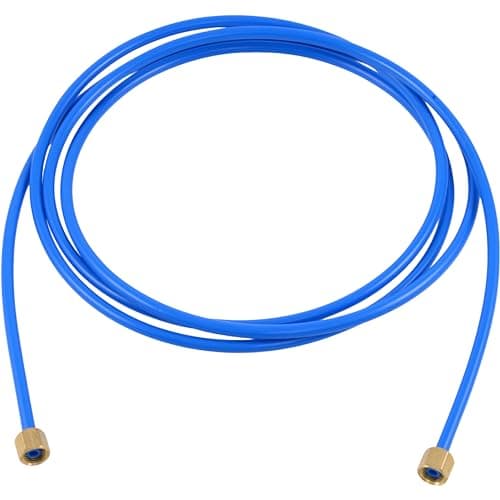
Eastman 48316 8 ft Flexible PEX Ice Maker Connector: named UPC and NSF marks and a stated pressure rating, with no braid to protect it.
Key Specs
Length
8 ft
Tube (stated)
High-impact flexible PEX, no braid
Fittings (stated)
1/4 in inlet x 1/4 in outlet lead-free brass nuts
Max working pressure (stated)
125 psi
Certification (stated)
UPC, NSF and AB1953; lead free for drinking water
Warranty
Not stated on this listing
Pros
Cons
Suited to
Buyers who want named plumbing certifications and have a clear route from valve to fridge
Our take
Eastman is the line to choose if you want the paperwork. Its listing names UPC, NSF and California AB1953 lead-free marks for drinking water use, plus a 125 psi maximum working pressure. Plumbing codes generally call for a pressure-reducing valve once house pressure passes 80 psi, so that rating leaves headroom. The trade-off is armor. This is bare PEX with no stainless braid, so it depends on careful routing: keep it clear of sharp cabinet edges and the fridge's rollers, and let the spare length fall in a loose curve rather than a tight coil. The 8 ft length suits a valve set beside the fridge or under the sink next to it.
Affiliate link — commission at no extra cost to you
Compare elsewhere
Check price
on Amazon ↗
Listing verified 13 Oct 2026
See it on Amazon ↗Best for a Valve Right Behind the Fridge
Quick Verdict
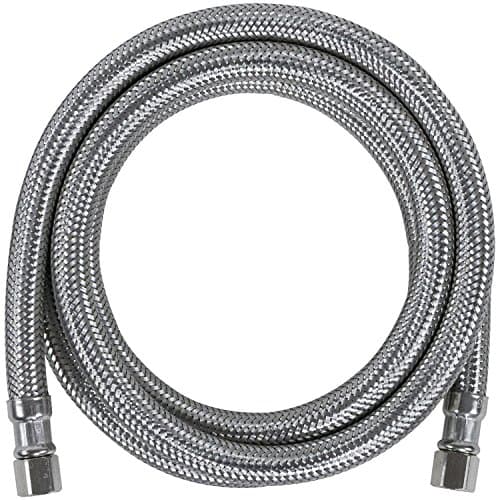
Certified Appliance Accessories 5 ft Braided Stainless Ice Maker Water Line: a plain braided line for a valve right behind the fridge, with no named mark.
Key Specs
Length
5 ft
Core (stated)
PVC
Outer layer (stated)
Braided stainless steel
Fittings (stated)
1/4 in female compression on both ends, stainless steel, washers included
Certification (stated)
Meets or exceeds industry certification standards; no named mark
Pressure rating
Not stated on this listing
Pros
Cons
Suited to
A fridge with a recessed ice maker outlet box directly behind it
Our take
This is a short, simple braided line for the tidiest layout: an ice maker outlet box set into the wall right behind the fridge. Five feet covers the drop from the box to the floor, the run to the inlet and enough slack to roll the fridge forward. The listing describes a PVC core under a stainless braid that resists punctures, crimping and kinking, with 1/4 in female compression fittings and washers at both ends. What it does not give is a named certification or a pressure rating; it says only that it meets industry standards. If your valve is under a neighboring cabinet or in the basement, skip this length and measure for a longer line.
Affiliate link — commission at no extra cost to you
Compare elsewhere
Check price
on Amazon ↗
Listing verified 13 Oct 2026
See it on Amazon ↗Best for Long Runs
Quick Verdict
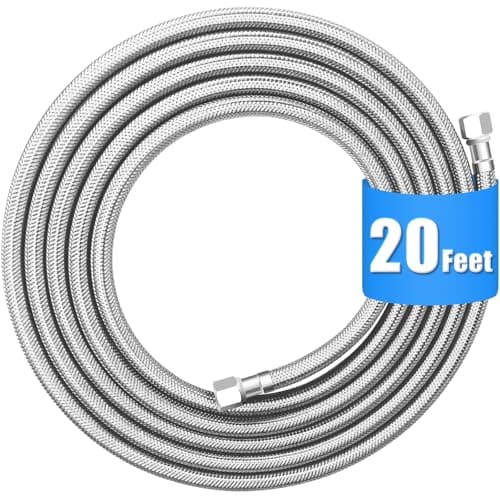
HAOCHEN 20 ft Braided Stainless Refrigerator Water Line: one joint-free run to a distant valve, with the same unnamed certification gap.
Key Specs
Length
20 ft; a 25 ft version is sold on the same listing
Inner tube (stated)
Food-grade PEX, BPA-free
Outer layer (stated)
Grade 304 stainless steel braid
Fittings (stated)
Brass 1/4 in compression on both ends, with built-in sealing rings
Pressure rating
Not stated on this listing
Certification
Not stated on this listing
Pros
Cons
Suited to
A fridge fed from a valve under the sink across the kitchen or from a tee in the basement below
Our take
When the nearest cold-water pipe is across the kitchen or in the basement below, the temptation is to join two short lines with a coupler. Every extra joint is another place to leak, out of sight, so one continuous line is the better fix. This HAOCHEN listing is a separate, longer version of the top pick, with the same PEX tube inside a 304 stainless braid and brass 1/4 in compression nuts, in 20 ft or 25 ft. Measure the real route first, through cabinet backs or up through the floor, and protect the line where it passes a cut edge. Then coil any spare in a wide loop where you can see it.
Affiliate link — commission at no extra cost to you
Compare elsewhere
What to know before you buy.
Four kinds of line feed refrigerators. Thin plastic tubing came with many older ice maker kits; it is soft, it can crack as it ages, and a fridge foot or cabinet edge can crush or cut it. Copper tubing lasts, but it is stiff, and repeated bending when the fridge moves can kink or crack it. PEX is the flexible plastic pipe used in house plumbing, much tougher than thin tubing, and the Eastman line is plain PEX with UPC and NSF marks. Braided stainless lines wrap a PEX or PVC tube in a steel braid that shields it from crushing and scraping; HAOCHEN uses PEX inside, Certified Appliance Accessories uses PVC. For most kitchens a braided line is the sensible pick, because the fridge gets moved and the line lives in a cramped space.
Most refrigerators and ice maker valves use a 1/4 in compression connection, and every line on this page has 1/4 in fittings at both ends. Check your fridge manual before ordering anyway, because some models use a different inlet, and a few lines sold for ice makers carry another size or a push-fit end. On braided and PEX lines the seal comes from a rubber washer or sealing ring inside the nut, so tighten as the line's instructions say and no further. Over-tightening can crush the washer and cause the very drip you are trying to stop. After connecting, open the valve slowly, wipe both joints with a dry paper towel, and look at them again the next morning.
Measure from the valve outlet to the fridge inlet along the path the line will really take: down from the valve, across the floor or through the cabinet, and up to the inlet. Then add slack equal to the distance the fridge must roll out for cleaning, usually about the depth of the fridge, so you never have to disconnect it to reach the wall. Some listings count the nuts in the stated length, so round up rather than down. As a rough guide, a recessed box behind the fridge often needs 5 to 6 ft, a valve under the sink next door 8 to 10 ft, and a tee in the basement 20 ft or more. Buy one continuous line instead of joining two with a coupler.
Many older ice maker kits came with a self-piercing saddle valve, which clamps onto a copper pipe and punches a small hole in it with a needle. It is quick to fit, but the rubber gasket can shift or wear, the small hole can clog with mineral deposits, and a slow leak at the clamp can go unseen for months. Some local plumbing codes no longer allow them. The better connection is a tee in the cold-water line with a quarter-turn shutoff valve that has a 1/4 in compression outlet, or a recessed ice maker outlet box in the wall behind the fridge. That valve also lets you shut off only the fridge when you change the line or travel. If you have a saddle valve and are not confident cutting a pipe, that swap is a short job for a plumber.
Close the valve, lay down a towel and keep a shallow pan ready for the water left in the old line. Connect the valve end first, then the fridge end, and open the valve slowly. Run the dispenser for a while to push air out of the line, since the first glasses may sputter, and follow the manual on discarding the first batches of ice. Next comes the step most installs skip. Push the fridge back slowly while someone watches the line, and stop if it folds or gets pinned under a roller. A kink starves the ice maker and strains the fittings. Finally, set a battery leak sensor on the floor behind the fridge, where a slow drip would otherwise go unseen, and check both joints with a flashlight a day later.
A new supply line fixes one thing: an old, kinked or leaking line between the valve and the fridge. It is the wrong purchase if water pools under the front of the fridge from a clogged defrost drain or a cracked drain pan, or if the leak starts at the filter housing or the inlet valve inside the fridge; those are appliance repairs. Water dripping from the shutoff valve itself means the valve needs replacing. Call a plumber to replace a saddle valve or add a new tee if you are not comfortable cutting into copper or PEX pipe. If the old line has been leaking for a while, check the subfloor and the base of the nearby cabinets, because the EPA advises drying water-damaged areas within 24 to 48 hours to prevent mold growth.
A braided stainless line with a PEX inner tube and brass 1/4 in compression nuts suits most kitchens, such as the HAOCHEN 6 ft line.
The braid protects the tube from being crushed or scraped when the fridge moves, and the brass nuts seal against both the fridge inlet and the valve outlet. If named certifications matter to you, the Eastman 48316 PEX connector lists UPC and NSF marks.
Most refrigerator water lines use 1/4 in compression fittings at both ends, and every line on this page is 1/4 in.
The valve has to match, which a standard ice maker valve or outlet box does with its 1/4 in compression outlet. A few fridges use a different inlet, so confirm the size in your manual before you buy a line.
Braided is the safer choice behind a fridge that gets moved, because the steel braid shields the tube from crushing and scraping. The two are not really opposites.
HAOCHEN's braided line carries the water through PEX inside the braid, while Eastman's is plain PEX with no braid but with UPC and NSF marks. Plain PEX works well where the route is clear of sharp edges and rollers.
Long enough to follow the real route from valve to inlet, plus enough slack to roll the fridge out from the wall. Measure the path the line will take rather than the straight distance.
A valve in a recessed box behind the fridge usually needs a short line, while a valve under the sink or in the basement can need 10 to 25 ft. Coil the spare in a wide loop.
YesThey are the weak point in many ice maker hookups.
A saddle valve clamps onto a pipe, pierces it with a needle and relies on a rubber gasket to seal, and that gasket can shift and leak slowly where nobody looks. Some local codes no longer permit them. A tee with a quarter-turn shutoff valve, or a recessed outlet box, is the dependable alternative.
Look for water or a damp patch beside or behind the fridge, flooring that has lifted or darkened, a musty smell, or an ice maker that suddenly makes less ice.
Roll the fridge out and run a dry paper towel over both joints and along the line. Because a leak back there can run unseen for weeks, a battery leak sensor on the floor behind the fridge is a sensible safeguard against a soaked subfloor.
Call (888) 840-6512. The line is answered 24 hours a day, seven days a week, and connects you with an IICRC-certified water damage restoration company that serves your area. A recorded menu picks up first: choose water damage or mold, key in your 5-digit ZIP code, and hold through the short silence while the call is passed to the company.
Describe what you can see — where the water is coming from, how long it has been there, and whether it smells — the more specific you are, the faster the right company is on the line. If the source is a pipe or an appliance, shut the main water valve first. Have four things ready and the call goes quickly: the address, when the water started, what is wet now, and whether you have filed an insurance claim.
Still not sure which of these is your situation? (888) 840-6512 · toll-free · answered 24/7
Methodology: How we source and verify data · Report an error
Free 2-day shipping
Amazon Prime members pay no shipping on restoration equipment
Dehumidifiers, air movers, and moisture meters qualify for free Prime delivery — bulk items that otherwise cost $15–$40 to ship.
Affiliate link — HearthDry earns a bounty if you sign up; costs you nothing extra.
A washing machine's two fill hoses sit under full house pressure whenever the valves are open, and an old rubber hose that splits keeps releasing water until someone closes the valve. These picks are braided stainless hoses compared on fittings, length, elbows and what each listing actually states, with the replacement habit and the shutoff valve that a better hose does not replace.
Read the comparisonA water leak detector catches a leak while it is still a puddle rather than an insurance claim. These four flood sensors and water alarms range from a standalone 110 dB alarm with no Wi-Fi to a LoRa kit that sounds on the spot and texts your phone.
Read the comparisonA smart water shutoff closes the supply when it detects a leak, so a burst pipe does not run for hours while nobody is home. The four systems here split into two designs: leak sensors that close the valve you already have, and valves on the main line that watch the flow itself.
Read the comparisonMost homeowners do not discover a leak until it has soaked into subfloor and drywall. A Wi-Fi water leak detector sends the alert to your phone while the water is still on the floor, whether or not anyone is home to hear a siren.
Read the comparisonA toilet supply line sits under full house pressure day and night, and an old plastic line that cracks at its nut keeps running until someone closes the valve. These picks are braided stainless connectors in the standard 3/8 in compression x 7/8 in ballcock size, compared on length, nut material and what each listing states, with the fitting habits and the leak sensor that matter as much as the hose.
Read the comparison