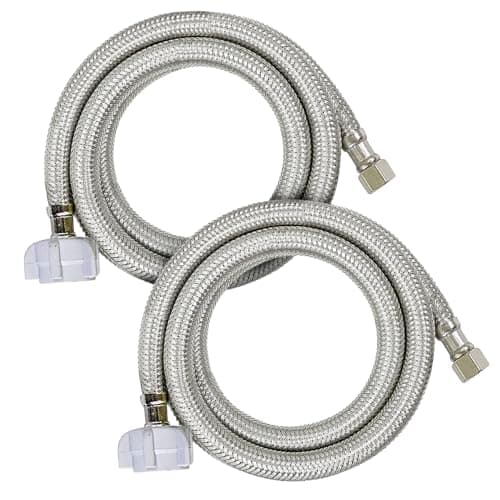
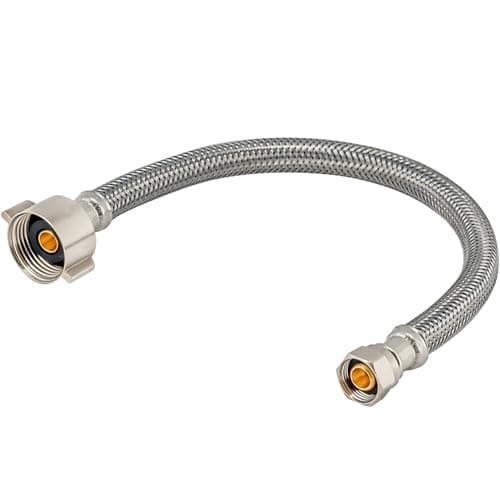
Best for: Replacing an old plastic or vinyl line on a standard toilet whose valve sits close below the tank
- Size (stated):
- 3/8 in compression x 7/8 in ballcock
- Length:
- 12 in; a 16 in version (48089) is listed separately
Listing verified 13 Oct 2026

Braided Stainless Connectors, the 3/8 x 7/8 Size, and How Tight the Tank Nut Should Be
5 picks compared · prices, ratings and stock checked October 12, 2026
Our Top Pick
For most toilets, the Eastman 48088 12 in Steel-Flex Toilet Connector, with a stated 125 psi working pressure and UPC, CSA and NSF marks. For a shutoff valve set well off to one side, the HIGHCRAFT 24 in Braided Stainless Toilet Supply Line 2-Pack. Whichever line you fit, put a leak sensor on the floor behind the toilet.
4.6 on Amazon · 4,705 ratings
Quick answer
The best toilet supply line for most homes is a 12 in braided stainless connector in the standard 3/8 in compression x 7/8 in ballcock size: if you are replacing a plain plastic or vinyl line, buy the Eastman 48088 12 in Steel-Flex Toilet Connector, rated 4.6 stars across 4,705 Amazon ratings. Its listing states a 125 psi working pressure and a 2,500 psi burst figure. Measure from the valve outlet to the tank inlet before you order. Snug the tank-side nut by hand, because it threads onto the fill valve's plastic shank, and put a leak sensor on the floor behind the toilet.
Every pick below is currently stocked — ratings and stock read from Amazon on 12 October 2026.
Best for: Replacing an old plastic or vinyl line on a standard toilet whose valve sits close below the tank
Listing verified 13 Oct 2026
Best for: A buyer who wants a written warranty, or a 9 in line for a valve directly below the tank
Listing verified 13 Oct 2026
Best for: Replacing the lines on two toilets at once with matching certified parts
Listing verified 13 Oct 2026
Best for: A landlord or a house with several bathrooms replacing every old line in one go
Listing verified 13 Oct 2026
Best for: A toilet whose shutoff valve sits well to one side, too far for a 12 in or 16 in line
Listing verified 13 Oct 2026
How this page was made: we compare the current Amazon listings, the makers' published specs and what verified buyers report, then rank by fit for the job. Ratings, review counts and stock are read from Amazon and dated. We earn a commission on purchases through our links; it does not change the order. Reviewed by Marcus Reed, IICRC-certified Water Restoration Technician.
Full Reviews
Each pick in detail: what the listing states, what buyers report, and where it falls short.
Check price
on Amazon ↗
Listing verified 13 Oct 2026
See it on Amazon ↗Best Overall
Quick Verdict
Eastman 48088 12 in Steel-Flex Toilet Connector: the most fully described line here, with stated pressure ratings and UPC, CSA and NSF marks, but no warranty term.
Key Specs
Size (stated)
3/8 in compression x 7/8 in ballcock
Length
12 in; a 16 in version (48089) is listed separately
Construction (stated)
PVC core, braided nylon reinforcement, clear vinyl shell, grade 304 stainless steel braid
Nuts (stated)
Nickel-plated solid brass hex nuts at both ends, full-flow brass barbs
Pressure (stated)
125 psi working; 2,500 psi burst
Temperature (stated)
40°F to 150°F working; 180°F maximum
Pros
Cons
Suited to
Replacing an old plastic or vinyl line on a standard toilet whose valve sits close below the tank
Our take
Eastman's listing is the most complete on this page. Inside the stainless braid is a PVC core with nylon reinforcement and a clear vinyl shell, and the listing gives a 125 psi working pressure with a 2,500 psi burst figure. Typical house pressure runs roughly 40 to 80 psi, so the hose body is rarely the weak point. Trouble tends to start at the nuts instead: a pinched washer, a ballcock nut cranked onto a plastic fill-valve shank, or a compression nut cross-threaded onto an old valve. Both nuts here are brass, which hold their threads well but make over-tightening easy. Hand-tight at the tank, plus a small wrench turn at the valve, is the usual practice.
Affiliate link — commission at no extra cost to you
Compare elsewhere
These open a search for this model. We quote prices only where we can verify them — Amazon, Sylvane and eBay.
Check price
on Amazon ↗
Listing verified 13 Oct 2026
See it on Amazon ↗Best Stated Warranty
Quick Verdict
Fluidmaster B1T12 12 in Braided Stainless Toilet Connector: the one stated 5-year warranty, on an otherwise thin listing.
Key Specs
Size (stated)
3/8 in female compression thread x 7/8 in female ballcock thread
Length
12 in; a 9 in version (B1T09) is listed separately
Outer layer (stated)
Braided stainless steel
Warranty (stated)
5 years
Origin (stated)
Made in China
Core and nut material
Not stated on this listing
Pros
Cons
Suited to
A buyer who wants a written warranty, or a 9 in line for a valve directly below the tank
Our take
Fluidmaster's B1T12 is the line to pick if a written warranty matters to you: its listing states 5 years, the only warranty term among these five. It is the standard 3/8 in female compression by 7/8 in female ballcock size in 12 in, with a 9 in version (B1T09) for a valve tucked directly under the tank. Beyond that, the listing is thin. It says braided stainless steel and little more, with no core material, nut material or pressure rating, and several bullets appear twice. Keep in mind that a warranty covers a faulty part. It does not tell you how long the core under the braid will last, so this line still needs a look whenever you clean behind the toilet.
Affiliate link — commission at no extra cost to you
Compare elsewhere
Check price
on Amazon ↗
Listing verified 13 Oct 2026
See it on Amazon ↗Best 2-Pack
Quick Verdict
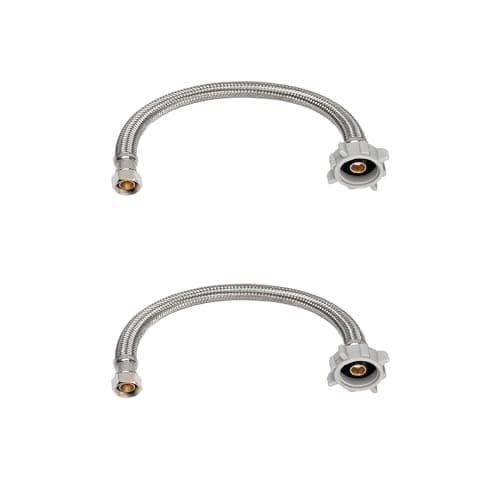
PLUMBINGMASTER 12 in Braided Stainless Toilet Supply Line 2-Pack: a certified, lead-free pair with a clear sizing rule, thin on pressure data.
Key Specs
Size (stated)
3/8 in female compression x 7/8 in nut
Length
12 in, two lines
Outer layer (stated)
Braided stainless steel
Nuts (stated)
Brass, described as anti-leaking
Certification (stated)
NSF and cUPC; lead-free, under 0.25% lead content
Sizing advice (stated)
Measure from the stub-out to the toilet inlet and add a couple of inches
Pros
Cons
Suited to
Replacing the lines on two toilets at once with matching certified parts
Our take
PLUMBINGMASTER sells its 12 in lines in pairs, which covers a two-bathroom house in one order. Its listing states NSF and cUPC certification, lead-free material with under 0.25 percent lead, braided stainless steel and brass nuts. It also gives the clearest sizing advice of any listing here: measure from the stub-out to the toilet's inlet and add a couple of inches, so a 10 in gap gets a 12 in line. Some of the wording is marketing, including the suggestion that you never need to worry about a burst. Any hose can fail at a nut or at an aged core. No pressure rating, core material or warranty term appears on the listing.
Affiliate link — commission at no extra cost to you
Compare elsewhere
Check price
on Amazon ↗
Listing verified 13 Oct 2026
See it on Amazon ↗Best for Landlords
Quick Verdict
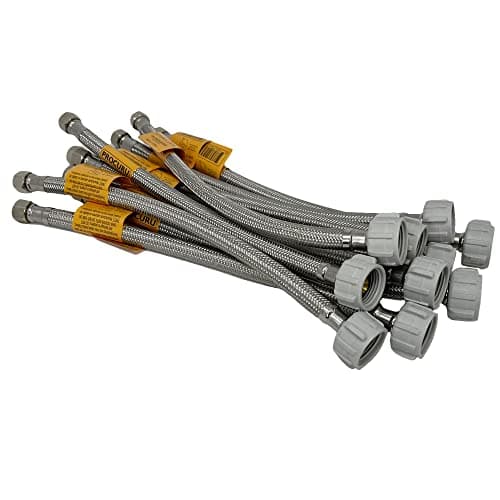
PROCURU 9ST12-10P 12 in Braided Stainless Toilet Connector 10-Pack: ten matching lines for a rental or a whole building, on a very short listing.
Key Specs
Size (stated)
3/8 in compression x 7/8 in ballcock
Length
12 in (1 ft), ten lines
Outer layer (stated)
Flexible braided stainless steel
Certification (stated)
Certified lead free; described as safe for drinking water
Installation (stated)
No tools required, per the listing
Core, nut material and pressure rating
Not stated on this listing
Pros
Cons
Suited to
A landlord or a house with several bathrooms replacing every old line in one go
Our take
PROCURU's 10-pack suits a landlord, a building manager or a house with several bathrooms and old plastic lines everywhere. Swapping every toilet to the same part on one day leaves one install date to remember and a spare on the shelf. Details are sparse: 12 in, 3/8 in compression by 7/8 in ballcock, braided stainless steel, certified lead free and described as safe for drinking water. It names no pressure rating, core, nut material or warranty. It also says no tools are required. Plastic tank nuts do go on by hand, but if the valve-end nut is metal it usually takes a small extra turn with a wrench to seal, so keep one nearby.
Affiliate link — commission at no extra cost to you
Compare elsewhere
Check price
on Amazon ↗
Listing verified 13 Oct 2026
See it on Amazon ↗Best for Long Reach
Quick Verdict
HIGHCRAFT 24 in Braided Stainless Toilet Supply Line 2-Pack: long reach and a hand-tight plastic tank nut, for a valve set well off to one side.
Key Specs
Size (stated)
3/8 in compression x 7/8 in ballcock
Length
24 in, two lines
Nuts (stated)
Brass 3/8 in compression nut; plastic 7/8 in ballcock nut
Core (stated)
PVC, certified lead-free and NSF/ANSI 61 compliant
Ratings (stated)
Up to 125 psi; 40°F to 140°F
Standards (stated)
ASME A112.18.6 and CSA B125.6
Pros
Cons
Suited to
A toilet whose shutoff valve sits well to one side, too far for a 12 in or 16 in line
Our take
HIGHCRAFT's 24 in pair solves an awkward bathroom, such as a shutoff valve set well off to one side of the toilet after a remodel moved the fixture. It is also the one listing here with a plastic nut on the tank end, paired with a brass nut at the 3/8 in compression end. That plastic nut is meant to be turned by hand, which protects the fill valve's plastic shank, but it will split if someone grips it with pliers. Stated details include a lead-free PVC core compliant with NSF/ANSI 61, a 125 psi rating, a 40°F to 140°F range, and conformance to ASME A112.18.6 and CSA B125.6. For an ordinary toilet, 24 in is too long and the spare will loop.
Affiliate link — commission at no extra cost to you
Compare elsewhere
What to know before you buy.
A toilet supply line is under full house pressure every minute of the day, flushed or not. That makes it one of the few hoses in a home that can leak for hours with nobody watching, often overnight or while you are away. Old lines fail in a handful of familiar ways. A solid plastic or vinyl line turns brittle and can crack at its nut. A plastic coupling nut that was cranked down with pliers can split later, not always on the day it went on. A braided line can corrode at a crimp, fray where it rubs the floor, or bulge when the core underneath has aged. The steel braid is only a jacket. The water still runs through a plastic or rubber tube inside it, which is why even a braided line needs checking and, eventually, replacing.
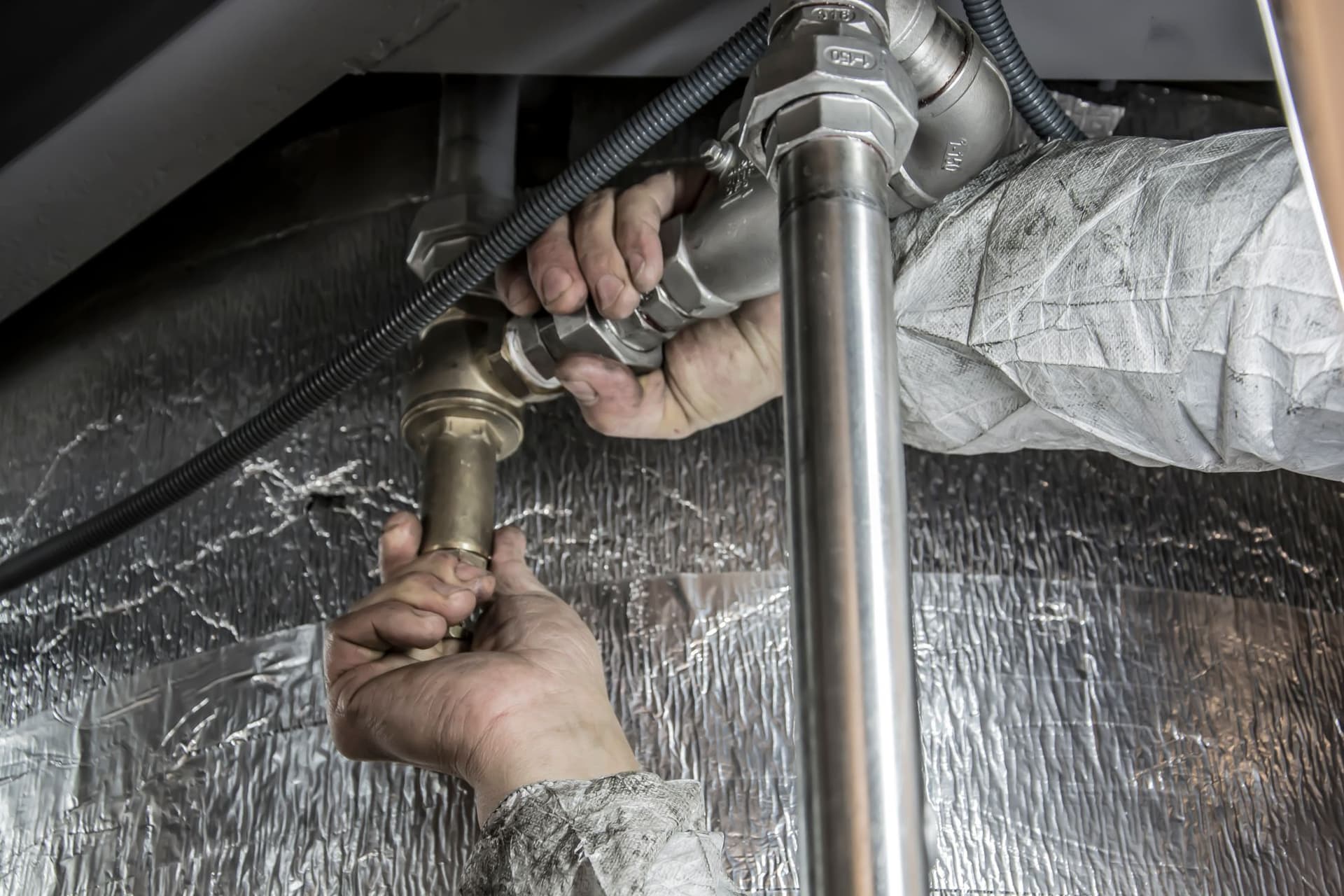
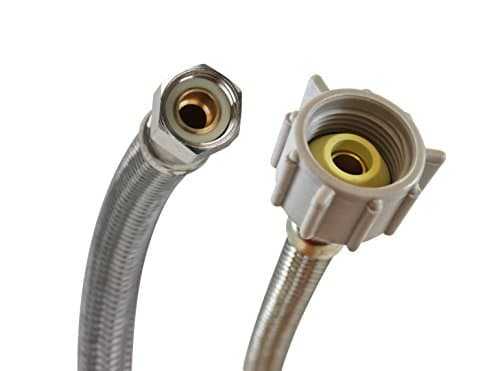
Every listing on this page describes the same size: 3/8 in compression at one end and 7/8 in ballcock at the other. The 3/8 in compression end screws onto the outlet of the shutoff valve on the wall or floor, often called the angle stop. The 7/8 in ballcock end threads onto the bottom of the fill valve, the plastic shank that pokes out under the tank. Those numbers name the threads, not the width of the hose, so a 3/8 x 7/8 line fits most US toilets whatever the brand. Look at the old line's nuts before you order. If the valve end is bigger, as on some older 1/2 in valves, you need a connector made for that size. Among the listings read for this page, lengths ran from 6 in to 24 in.
Length is the part people get wrong. Measure from the face of the valve outlet to the bottom of the fill-valve shank, following the curve the line will take rather than a straight line between the two points. PLUMBINGMASTER's listing gives a simple rule: add a couple of inches, so a 10 in measurement means ordering 12 in. A line that is too short pulls sideways on both nuts, and a sideways load is how a washer unseats. One that is far too long ends up in a loop that can kink, which is why the 24 in HIGHCRAFT belongs only where the valve sits well off to one side. When the valve is directly below the inlet, Fluidmaster's 9 in version (B1T09) avoids a loop. Never join two lines with a coupler, since every extra joint is another place for a drip to start.
Tighten the two ends differently. At the tank, the nut threads onto the fill valve's plastic shank, so turn it by hand until it is snug and stop there; a wrench can crack the shank or a plastic nut, and that crack may not show for days. At the valve, a metal compression nut usually goes on hand-tight and then gets a small extra turn with a wrench, while a second wrench holds the valve body so it does not twist on its pipe. These connectors seal on the rubber washer inside each nut, not on the threads, so thread tape is normally unnecessary. Open the valve slowly, flush twice, then wipe each nut with a dry tissue. EPA WaterSense suggests checking pipe fittings for water on the outside, and a damp spot here calls for a quarter turn more at that nut, not a full turn.
A new line is only as useful as the valve behind it. Before you swap the line, close the shutoff valve and flush: if the tank keeps refilling, the valve does not close, and replacing it comes first. Old multi-turn valves often seize, or start to weep at the stem once they are finally moved, which is a common reason a ten-minute job grows. Once everything is sound, build two habits. Close the toilet valve, or better the main, before you leave home for more than a few days, so the line holds no pressure while nobody is there. And put a battery leak alarm on the floor behind the toilet, where a dripping nut shows first. A smart shutoff valve on the main goes further and closes the water when its sensor gets wet. EPA's mold guide says wet materials dried within 24 to 48 hours will, in most cases, not grow mold.
A new supply line fixes one thing: water coming from the line or its two nuts. Water at the base of the toilet after a flush usually points to the wax ring or a loose bowl, which our guide to a toilet leaking at the base covers. A toilet that runs or refills on its own is leaking inside the tank, most often at the flapper; EPA WaterSense suggests a few drops of food coloring in the tank, and if color shows in the bowl after 10 minutes, you have a leak. Drips from the tank bolts call for new bolt washers. Beads of water all over the tank and line on a humid day are condensation. If the shutoff valve drips at its stem or will not close, the valve needs replacing, a plumber's job when it is soldered on. Water already coming through the ceiling below means shutting the water off and drying first.
Most US toilets take a 3/8 in compression x 7/8 in ballcock supply line, with 12 in the length most listings lead with. The 3/8 in end fits the outlet of the shutoff valve, and the 7/8 in end threads onto the fill valve under the tank.
Both figures are thread sizes, not hose width. Length depends on the bathroom, so measure the route from valve to tank inlet and add a couple of inches.
Usually because of one of the two nuts, not the hose itself. A loose or cross-threaded compression nut is common on the valve end; on the tank end, a cracked plastic nut or fill-valve shank, often from over-tightening, is the usual cause.
Dry everything, open the valve and hold a tissue under each nut to find the drip. A bulge, fraying or rust on the hose itself means replacing the line at once.
YesFor most homes. A stainless braid shields the inner tube from kinks, crushing and abrasion, while a plain plastic or vinyl line has nothing over it and can turn brittle with age.
Braided lines still carry the water through a plastic or rubber core, though; Eastman's listing names PVC. Inspect a braided line now and then, and replace any that bulges, frays or shows rust.
Hand-tight at the tank, and hand-tight plus a small wrench turn at the valve. The tank nut threads onto the fill valve's plastic shank, which a wrench can crack.
On the valve side, steady the valve body with a second wrench while you snug the nut. If a nut drips once the water is on, go a quarter turn at a time and check again with a dry tissue.
Usually notA braided toilet connector seals on the rubber washer inside its nut, pressed against the valve outlet or the fill-valve shank, so tape on the threads does not form the seal.
Thick tape can even keep a nut from seating squarely. Follow the instructions in the package, and fix a drip by checking the washer and the tightness rather than adding more tape.
Replace a plain plastic or vinyl line now, and any line at the first sign of wear. None of the listings on this page states a service life, and Fluidmaster's 5-year warranty covers defects rather than predicting how long the core lasts.
Look at the line whenever you clean behind the toilet. Fit a new one if you see a bulge, fraying, rust or a damp nut, and whenever you replace the fill valve or the toilet.
Call (888) 840-6512. The line is answered 24 hours a day, seven days a week, and connects you with an IICRC-certified water damage restoration company that serves your area. A recorded menu picks up first: choose water damage or mold, key in your 5-digit ZIP code, and hold through the short silence while the call is passed to the company.
Describe what you can see — where the water is coming from, how long it has been there, and whether it smells — the more specific you are, the faster the right company is on the line. If the source is a pipe or an appliance, shut the main water valve first. Have four things ready and the call goes quickly: the address, when the water started, what is wet now, and whether you have filed an insurance claim.
Still not sure which of these is your situation? (888) 840-6512 · toll-free · answered 24/7
Methodology: How we source and verify data · Report an error
Free 2-day shipping
Amazon Prime members pay no shipping on restoration equipment
Dehumidifiers, air movers, and moisture meters qualify for free Prime delivery — bulk items that otherwise cost $15–$40 to ship.
Affiliate link — HearthDry earns a bounty if you sign up; costs you nothing extra.

A washing machine's two fill hoses sit under full house pressure whenever the valves are open, and an old rubber hose that splits keeps releasing water until someone closes the valve. These picks are braided stainless hoses compared on fittings, length, elbows and what each listing actually states, with the replacement habit and the shutoff valve that a better hose does not replace.
Read the comparisonA water leak detector catches a leak while it is still a puddle rather than an insurance claim. These four flood sensors and water alarms range from a standalone 110 dB alarm with no Wi-Fi to a LoRa kit that sounds on the spot and texts your phone.
Read the comparisonA smart water shutoff closes the supply when it detects a leak, so a burst pipe does not run for hours while nobody is home. The four systems here split into two designs: leak sensors that close the valve you already have, and valves on the main line that watch the flow itself.
Read the comparisonMost homeowners do not discover a leak until it has soaked into subfloor and drywall. A Wi-Fi water leak detector sends the alert to your phone while the water is still on the floor, whether or not anyone is home to hear a siren.
Read the comparisonA refrigerator water line sits under house pressure behind an appliance that rarely moves, so a slow leak can soak the floor for weeks before anyone notices. These picks compare braided stainless and PEX lines on tubing, 1/4 in fittings, length and the certifications each listing names, with the shutoff valve and leak sensor that belong alongside them.
Read the comparisonA toilet needs a plunger with a flange or beehive head, because a flat cup cannot seal in the curved outlet at the bottom of the bowl. These picks are compared on head shape, handle and storage as each listing states them, alongside the steps that stop a rising bowl from reaching the floor and the point where a toilet auger should take over.
Read the comparisonA toilet flapper that no longer seals lets tank water trickle into the bowl around the clock, and the fill valve quietly tops the tank up behind it. These picks are 2 in and 3 in flappers from Korky and Fluidmaster, compared on which flush valves they fit, whether the flush volume adjusts, and how the material stands up to chlorine, with the dye test that tells you whether you need one at all.
Read the comparisonThe fill valve is the part that refills the tank and, more importantly, the part that has to stop. One that sticks open runs water down the overflow tube all day, and if that tube is blocked the water comes over the rim. These picks are Fluidmaster, Korky and Kohler fill valves compared on height range, water-level adjustment, what the kit includes and which toilets each one fits, with the critical level mark and the 1 in water line explained.
Read the comparisonThe seal between the toilet and the drain flange is the one plumbing joint in the house that sits under the fixture where no one can see it fail. When it does, a little water escapes at the base on every flush and soaks the subfloor for months before the floor feels soft. These picks are wax rings and waxless seals compared on the flange heights each one covers, whether you can lift the toilet and reset it, and what each listing includes.
Read the comparison