Best Toilet Plunger in 2026 — Flange and Beehive Heads, and What to Do Before the Bowl Spills Over

Best Toilet Plunger in 2026

Flange and Beehive Heads, and What to Do Before the Bowl Spills Over

5 picks compared · prices, ratings and stock checked October 12, 2026

Our Top Pick

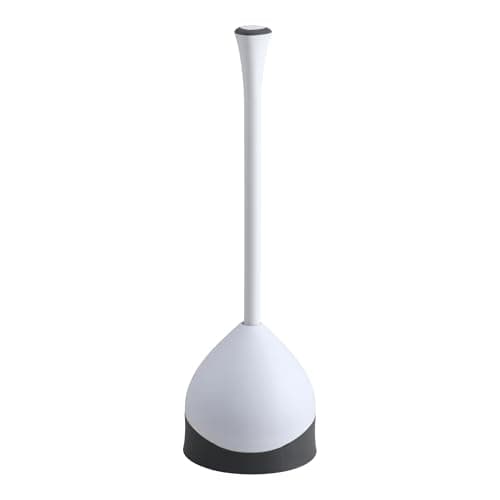
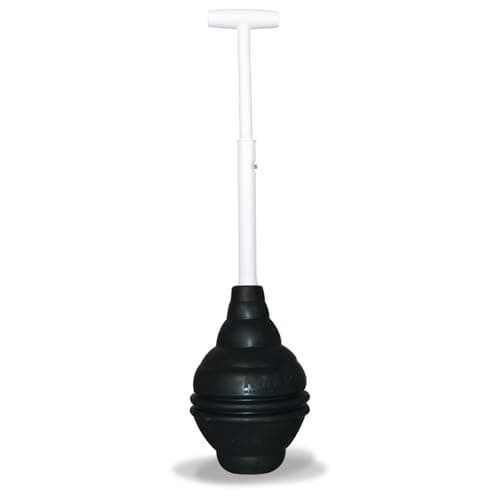
For most toilets, the Korky Beehive MAX Heavy Duty Toilet Plunger (model 96): a beehive head built to seal both older bowls and newer high-efficiency ones, on a T-handle that telescopes down for storage. If you want the plunger to live in a closed holder right beside the toilet, the Clorox Toilet Plunger with Hideaway Holder Caddy is the alternative.

4.5 on Amazon · 6,149 ratings

Quick answer

If you are buying a plunger for a toilet, get one with a flange or beehive head, and for most bowls that is the Korky Beehive MAX Heavy Duty Toilet Plunger (model 96), rated 4.5 stars across 6,149 Amazon ratings. Its listing says the beehive head fits older toilets and newer high-efficiency bowls, and the T-handle telescopes so it can be stored under the sink. A flat cup plunger is for sinks. If the bowl is rising, do not flush again: push the flapper down inside the tank and turn the supply valve behind the toilet clockwise before you plunge.

Our Picks at a Glance

Available picks first — 4 of 5 in stock at our last check — ratings and stock read from Amazon on 12 October 2026.

Best Overall
Korky Beehive MAX Heavy Duty Toilet Plunger, Model 96 (Telescoping T-Handle, Fits High-Efficiency Bowls)
4.5 from 6,149 Amazon ratings · checked 12 OctAmazon's Choice

Best for: Any household toilet, and especially a newer high-efficiency bowl where a plain flange plunger keeps losing its seal

Head:
Beehive shape, per the listing
Fits (stated):
Older toilets and newer high-efficiency (HET) bowls, including elongated designs

Listing verified 13 Oct 2026

Best for Odd-Shaped Bowls
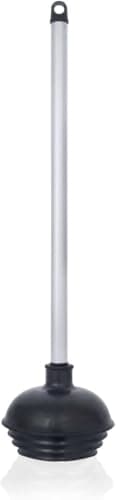
NEIKO 60166A All-Angle Toilet Plunger (4-Step Cup, Aluminum Handle, Black)
4.6 from 11,739 Amazon ratings · checked 12 OctAmazon's Choice

Out of stock at our last check — the link still works if it returns.

Best for: An older or unusual bowl where a flange plunger keeps losing its seal

Head (stated):
Patented all-angle design with a 4-step level suction cup
Fits (stated):
Different types of toilet openings

Listing verified 12 Oct 2026

Best Two-Way Plunger for Toilet and Bathroom Sink
TRENTI Toilet Plunger with Holder (Fold-Up Flange, 19.5 in Handle, Natural Rubber, White)
4.3 from 1,121 Amazon ratings · checked 12 OctAmazon's Choice

Best for: One plunger for a small home or apartment bathroom that has to handle both the toilet and the sink

Head (stated):
Flange you pull out for toilets and fold up for shower drains and sinks
Material (stated):
Natural rubber rather than TPR

Listing verified 13 Oct 2026

How this page was made: we compare the current Amazon listings, the makers' published specs and what verified buyers report, then rank by fit for the job. Ratings, review counts and stock are read from Amazon and dated. We earn a commission on purchases through our links; it does not change the order. Reviewed by Marcus Reed, IICRC-certified Water Restoration Technician.

Full Reviews

Each pick in detail: what the listing states, what buyers report, and where it falls short.

#1
Best Overall

Check price

on Amazon ↗

Listing verified 13 Oct 2026

Korky Beehive MAX Heavy Duty Toilet Plunger, Model 96 (Telescoping T-Handle, Fits High-Efficiency Bowls)See it on Amazon ↗

Quick Verdict

Korky Beehive MAX Heavy Duty Toilet Plunger (model 96): a beehive head that seals older and high-efficiency bowls, with a handle that stores under the sink.

Key Specs

Head

Beehive shape, per the listing

Fits (stated)

Older toilets and newer high-efficiency (HET) bowls, including elongated designs

Handle (stated)

T-handle that telescopes for storage under a sink or vanity

Handle length

Not stated on the listing

Material (stated)

Durable rubber that does not mark the bowl

Made in (stated)

America

Pros

  • The beehive head narrows toward the tip, so the lower part seats inside the outlet while the wider part presses on the porcelain above it
  • The listing names both older bowls and newer high-efficiency designs, the toilets where a plain flange plunger most often fails to seal
  • A telescoping handle shortens to fit under the vanity, so the plunger can be kept in the bathroom where the clog happens
  • The T-grip lets you push straight down with both hands, which helps hold the seal through each stroke

Cons

  • No holder comes in this listing, so a wet head needs somewhere to drip after use
  • Handle length is not stated, which matters if bending low over a bowl is hard for you
  • A telescoping joint has to be fully extended and locked before you push, or it can slip mid-stroke

Suited to

Any household toilet, and especially a newer high-efficiency bowl where a plain flange plunger keeps losing its seal

Our take

A toilet plunger works by pushing a slug of water against the clog and pulling it back, and it can only do that if no air escapes around the head. The Korky's beehive head is shaped like stacked rings that narrow toward the tip, so one of the lower rings sits inside the bowl outlet while the wider ones press on the porcelain above. That is the basis for its listing's claim of a fit on both older bowls and newer high-efficiency designs, whose outlets are often smaller or set at an awkward angle. The telescoping T-handle is the practical feature. A plunger stored in the garage is not there when the water is rising, so keep this one shortened under the bathroom sink, and extend and lock it before the first push.

Check today's price on Amazon →

Affiliate link — commission at no extra cost to you

Compare elsewhere

These open a search for this model. We quote prices only where we can verify them — Amazon, Sylvane and eBay.

#2
Best With a Holder

Check price

on Amazon ↗

Listing verified 13 Oct 2026

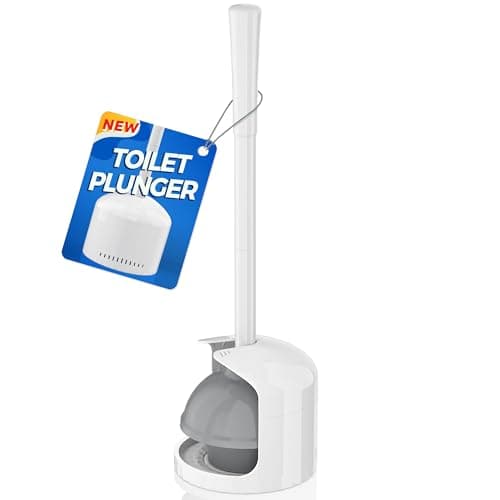
Clorox Toilet Plunger with Hideaway Holder Caddy (Flange Cup, 15.5 in Handle, White)See it on Amazon ↗

Quick Verdict

Clorox Toilet Plunger with Hideaway Holder Caddy: a flange plunger that waits beside the toilet in a closed caddy with a drip tray.

Key Specs

Head (stated)

Heavy-duty flange cup

Handle (stated)

15.5 in with an ergonomic grip

Holder (stated)

Hideaway caddy that opens when the plunger is lifted out and closes when it goes back

Drip tray (stated)

Internal tray inside the caddy

Caddy size (stated)

6.5 x 6.5 x 16.5 in with a non-skid rubber base

Pack

One plunger and caddy; a set of two is listed separately

Pros

  • The caddy keeps the plunger next to the toilet, where you need it in the first minute of a rising bowl
  • A tray inside the caddy catches what drips off the head, so a used plunger does not leave dirty water on the floor
  • A flange cup is the right head type for a toilet outlet
  • The rubber base on the caddy is there to stop it tipping or sliding, per the listing

Cons

  • At 15.5 in, the handle is short, so expect to bend lower than with a long-handled plunger
  • The listing makes no claim about high-efficiency or unusual bowl outlets, which the Korky and NEIKO listings address
  • Closed inside a caddy, a wet head can stay damp; shake it off over the bowl before you put it away

Suited to

A bathroom where you want the plunger beside the toilet, out of sight, and ready for the next clog

Our take

The hardest part of handling an overflow is having a plunger within reach in the first minute. Many homes keep one plunger for the whole house, and it is often in the wrong bathroom or the garage. Clorox solves that with a caddy built to sit next to the toilet: the lid opens as you lift the plunger out and closes when you drop it back, and a tray inside catches drips. The head is a flange cup, the shape that suits a toilet, on a 15.5 in handle. What the listing does not claim is a fit for high-efficiency bowls, so if your toilet is newer and a flange plunger has failed to seal on it before, the Korky beehive is the better match. A two-pack is listed separately for a second bathroom.

Check today's price on Amazon →

Affiliate link — commission at no extra cost to you

#3
Best for Odd-Shaped Bowls

Check price

on Amazon ↗

Listing verified 12 Oct 2026

NEIKO 60166A All-Angle Toilet Plunger (4-Step Cup, Aluminum Handle, Black)See it on Amazon ↗

Quick Verdict

NEIKO 60166A All-Angle Toilet Plunger: a four-step cup that seats in awkward outlets and is built not to flip, on an aluminum handle.

Key Specs

Head (stated)

Patented all-angle design with a 4-step level suction cup

Fits (stated)

Different types of toilet openings

Cup (stated)

Will not flip back over itself

Handle (stated)

Aluminum, with a peg hole for hanging

Cleaning (stated)

Smooth edge and bottom with no interior ridges

Handle length

Not stated on the listing

Pros

  • Four stepped levels on the cup let it seat in outlets of different sizes, even at an angle
  • NEIKO states the cup will not fold back on itself, a common way a soft plunger loses its push
  • The aluminum handle wipes clean, and the peg hole lets it hang on a hook to drip dry
  • No ridges inside the cup for waste to collect in, per the listing

Cons

  • No holder or drip tray, so you need a hook or a spot to hang it
  • Handle length is not stated on the listing
  • Stock was shown as limited when the listing was read on 12 Oct 2026, so it may show a wait

Suited to

An older or unusual bowl where a flange plunger keeps losing its seal

Our take

When a plunger fails on a toilet, the cause is usually one of two things: a seal that leaks air, or a cup that folds back on itself halfway through a push. NEIKO's listing addresses both. The cup steps down in four levels, so whichever level matches the outlet seats there, and NEIKO states it will not flip inside out. The aluminum handle is the other difference from most plungers here. It will not soak up dirty water the way a bare wooden handle can, and the peg hole lets it hang over a bucket or the tub to drip. The cup is described as smooth inside, with no ridges, so it rinses clean faster. With no caddy in the box, decide where it will hang before you need it.

Check today's price on Amazon →

Affiliate link — commission at no extra cost to you

#4
Best Two-Way Plunger for Toilet and Bathroom Sink

Check price

on Amazon ↗

Listing verified 13 Oct 2026

TRENTI Toilet Plunger with Holder (Fold-Up Flange, 19.5 in Handle, Natural Rubber, White)See it on Amazon ↗

Best Two-Way Plunger for Toilet and Bathroom Sink

TRENTI Toilet Plunger with Holder (Fold-Up Flange, 19.5 in Handle, Natural Rubber, White)

4.3(1,121 reviews)

Quick Verdict

TRENTI Toilet Plunger with Holder: a fold-up natural rubber flange on a 19.5 in handle for a bathroom's toilet and sink.

Key Specs

Head (stated)

Flange you pull out for toilets and fold up for shower drains and sinks

Material (stated)

Natural rubber rather than TPR

Handle (stated)

19.5 in with a large grip

Drain size (stated)

Title names a 5.3 in toilet drain

Holder (stated)

Ventilated base that collects drips and can be turned to hide the head

Pros

  • One plunger covers the toilet with the flange out and a sink or shower drain with it folded up
  • At 19.5 in, it has the longest stated handle on this page, so there is less stooping over the bowl
  • The ventilated base lets the head dry, and it turns so the head is half hidden

Cons

  • The title sizes it for a 5.3 in toilet drain but says nothing about smaller high-efficiency outlets
  • After a toilet, it should never go near a kitchen sink, so a two-way plunger still means a second cup plunger for the kitchen

Suited to

One plunger for a small home or apartment bathroom that has to handle both the toilet and the sink

Our take

A flange that folds up is the classic answer for a household that owns one plunger. Pulled out, the rubber sleeve reaches into the toilet outlet and seals there. Folded up inside the cup, the head sits flat on a sink or shower drain. TRENTI's version uses natural rubber and a 19.5 in handle, the longest stated handle here, which means less bending over the bowl. Its title names a 5.3 in toilet drain. When you use it on a bathroom sink, hold a wet rag over the overflow hole, or the push escapes through it instead of reaching the clog. One rule applies to any two-way plunger: once it has been in a toilet, keep it in the bathroom and use a separate cup plunger in the kitchen.

Check today's price on Amazon →

Affiliate link — commission at no extra cost to you

#5
Best Powered Option for a Weak Grip

Check price

on Amazon ↗

Listing verified 13 Oct 2026

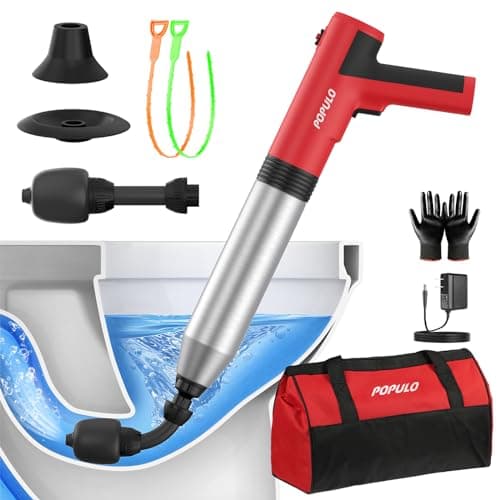
POPULO Electric Toilet Plunger (Rechargeable Air Pump, Up to 5 Bar)See it on Amazon ↗

Best Powered Option for a Weak Grip

POPULO Electric Toilet Plunger (Rechargeable Air Pump, Up to 5 Bar)

4.5(3,527 reviews)

Quick Verdict

POPULO Electric Toilet Plunger: up to 5 bar of air at a button press for soft toilet clogs, best kept alongside a manual plunger.

Key Specs

Type

Compressed-air clog remover with a built-in rechargeable pump

Pressure (stated)

Up to 5 bar (about 72 psi) with the stainless canister fully tightened

Made for (stated)

Soft blockages such as toilet paper and human waste in standard household toilets

Not for (stated)

Towels, toys, plastics or tree roots; not a drain snake or auger

Fit (stated)

Measure your toilet opening before ordering

In the box (stated)

Storage bag; 2-year warranty

Pros

  • Pressurizes at the push of a button, which suits someone who cannot push a plunger hard
  • The listing states its limits plainly: soft blockages only, and not a substitute for an auger
  • For a stubborn clog, the listing's method is to reseat the head and use short repeated bursts rather than one long one

Cons

  • A flat battery in the middle of an overflow is a real risk, so keep it charged and keep a manual plunger too
  • Pressure depends on a tight canister and a well-seated head; a loose canister means low pressure, per the listing
  • A burst of air moves water as well as the clog, so expect splashing unless the bowl is bailed down first

Suited to

A household where pushing a plunger is hard, for soft clogs of paper and waste, kept alongside a manual plunger

Our take

Five bar is about 72 psi, and POPULO says the tool reaches it only when the stainless canister is hand-tightened all the way and the head is firmly seated. Released in a burst, that pressure drives the water in the trap against the clog in place of your arms. The listing is clear about the job: paper and waste in an ordinary household toilet, not a towel, a toy, plastic or a root in the line, and it is not an auger. Two cautions follow from that. A burst of air in a full bowl throws water, so bail the bowl down to about half first. And a rechargeable tool helps only when it is charged, so top it up every few months and keep a plain plunger in the same room.

Check today's price on Amazon →

Affiliate link — commission at no extra cost to you

Buyer's Guide

What to know before you buy.

First, Stop the Overflow: Flapper, Valve, Then Plunger

When the bowl is rising, the first job is to stop more water coming in, not to clear the clog. Do not flush again, because every flush sends a full tank, up to 1.6 gallons on a toilet made for the US market since 1994, into a bowl that cannot drain. Lift the tank lid and press the flapper, the rubber seal at the bottom of the tank, down onto its seat. Then turn the supply valve on the wall or floor behind the toilet clockwise until it stops. If that valve will not turn, lift the float inside the tank to stop the fill valve, and use the main shut-off for the house if you have to. With the water off, lay towels around the base, and only then start plunging.

Flange, Beehive, Cup or Accordion: Which Head Fits a Toilet

The outlet at the bottom of a toilet bowl is a curved hole in sloped porcelain, so the plunger has to reach into it to seal. A flange plunger has a soft rubber sleeve below the cup that slides into the outlet. A beehive head, like the Korky, narrows in rings so one of them seats in outlets of different sizes, which helps on newer high-efficiency bowls. A flat cup plunger, the classic red sink plunger, is made for flat surfaces such as sinks, tubs and shower drains; on a toilet it rocks on the curve and leaks air. Accordion plungers use a stiff plastic bellows that moves a lot of water per stroke but takes real force to seat on a curved bowl; none of the listings shortlisted for this page was an accordion model.

How to Plunge a Toilet Without Spraying the Bathroom

Check the water level first. You want enough water in the bowl to cover the plunger head, roughly half full, so bail some into a bucket if it is near the rim. Put on rubber gloves. Tip the plunger in at an angle so the head fills with water rather than air, then seat the flange or beehive tip in the outlet. Make the first push slow, because it drives out the air left in the head. After that, pump hard and fast about 15 to 20 times while keeping the seal, and finish with a sharp pull. Break the seal and watch the water. If it drains, turn the supply valve back on, let the tank refill, and flush once to test with your hand ready to push the flapper down. Never plunge after pouring in chemical drain cleaner, since the strokes can splash it onto your skin and eyes.

When to Put the Plunger Down and Use a Toilet Auger

Three good rounds of plunging is a fair limit. If the water still will not drain, or if something solid went down, such as a toy, a phone or a pill bottle, a plunger can push the object deeper into the trap where it becomes harder to reach. That is the job of a toilet auger, also sold as a closet auger. Its cable runs through a rigid tube with a rubber-sleeved bend, so the steel feeds through the trap without scratching the porcelain, and it can hook or break up what a plunger cannot move. A drain snake meant for sinks is the wrong tool, as its bare cable can mark the bowl and kink in the tight bend of the trap. If the auger reaches the end of its cable and the bowl still backs up, the blockage is past the toilet and in the drain line.

Who Should Not Reach for a Plunger

A plunger fixes a clog in one toilet. It is the wrong tool when the problem is further down the line. If the tub or shower fills when you flush, a floor drain gurgles, or several fixtures back up at once, the main sewer line is blocked, and plunging just pushes waste up through the lowest drain in the house. Stop using water anywhere in the home and call a plumber or sewer service. The same goes for a toilet that overflows again and again without a visible clog, a home on a septic system that is slow everywhere, and a bathroom where water has already come through the ceiling below. In those cases you need the line cleared and the wet ceiling, subfloor and walls checked, not a better plunger.

Overflow Water Is Dirty Water: Cleanup and Drying

Water from the bowl is never clean. The IICRC S500 standard that restoration companies work to classes a bowl overflow with urine only as Category 2 and one with feces in it, or any backflow from beyond the trap, as Category 3, the grossly contaminated class. For a small spill on tile, wear gloves and boots, soak it up, wash the floor with detergent and water and then disinfect it, and bag the rags. Carpet, carpet pad or drywall soaked by Category 3 water is usually cut out rather than dried. EPA advises calling in a professional when water damage was caused by sewage or other contaminated water, and it says to dry water-damaged areas and items within 24 to 48 hours to prevent mold growth. Afterward, check the flapper: EPA WaterSense says a worn one can leak silently and should be replaced at least every five years.

Frequently Asked Questions

What is the best type of plunger for a toilet?

A flange or beehive plunger is the right type for a toilet. Both reach into the curved outlet at the bottom of the bowl and seal there, which a flat cup plunger cannot do.

A beehive head, such as the Korky Beehive MAX Heavy Duty Toilet Plunger (model 96), narrows in rings so it fits outlets of different sizes, which helps on newer high-efficiency bowls. Keep the flat cup plunger for sinks and tubs.

What do you do when your toilet is overflowing?

Stop the water first, then deal with the clog. Do not flush again. Lift the tank lid and push the flapper down onto its seat, then turn the supply valve behind the toilet clockwise until it stops.

If the valve is stuck, hold the float up and shut the main water valve. Once nothing is coming in, bail the bowl to about half full, lay towels around the base, and plunge.

Why won't my plunger unclog the toilet?

Usually the plunger is not sealing, or it is the wrong type. A flat cup plunger leaks air on a curved toilet bowl, and a head full of air pushes air instead of water.

Use a flange or beehive plunger, tip it in so the head fills with water, and keep it seated through 15 to 20 firm strokes. If three rounds fail, the clog may be a solid object or deeper in the line, which needs a toilet auger.

Can you use a sink plunger on a toilet?

It can work on a mild clog, but a sink plunger is a poor fit for a toilet. Its flat rim cannot seal in the bowl's curved outlet, so much of each push escapes as air and splash.

A flange plunger with the sleeve folded up can do both jobs, but once a plunger has been in a toilet, keep it out of the kitchen sink for hygiene.

Is water from an overflowing toilet dangerous?

YesTreat it as contaminated. Under the IICRC S500 standard, a bowl overflow with urine only is Category 2 and one with feces is Category 3, which carries bacteria and viruses.

Wear gloves and boots, keep children and pets away, clean hard floors with detergent and then disinfectant, and throw away soaked rags. If it reached carpet, a ceiling or the room below, EPA advises bringing in a professional for sewage-contaminated water.

When should I use a toilet auger instead of a plunger?

Use a toilet auger when plunging has failed after a few rounds or when something solid went down the toilet. A plunger can push a toy or a phone deeper into the trap, while an auger's cable can hook it or break up a dense clog.

Its rubber-sleeved bend protects the porcelain, which an ordinary drain snake does not. If several drains back up at once, call a plumber instead.

Who do I call right now for water damage?

Call (888) 840-6512. The line is answered 24 hours a day, seven days a week, and connects you with an IICRC-certified water damage restoration company that serves your area. A recorded menu picks up first: choose water damage or mold, key in your 5-digit ZIP code, and hold through the short silence while the call is passed to the company.

Describe what you can see — where the water is coming from, how long it has been there, and whether it smells — the more specific you are, the faster the right company is on the line. If the source is a pipe or an appliance, shut the main water valve first. Have four things ready and the call goes quickly: the address, when the water started, what is wet now, and whether you have filed an insurance claim.

Still not sure which of these is your situation? (888) 840-6512 · toll-free · answered 24/7

Sources

  1. EPA — A Brief Guide to Mold, Moisture, and Your Home
  2. EPA — Mold Cleanup in Your Home
  3. EPA WaterSense — Fix a Leak Week

Methodology: How we source and verify data · Report an error

How we chose these picks

  • Every pick is a current listing. Stock, star ratings and rating counts are read from Amazon by script and carry the date they were read.
  • Nothing under 4.0 stars makes the list, and the top pick needs a large rating count, so one good week of reviews cannot put it there.
  • Specs are quoted from the listing or the maker, with the test condition behind the number where there is one, and sized against the job rather than the room on the box.
  • We do not run lab or field tests. Where a spec matters, we say what it is measured under and what it cannot tell you.

Free 2-day shipping

Amazon Prime members pay no shipping on restoration equipment

Dehumidifiers, air movers, and moisture meters qualify for free Prime delivery — bulk items that otherwise cost $15–$40 to ship.

Try Prime free →

Affiliate link — HearthDry earns a bounty if you sign up; costs you nothing extra.

Also Worth Comparing

Best Drain Snakes in 2026 — Hair Tools, Hand Augers and a Cordless Auger for Sink, Tub and Shower Clogs, Plus What a Toilet Needs Instead

The right drain snake depends on where the clog sits: hair near a bathroom drain, a soft clog past the trap, or a toilet, which needs a tool of its own. These picks are hair tools and 25 ft cable augers compared on reach, cable size and what each listing states, with the signs that the clog is in the sewer line and a snake is the wrong tool.

Read the comparison

Best Sewage, Wastewater & Stormwater Boots in 2026 — Category 3 Protective Footwear

Sewage can carry E. coli, hepatitis A and norovirus, which can enter through cuts and scrapes on unprotected feet. Fully waterproof rubber or PVC boots are essential for Category 3 work, and the details that separate them are seams, height, toe protection and how well they clean.

Read the comparison

Best PPE for Sewage Cleanup in 2026 — Category 3 Safety Gear

Sewage water (Category 3) contains E. coli, hepatitis A, Norovirus, and dozens of other pathogens. The right PPE is not optional — it's the difference between a cleanup job and a biohazard exposure.

Read the comparison

Best Toilet Supply Lines in 2026 — Braided Stainless Connectors, the 3/8 x 7/8 Size, and How Tight the Tank Nut Should Be

A toilet supply line sits under full house pressure day and night, and an old plastic line that cracks at its nut keeps running until someone closes the valve. These picks are braided stainless connectors in the standard 3/8 in compression x 7/8 in ballcock size, compared on length, nut material and what each listing states, with the fitting habits and the leak sensor that matter as much as the hose.

Read the comparison

Best Wet/Dry Vacuums for Water Damage in 2026 — Standing Water Removal

Before you run a dehumidifier, you need to remove standing water. These are the best wet/dry vacuums for water damage — compared on capacity, suction, and filtration.

Read the comparison

Best Toilet Augers in 2026 — 3 ft and 6 ft Closet Augers With Bowl Guards, and the Signs the Clog Is in the Main Line Instead

When a plunger fails, a toilet auger is the next tool, because its cable is built to pass through the trap cast into the porcelain without scratching the bowl. These picks are 3 ft and 6 ft closet augers compared on reach, bowl protection and drill use, with the signs that point past the toilet to the main line.

Read the comparison

Best Toilet Flapper in 2026 — 2 in vs 3 in Sizing, Which Flapper Fits Kohler, American Standard and TOTO, and the 10-Minute Dye Test

A toilet flapper that no longer seals lets tank water trickle into the bowl around the clock, and the fill valve quietly tops the tank up behind it. These picks are 2 in and 3 in flappers from Korky and Fluidmaster, compared on which flush valves they fit, whether the flush volume adjusts, and how the material stands up to chlorine, with the dye test that tells you whether you need one at all.

Read the comparison

Best Toilet Wax Ring in 2026 — Wax vs Waxless Seals, Extra-Thick Rings for Recessed Flanges, and the Flange Height Arithmetic Before You Buy

The seal between the toilet and the drain flange is the one plumbing joint in the house that sits under the fixture where no one can see it fail. When it does, a little water escapes at the base on every flush and soaks the subfloor for months before the floor feels soft. These picks are wax rings and waxless seals compared on the flange heights each one covers, whether you can lift the toilet and reset it, and what each listing includes.

Read the comparison

Best Toilet in 2026 — The One That Clears in a Single Flush, Sized to Your Rough-In, So the Bowl Never Comes Over the Rim

Most toilet overflows start with a bowl that did not clear, so a flush that does the job in one go is the first line of water-damage prevention in a bathroom. These picks are compared on the flush score and trapway each listing states, gallons per flush, seat height and rough-in, with the measuring and the parts an install needs before the box arrives.

Read the comparison