
Quick answer
Water mitigation is the emergency half of a water damage job: stopping the water, extracting it, removing what cannot be dried, drying the structure to measured readings and documenting it all. Restoration, often called reconstruction, is the rebuild that follows: new drywall, flooring, cabinets and paint. Mitigation is what your policy's duty to protect the property from further damage expects you to start promptly; it runs about $3–$7 per square foot for clean water, rising to $7–$15 for contaminated water, and $10–$25 with reconstruction. Call (864) 806-2818 to reach a certified water damage restoration company in your area; the line is answered 24/7.
Enter your 5-digit ZIP when asked. The line goes quiet for about half a minute while it connects — that is normal, stay on. If it does not connect, call once more: companies taking calls change minute to minute.

Written & reviewed by Marcus ReedIICRC WRT
Reviewed October 12, 2026· Next review Apr 2027
The estimate on your kitchen table may say "mitigation" on one page and "restoration" or "reconstruction" on another, and the two words decide more than the total. They decide what has to start tonight and what can wait a month, what your insurer expects of you, and what you should and should not sign on the first day. Companies use the words loosely, and plenty use "restoration" for the whole job, so this page separates them the way the industry standard and a standard homeowners policy do.
What Water Mitigation Means
To mitigate is to make something less severe. Water mitigation is everything done to keep a water loss from growing: shut the source, get the water out, take out what cannot be saved, dry the structure to measured readings, and write all of it down. It is emergency work with a clock on it, because the EPA's guidance is to dry water-damaged areas and items within 24–48 hours to prevent mold growth, and that window starts when the material got wet, not when you noticed.
The ANSI/IICRC S500 is the standard for professional water damage restoration (fifth edition, 2021). It sets out the procedures and precautions for water damage work in residential, commercial and institutional buildings, and it places responsibility for finding and correcting the source of the water on the property owner, not the restorer. That is why the plumber is a separate call: the mitigation company dries the house, and someone else fixes the pipe.
What a water mitigation company actually does
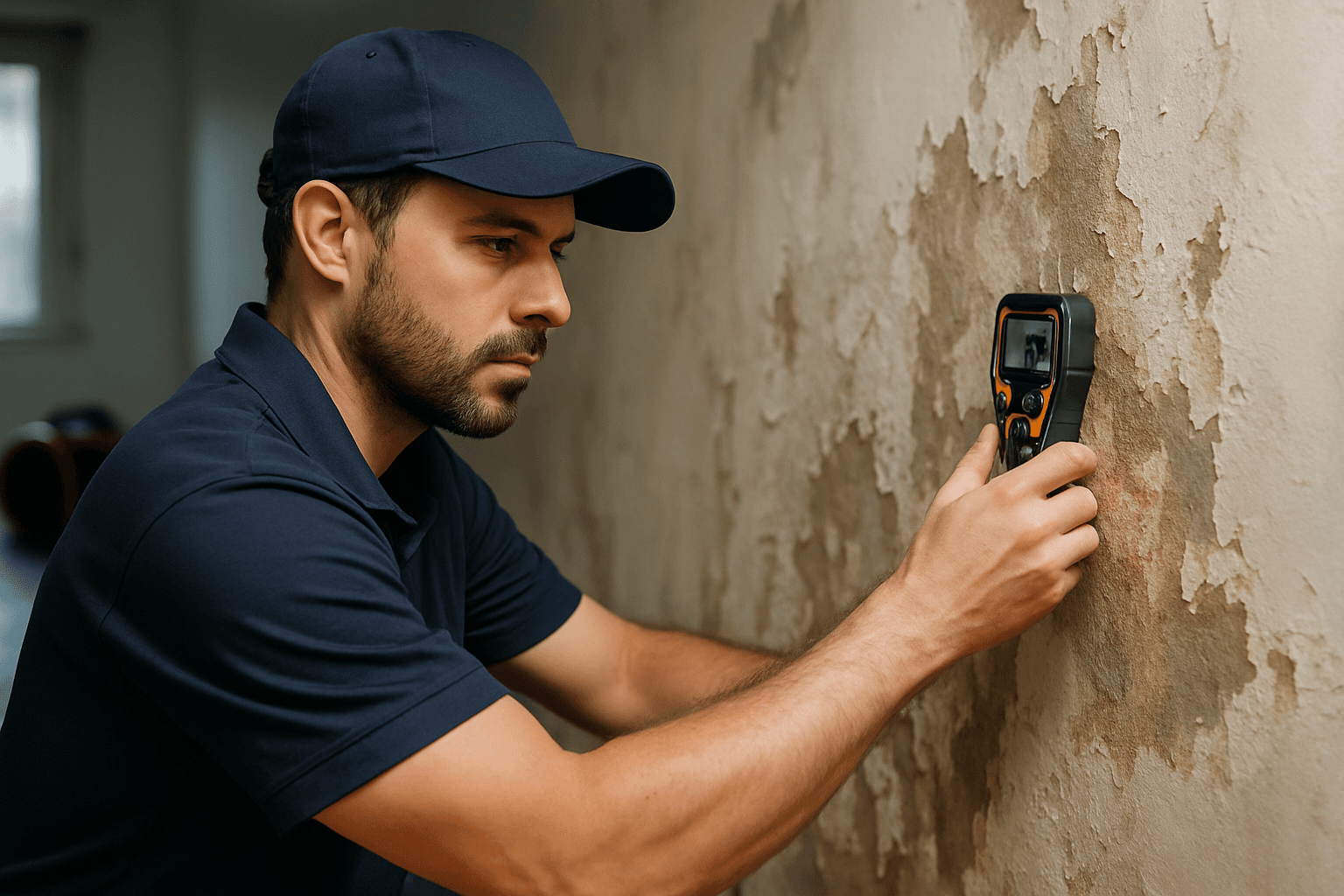
- 1Inspects and maps. Moisture meters and a thermal camera find the edge of the wet area, which is almost always further out than the visible stain, and the loss is classified by water category and by how much material is wet.
- 2Extracts. Standing water comes out with truck-mounted or portable extractors, including water held in carpet and pad.
- 3Removes what cannot be dried. Wet carpet pad, saturated drywall and insulation, swollen laminate, and anything porous that Category 3 water touched.
- 4Dries. Air movers and dehumidifiers are placed by the size and wetness of the area, and cavities are opened or injection-dried.
- 5Monitors. A technician returns daily, reads the meters, moves equipment and records the numbers until readings match a dry reference area in the same house.
- 6Documents. A moisture map, a daily drying log, photographs and an equipment list go to you and to your adjuster.
The restoration process guide walks through each visit in detail, and the structural drying guide explains what the daily readings should look like.
What Restoration (Reconstruction) Means
Restoration in the narrow sense is putting the house back: new drywall and insulation, paint, flooring, cabinets, trim, tile. It is ordinary construction, usually requiring a contractor's license, and it has no clock. Some restoration companies have a rebuild division and some do not; SERVPRO's site, for instance, lists construction alongside water, fire and mold. A general contractor who never touches a dehumidifier can do the same work.
The one rule that binds the two phases is sequence. Nothing gets closed up until the drying report says the framing, subfloor and remaining drywall are dry. A rebuilder who does not ask for that report before hanging new drywall is a rebuilder to question.
Mitigation vs Restoration Side by Side
| Mitigation | Restoration (reconstruction) | |
|---|---|---|
| Purpose | Stop the loss from getting worse | Return the house to its pre-loss condition |
| When it starts | The day of the loss | After the dry-standard sign-off, often weeks later |
| Urgency | High: mold on wet material within 24–48 hours | None; it can be scheduled and bid |
| Who does it | A water damage restoration company; look for IICRC WRT and ASD on the crew | The same company's construction side, or a general contractor |
| Tools | Extractors, air movers, dehumidifiers, moisture meters, thermal camera | Ordinary trades |
| How it is billed | Line items: extraction per square foot, equipment per unit per day, removal per square foot | Trade pricing per line item |
| What the insurer sees it as | A duty you owe under the policy | Covered repair, reviewed line by line |
| What you sign | A mitigation-only work authorization | A separate construction contract |
Why Insurers Treat Mitigation Differently
The standard ISO HO-3 homeowners form lists your duties after a loss. Two of them are the point of this page. You must give prompt notice, and you must "protect the property from further damage," which the form spells out as making "reasonable and necessary repairs to protect the property" and keeping "an accurate record of repair expenses." Mitigation is that duty in practice. You do not wait for an adjuster to approve extraction; you start it, keep the invoices and the drying log, and the reasonable cost is part of the claim.
The same form shows why delay is expensive. The accidental discharge peril excludes loss caused by mold, fungus or wet rot unless it is hidden within walls, ceilings or floors, and most policies cap mold from a covered loss at a sublimit, commonly $1,000–$10,000; check your declarations page. Mold that grew because drying was delayed is the easiest thing for an adjuster to decline. The drying log is what shows the delay was not yours. The claim checklist covers the order of calls and paperwork.
per sq ft, mitigation only
- Category 1Clean supply water
- Category 2Grey water
- Category 3Black water
Extraction and drying only. Rebuilding drywall, floors and cabinets is priced separately.
The mold clock on wet material
- Hour 0Water stopsShut the supply and start getting water out. Drying begins here.
- About 24 hSpores germinateMold spores start growing on wet drywall, carpet pad and wood.
- 48–72 hVisible coloniesGrowth you can see and smell. Drying becomes a mold job.
 Serving US homesCertified US companiesCall nowLine answered 24/7
How to Authorize Water Mitigation Without Signing Up for the Rebuild
- 1Authorize mitigation only, in writingThe work authorization should name extraction, removal, drying and monitoring, and nothing else.
- 2Get the moisture map and daily drying logAsk on day one for the initial moisture map and for the daily readings as they are taken.
- 3Ask for the dry-standard sign-off before any rebuildWalls and floors get closed only after final readings match a dry reference area in your house.
- 4Bid the reconstruction separatelyOnce the structure is dry there is no clock.
Talk to a water damage pro now
Answered 24/7 · Toll-free · no obligation
(864) 806-2818- Enter your ZIP when asked
- Stay on through the short quiet while it connects
- A local certified company explains the job and price
What Water Mitigation Costs
Mitigation is priced by the square foot of affected area, and the water category moves the number more than anything else, because contaminated material is removed rather than dried.
| Loss | Mitigation only, per square foot |
|---|---|
| Category 1, clean supply water | $3–$7 |
| Category 2, gray water (washer or dishwasher drain water) | $4–$8 |
| Category 3, contaminated (sewage, toilet overflow past the trap) | $7–$15 |
| High-cost metros (New York, San Francisco, Miami) | $8–$18 |
| Mitigation plus reconstruction | $10–$25 |
A whole job, mitigation and rebuild together, most often lands around $2,000–$6,000 for a residential incident, with a national range of $1,200 to $25,000 and up when large areas, contaminated water or extensive reconstruction are involved. The water extraction cost page and the structural drying cost page break the mitigation half into its line items, and the water damage restoration cost guide covers the whole range by room. The category guide explains how the category is assigned, which is worth knowing because a Category 3 label on a clean-water loss can double a bill.
Why to Authorize Mitigation Separately From the Rebuild
A company that does both phases will usually offer one document covering both. Decline that, politely, and split it. Four steps:
Authorize mitigation only, in writing. The work authorization should name extraction, removal, drying and daily monitoring and nothing more. Read it for two things before signing: a clause assigning your insurance benefits to the contractor, which changes who controls your claim, and any language committing you to reconstruction by the same company. Neither belongs in an emergency drying authorization.
Get the moisture map and daily drying log. Ask for the initial map on day one and for each day's readings as they are taken, not at the end. Every equipment day on the final invoice should correspond to a logged reading that justified keeping the machines running.
Ask for the dry-standard sign-off before any rebuild. The final report should show the readings that ended the job and the dry reference they were compared with. Keep it. A rebuilder should want it before closing a wall, and an adjuster will want it if anything is argued later.
Bid the reconstruction separately. Once the house is dry there is no urgency. Get a written rebuild bid from the mitigation company's construction side if it has one and from at least one general contractor, and compare them line by line. The franchise versus local guide explains why a local contractor often prices the rebuild lower.
Splitting the phases also keeps the mitigation scope honest. A company that knows it will get the rebuild has a reason to remove more than the readings justify; one that may not has a reason to dry in place where it can.
"Mitigation" Means Something Else in Mold
In mold work, mitigation, remediation and abatement are used almost interchangeably for the same job, and the distinction is one of emphasis rather than phase. The mold mitigation vs remediation guide sorts that out; it is a different page because it is a different question.
If the House Is Wet Now
Mitigation is the half you cannot shop at leisure, because the clock is running while you compare. (864) 806-2818 is answered 24/7 and connects you to an IICRC-certified water damage restoration company taking calls in your ZIP; there is no charge for the referral. Enter the 5-digit ZIP of the property, and stay on through about half a minute of quiet while it connects. Ask the company for a mitigation-only authorization and the daily log before anyone sets equipment; the rebuild can be bid once the readings say the house is dry.
Serving US homesCertified US companiesCall nowLine answered 24/7Water moves fast. What you do first decides if it stays a drying job.
Do this first
- Shut off the mainNear the meter or where the line enters.
- Kill power to wet roomsFlip the breaker before you step in.
- Photograph everythingBefore you move or throw anything out.
Reading to confirm what you already suspect?
Confirm it in two minutes instead — the pro on this line answers questions about YOUR situation all day: what it is, what it should cost, whether you even need service. If you want, they'll set the appointment on the same call.
Toll-free · no obligation · asking costs nothing
Frequently Asked Questions
What is the difference between water mitigation and water restoration?
Mitigation is the work that stops a water loss from getting worse: extraction, removal of materials that cannot be saved, structural drying and the moisture records that prove it.
Restoration, which many companies call reconstruction, is the rebuild afterward: drywall, insulation, flooring, cabinets, paint. Mitigation starts the day of the loss and is finished when readings meet the dry standard; restoration can start weeks later and should not start before that sign-off.
What does a water mitigation company do?
It inspects and maps the wet area with moisture meters and a thermal camera, classifies the water, extracts standing water, removes wet pad, saturated drywall and insulation, sets air movers and dehumidifiers sized to the space, returns daily to take readings and adjust equipment, and hands you a moisture map, a drying log and photographs when the structure is dry.
Finding and fixing the source is a plumber's job, which the S500 standard places on the owner rather than the restorer.
Is water mitigation covered by homeowners insurance?
For a covered loss, yes, and the policy expects it. The standard HO-3 form lists protecting the property from further damage among your duties after a loss and tells you to keep an accurate record of repair expenses, so reasonable drying costs are part of the claim rather than a risk to it.
You do not need an adjuster's visit before extraction starts. Check your declarations page for the deductible and any mold sublimit, which commonly runs $1,000–$10,000.
How long does water mitigation take?
Extraction happens on the first visit. Structural drying then typically runs three to five days, longer for hardwood, plaster, dense subfloor or a slab, and it ends when daily readings match a dry reference area in the same house, not when surfaces feel dry.
Expect a technician each day to read meters and move equipment. Reconstruction is a separate schedule that begins after the drying report is signed off.
How much does water mitigation cost?
Mitigation alone runs about $3–$7 per square foot for clean water, $4–$8 for gray water and $7–$15 for contaminated water, with high-cost metros such as New York, San Francisco and Miami at $8–$18.
Add reconstruction and the job runs $10–$25 per square foot. Most residential incidents land around $2,000–$6,000 all in, with the national range stretching from $1,200 to $25,000 or more when large areas or Category 3 water are involved.
Can I do water mitigation myself?
A small spill of clean water on a hard floor, wiped up the same hour, needs no company. Anything that reached carpet pad, drywall, cabinets or a subfloor usually does, because the part that matters, moisture inside materials you cannot see, is measured with meters and dried with equipment a household fan does not replace.
Doing it yourself also leaves you without the drying record an adjuster will ask for if mold shows up later.
Who do I call right now for water damage?
Call (864) 806-2818. The line is answered 24/7, and connects you with an IICRC-certified water damage restoration company that serves your area. A recorded prompt picks up first: key in your 5-digit ZIP code, and hold through the short silence while the call is passed to the company.
Describe what you can see — where the water is coming from, how long it has been there, and whether it smells — the more specific you are, the faster the right company is on the line. If the source is a pipe or an appliance, shut the main water valve first. Have four things ready and the call goes quickly: the address, when the water started, what is wet now, and whether you have filed an insurance claim.
Still not sure which of these is your situation? (864) 806-2818 · toll-free · answered 24/7
Sources
- ANSI/IICRC S500 Standard for Professional Water Damage Restoration (5th edition, 2021)
- Insurance Information Institute — sample ISO HO 00 03 homeowners form (Duties After Loss; accidental discharge peril)
- EPA — A Brief Guide to Mold, Moisture and Your Home (dry within 24–48 hours)
- IICRC — Applied Structural Drying (ASD) certification
Methodology: How we source and verify data · Report an error
Disclaimer: HearthDry is an independent educational resource. This article is for informational purposes only and does not constitute professional, legal, or insurance advice. Consult licensed professionals before making decisions about your property or insurance claims.
Free 2-day shipping
Amazon Prime members pay no shipping on restoration equipment
Dehumidifiers, air movers, and moisture meters qualify for free Prime delivery — bulk items that otherwise cost $15–$40 to ship.
Affiliate link — HearthDry earns a bounty if you sign up; costs you nothing extra.
Equipment
What each machine actually does
Removes the moisture the structure is still giving off — the machine that decides how long drying takes
See the picks →Moves air across wet surfaces so the dehumidifier has something to take out of the air
See the picks →Finds water behind walls and under floors, and tells you when a material is actually dry
See the picks →Alerts you the moment a leak starts; a small cost, and the one preventive item here
See the picks →Those pages carry affiliate links. As an Amazon Associate, HearthDry earns from qualifying purchases; it costs you nothing extra.
Our Amazon storefront →Advertisement
